
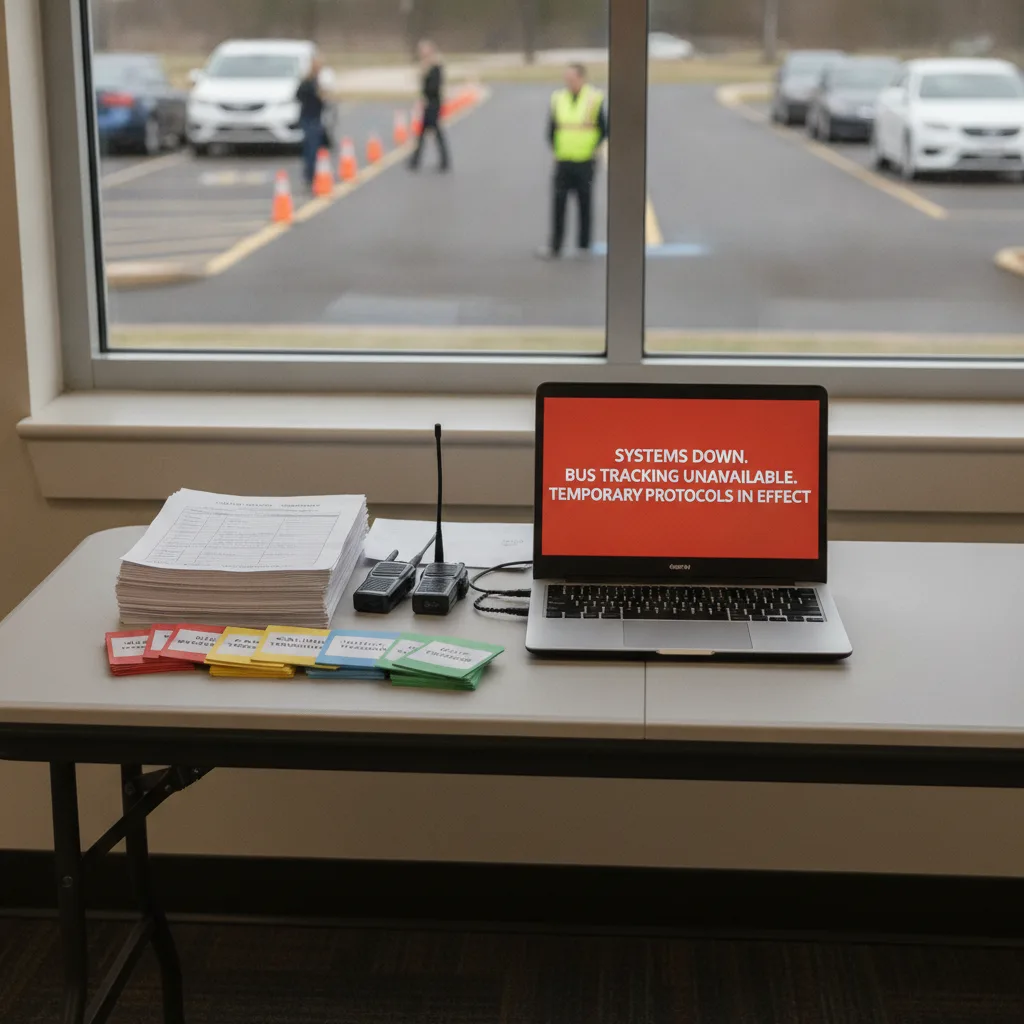
A bus app failure dismissal workflow should move affected students into a temporary release process instead of letting families improvise. Freeze the affected-student list, tell families which transportation information is authoritative, verify adults before carline or walk-up release, and reconcile every temporary change before the student returns to the bus.
Key Takeaways
- A bus tracking outage is not only a transportation problem; it can quickly become a student-release problem at the curb.
- Families should not be told to choose an alternate bus, stop, carline, or walk-up plan unless the school or transportation team has authorized the change.
- The campus needs one temporary list showing route status, pickup mode, authorized adults, vehicle or tag information, and the staff owner for each unresolved case.
- Vehicle recognition can help only after the release record is current; it should not override route status or staff approval.
- Every temporary carline or walk-up exception needs an expiry, a same-day communication note, and a return-to-bus reconciliation step.
What This Workflow Involves
This workflow is an incident branch for ordinary school dismissal. It starts when the transportation office, routing software, bus tracking app, or family information system stops giving reliable bus status for a group of students. Some families may still have a bus. Others may have a route pending, a stop mismatch, a delayed ETA, or no assignment visible at all.
The campus response should be narrower than a district transportation recovery plan. Transportation teams own buses, routes, drivers, stops, and routing software. The school owns the release decision in the afternoon. That means the campus has to decide which affected students are still bus riders, which students are temporary car riders, which adults may pick them up, and where unresolved families should go without exposing private student details in the pickup lane.
A good fallback packet has four parts: an affected-student roster, a family message, a carline and walk-up release script, and a reconciliation log. The roster keeps staff from guessing. The message gives families one source of truth. The script keeps curbside release consistent. The log makes sure temporary changes do not become stale records after the bus system stabilizes.
Why This Problem Is Showing Up Now
WJLA reported on August 25, 2026 that Prince George’s County Public Schools acknowledged major opening-day transportation failures after a new bus tracking app crashed and thousands of students lacked assigned bus service. The article reported that the district connected the problems to app failure, route assignment gaps, and staff learning a new routing system.
The district’s own August 25, 2026 transportation and bus app update is the most useful operating source. PGCPS told families that some students could use an eligible stop shown through BusPlanner while waiting for permanent transportation, but it also warned families not to place a student on an alternate bus or route without authorization from the school or transportation team. That is the exact boundary a campus fallback workflow has to preserve.
PGCPS followed with an August 27, 2026 transportation town hall notice, saying families still needed clear information about what happened, where things stood, and what came next. The ongoing communication need matters because dismissal teams cannot solve route software in the lane, but they can prevent unclear route status from becoming an unsafe release decision.
The broader pressure is not isolated to one district. School Transportation News reported on July 30, 2026 that persistent school bus driver shortages are leading to canceled routes, longer rides, and educational disruptions. HopSkipDrive’s 2026 transportation research summary, used here as industry context rather than neutral authority, describes missed or late pickups, canceled routes, and parent complaints as current district consequences.
The Core Operational Problem
The hard part is version control under pressure. A parent may see no bus in the app and drive to campus. A student may still be marked as a bus rider in the classroom list. Transportation may be working a backlog. The front office may receive route questions by phone. The lane team may only see a family vehicle waiting at the curb. Each group has a partial answer, and partial answers are risky during release.
The immediate risk is not that a bus is late. The immediate risk is that staff release a student under the wrong mode because the temporary plan was never written down. A student who is normally a bus rider may need carline pickup for two days. A family may use a walk-up process because the pickup line is too long after a route failure. A route may appear in a parent app after dismissal has already started. Without a controlled temporary record, staff are forced to improvise.
The second risk is parent trust. If families are told that a technology system will provide real-time visibility, then the campus needs a manual fallback when that visibility disappears. The fallback does not need to be elaborate. It does need to name who is affected, what families should do, which adults can pick up, and how the school will close the loop tomorrow.
Bus App Failure Dismissal Workflow Checklist
| Step | Campus action | Record to keep |
|---|---|---|
| Declare the fallback | Name the issue as route pending, app unavailable, ETA unreliable, stop mismatch, or transportation backlog. | Incident note with date, start time, and owner. |
| Freeze the affected list | Export or write the students whose bus status is unclear before afternoon release begins. | Affected-student roster with mode and last update. |
| Set temporary modes | Mark each student as bus confirmed, bus pending, temporary carline, temporary walk-up, office pickup, or hold. | Temporary dismissal-mode field with expiry. |
| Protect authorization | Verify the pickup adult and vehicle or tag before release when a normal bus rider becomes a carline or walk-up pickup. | Approved adult check and staff initials. |
| Control the message | Tell families which app, web page, phone line, or office contact is authoritative for the day. | Message copy, send time, and language version. |
| Separate the lane | Route unresolved families to an exception desk instead of resolving bus questions in the live loading zone. | Exception queue with outcome. |
| Reconcile before tomorrow | Close each temporary mode as route restored, route still pending, family plan changed, or administrative follow-up. | End-of-day reconciliation log. |
How To Communicate Without Creating More Confusion
The first family message should separate what is known from what is still being corrected. Say whether the bus app is working, whether route assignments are complete, whether eligible stops can be used, and whether families need school or transportation authorization before choosing an alternate route. Avoid vague promises such as everything will be fixed today unless transportation leadership can support that claim.
The second message should be campus-specific. Families need to know where temporary carline vehicles should enter, where walk-up pickup is allowed, what ID or tag is required, when the office cutoff applies, and how the school will notify them when the student returns to normal bus service. A districtwide transportation update is useful, but it rarely tells a parent which curb to use at 3:05 p.m.
The third message is the closeout. At the end of each day, tell affected families whether their student’s route is restored, still pending, or still under review. If the temporary pickup mode remains active, give it an expiry or next update time. This reduces repeated phone calls and prevents teachers, office staff, and lane staff from giving different answers.
Where Vehicle Recognition Fits
Vehicle recognition can help during a transportation fallback only when the record behind the vehicle is current. If a normally assigned bus rider is temporarily approved for carline, the system should show that temporary mode, the authorized adult, and the expiry. A plate or car tag should not trigger release by itself when the transportation status is unresolved.
The school pickup line license plate recognition guide explains how vehicle arrival can support student release when authorization records are clean. In this incident workflow, the most useful feature is the exception queue: staff can see that the arriving vehicle belongs to a temporary carline case, hold the release if the adult is not approved, and log the outcome.
Use the automated school student dismissal workflow once the campus knows which records are authoritative. Automation should reduce radio calls and clipboard searches, not hide the fact that a route is pending or that a student has moved into a temporary release mode.
Risks, Limits, And Exceptions
This article is not transportation or legal advice. Bus eligibility, alternate-stop rules, special transportation, disability-related service requirements, and custody restrictions depend on district policy and student records. The campus should follow its own transportation, student privacy, and release policies before changing any dismissal mode.
Do not place student details, route numbers, home addresses, disability information, or custody notes in a shared carline spreadsheet. Lane staff usually need a short action label such as route pending, send to exception desk, or office pickup verified. Sensitive context belongs in the student information system or another approved record with limited access.
Also be honest about fit. PLACA.AI can support vehicle-arrival matching, release queues, staff approval, and exception logs. It does not replace bus dispatch, driver staffing, route design, or the district’s family transportation platform. If the main issue is route assignment, solve that with transportation leadership first, then use pickup automation to control the temporary overflow safely.
Worked Example: Route Backlog On Day Two
A middle school starts day two with 45 students whose permanent bus assignment is still missing or unclear. Transportation tells the principal that some routes will be corrected by noon, but families are already calling the front office. The school declares a temporary transportation fallback before lunch.
The front office creates a roster with five fields: student, normal mode, current route status, temporary pickup mode, and authorization owner. Twenty students are confirmed bus riders. Fifteen are temporary carline pickups for the day. Six are walk-up pickups. Four remain on hold until transportation confirms the route or the approved adult contacts the office.
At dismissal, the lane team does not debate bus status at the curb. If a vehicle arrives for a temporary carline student, staff verify the adult and release under the temporary record. If a family arrives for a student still marked hold, staff route them to the exception desk. After dismissal, the principal and transportation contact reconcile the list and send families a route restored, pending, or next update message.
Frequently Asked Questions
Can families use any nearby bus stop when the app is down?
No. Families should follow district instructions and use only stops, routes, or temporary options authorized by the school or transportation team. An app outage does not make every alternate route safe or approved.
Should a bus rider automatically become a carline student for the week?
Only if the school creates a temporary dismissal record with an expiry. Otherwise staff may continue treating a short-term transportation exception as the new normal after the route is restored.
What should the front office verify before releasing a temporary carline pickup?
Verify the adult, the student’s temporary mode, the vehicle or tag if used, and any hold notes that affect release. If any field is unclear, route the family to the exception owner before calling the student.
Does license plate recognition fix a bus routing failure?
No. LPR can identify an arriving vehicle and help staff manage carline exceptions, but transportation teams still have to correct route assignments, stops, driver coverage, and family bus information.
How long should the fallback list stay active?
Keep it active only while the route or app issue is unresolved. Reconcile it daily and close each case as restored, pending, changed by family request, or escalated for transportation follow-up.
Related PLACA Resources
- Start with the school pickup line license plate recognition guide when temporary carline overflow creates vehicle-identification pressure.
- Use the automated school student dismissal workflow to connect vehicle arrival, staff approval, exception handling, and release logs.
- Run the first-week school pickup safety log if the transportation fallback also creates unsafe pedestrian, parking, or bus-loop patterns.
Next Step
Before the next dismissal, identify the students whose bus status is unresolved and assign each one a temporary mode, approved pickup path, family message, exception owner, and closeout rule. If your campus needs a cleaner way to connect vehicle arrival with staff-approved release during overflow days, PLACA.AI can review your pickup workflow.