

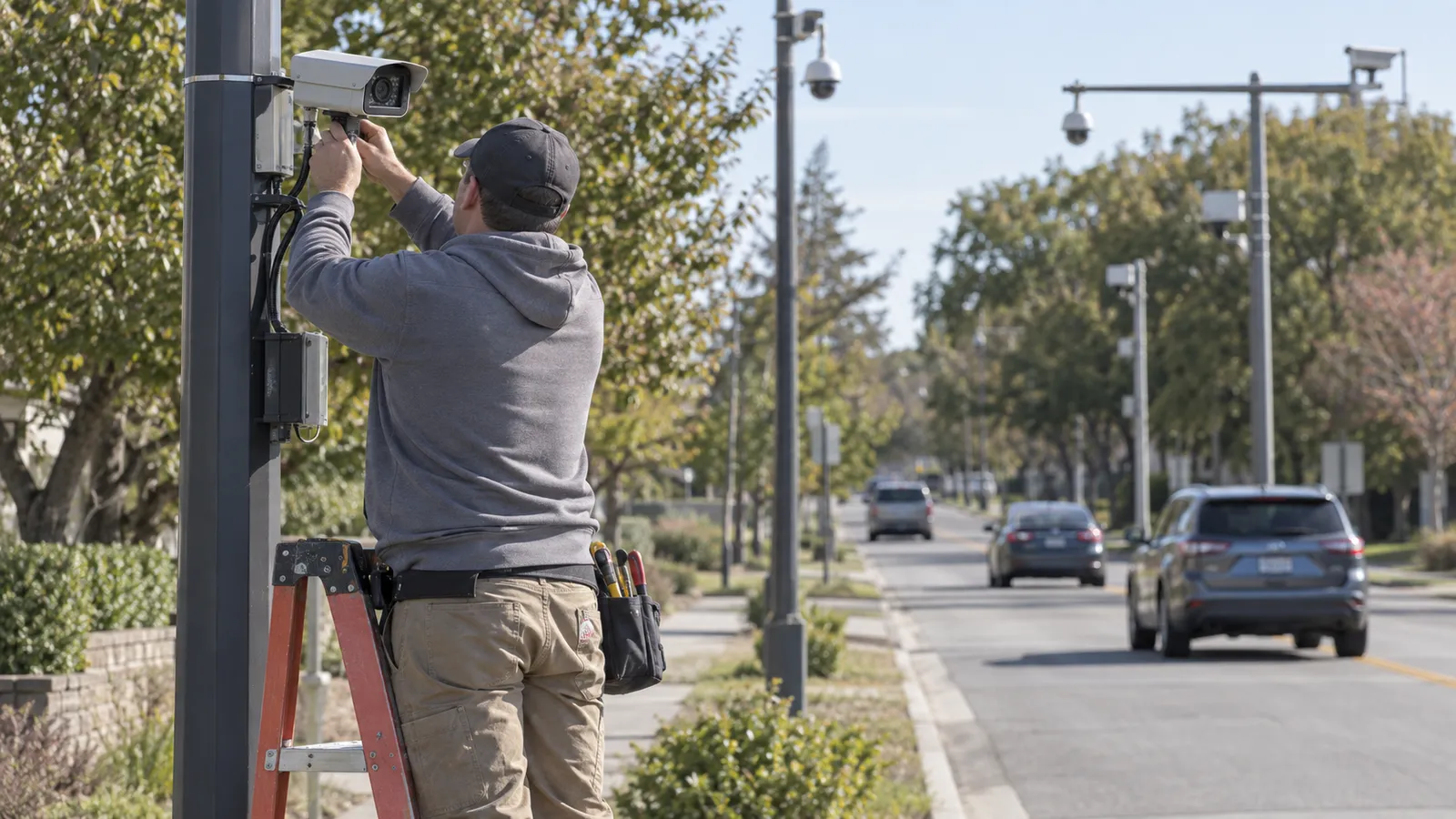
Changing an ALPR vendor does not necessarily end vehicle surveillance. Other cameras may still collect plate data, historical copies may remain, and replacement systems may preserve the same search and sharing model. To measure a real change, compare collection, retention, users, integrations and oversight before and after the transition, then verify decommissioning.
By Dr. Suhayb · Sources reviewed September 9, 2026
A camera removal is only one part of a system change
The visible equipment is easy to count. The information paths are harder to see. Plate records may exist in a camera service, an incident export, an evidence platform or an authorized recipient’s system. Removing a pole-mounted device says little about those other locations.
The Guardian reported in August 2026 that surveillance continued in some cities after Flock removal. Read the reporting. Our assessment framework below asks what changed locally; it does not assume that every replacement has the same outcome.
Map five layers before changing suppliers
| Layer | What to inventory | Transition evidence |
|---|---|---|
| Capture | Camera positions, owner, field of view and captured attributes. | A final site map showing devices removed, retained and added. |
| Storage | Routine plate records, images, incident holds and backups. | Retention schedule and deletion or export records. |
| Users | Staff, contractors, vendor support and outside recipients. | Named account list, revoked credentials and current roles. |
| Connections | APIs, alerts, downloads and external platforms. | A reviewed connection list with owners and permissions. |
| Governance | Search purposes, complaints, oversight and contract terms. | Approved policy, training records and scheduled review. |
Compare the old and new operating models
First write the job the property or agency needs done. Then compare the old and new system using the same questions. A technically better camera does not answer a privacy question. A shorter retention period does not answer an external-access question.
- Will the replacement record fewer, the same or more locations?
- Will the same people and organizations be able to search?
- Will collected fields or searchable vehicle attributes expand?
- Will routine retention shrink, remain unchanged or grow?
- Will exports and incident holds receive their own limits?
- Who verifies that the settings match the public policy?
Keep “unknown” as a separate result. Do not score an unanswered contract question as a privacy benefit. The Axon and Motorola privacy comparison shows how to distinguish useful vendor capabilities from measurable reductions in exposure.
A practical decommissioning sequence
- Approve a transition owner and the intended end state. Inventory equipment, services and accounts before removing anything.
- Identify records that legitimately need preservation with the responsible decision-maker. Separate those records from routine history.
- Export only what is needed and verify the export can be used by the authorized recipient. Document its new retention rule.
- Disable integrations and revoke access to the retired service. Include shared logins, support access and API credentials.
- Confirm the applicable deletion process, timing and backup treatment with the departing vendor. Keep the completion record.
- Validate the replacement’s capture scope, account permissions and expiration behavior before treating the transition as complete.
Operational continuity may require a short period with both systems running. That overlap can temporarily increase collection. Put an end date on the overlap and give each temporary record set a retention rule.
Two illustrative outcomes
Supplier-only change: a community replaces cameras but keeps the same roads in view, same search users and same retention. This may improve service or image quality. The board has not yet demonstrated a reduction in privacy exposure.
Operational change: another community limits cameras to its entrances, removes unused integrations, narrows access and verifies deletion. Those are specific, assessable improvements even if some collection continues. These examples are hypothetical; the same method applies to any supplier.
What residents can ask to see
Ask the operator for the current policy, a description of camera coverage, retention rules, authorized recipient categories and the complaint contact. Seek a summary of transition results that does not expose other people’s plate records or security credentials. Access rights and disclosure requirements depend on applicable rules and the operator’s obligations.
The ACLU’s ALPR resource provides background on location-history concerns. For the practical records to request, use the data-access map and the retention lifecycle guide.
Frequently asked questions
Can another vendor keep using the same cameras?
Compatibility depends on hardware, licensing and contractual rights. Ask for a model-specific assessment rather than assuming a camera can be reused.
Are historical plate records deleted when the hardware is removed?
Not necessarily. Hardware removal and data deletion are separate steps governed by the system, records involved and applicable terms.
Does a vendor change prove privacy improved?
No. Document the changes in collection, access, retention and oversight, then verify them.
Plan a bounded replacement
Private-property operators can start with the public-versus-private system guide, compare options in the supplier hub and use the full procurement checklist to record acceptance evidence. Placa can help assess the property workflow; any proposed data controls should be written into the agreed scope.