

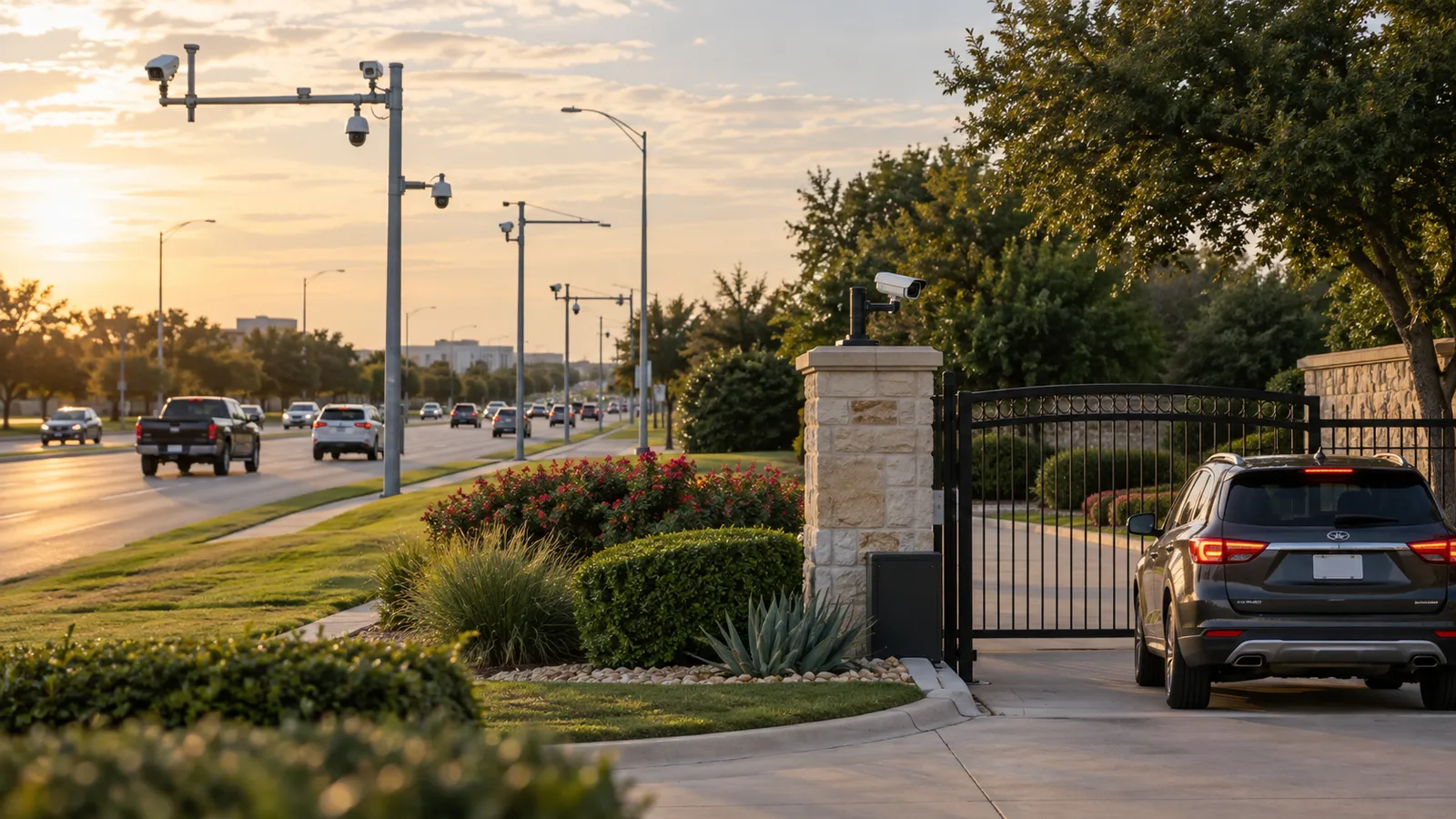
Public-safety ALPR networks support investigative and response workflows across roads or jurisdictions. Private-property LPR supports a defined site task such as gate access, parking validation or entrance incident review. The same recognition technology can serve either model. Privacy depends on collection boundaries, retention, users and sharing, so a private installation still needs explicit governance.
By Dr. Suhayb · Sources reviewed September 9, 2026
The difference is the job the system performs
LPR and ALPR both refer to technology that reads vehicle license plates from images. The terminology alone does not establish who controls the data or how widely it can be searched. The useful distinction is between an investigative operating model and a property workflow.
A public-safety team may need to search across multiple locations during an investigation. A property manager may need to decide whether a vehicle may enter one gate. The latter task does not automatically require a broad searchable travel history.
Compare purpose, reach and responsibilities
| Dimension | Public-safety operating model | Private-property operating model |
|---|---|---|
| Purpose | Investigation, locating vehicles and coordinated response. | A defined entrance, parking or property-management task. |
| Geography | May span roads, multiple sites or jurisdictions. | Usually a specified property or portfolio. |
| Captured subjects | Passing vehicles within the deployed camera coverage. | Vehicles within the chosen site coverage; incidental capture still matters. |
| Users | Authorized agency personnel and selected partners. | Authorized property staff, service providers and any approved recipients. |
| Searches | Investigative queries subject to policy and applicable law. | Operational queries linked to the approved property purpose. |
| Integrations | Dispatch, evidence and other selected public-safety systems. | Gate controllers, permit systems or other required workflow tools. |
| Retention | Must match the record type, purpose and applicable obligations. | Should be no longer than justified for the site task, with governed exceptions. |
| Oversight | Agency policy, access review and public accountability mechanisms. | Board or operator policy, access review, resident notice and complaints. |
These are category descriptions, not fixed attributes of every product. A private site can connect to broader systems, and a public agency can limit collection and sharing. Verify the actual deployment.
A plate read is not a completed workflow
For a gate, recognition must connect to an authorization record and a safe control decision. The operator needs a fallback when a plate is obscured, misread or unregistered. A search screen alone does not define that sequence.
For parking, the system must distinguish an observed vehicle from a valid permit, guest registration or possible violation. For school pickup, a plate match should not replace the school’s approved release checks. For towing or valet operations, the plate event must fit staff responsibilities and exception handling. These are workflow requirements to demonstrate during a pilot, not assumed capabilities of every LPR camera.
How to limit a property deployment
- Draw the intended capture area and check whether adjacent public roads, homes or unrelated spaces enter the frame.
- Choose the minimum captured fields needed to complete the task. Review any extra analytics separately.
- Limit operational access to assigned staff and remove access promptly when responsibilities change.
- Set record-specific retention and incident-hold rules. Verify the behavior rather than relying only on a policy document.
- Document external recipients and the purpose of every connection. Review new integrations before enabling them.
- Tell residents or affected users who operates the system and how to raise a concern.
Use the data-access guide to map recipients and the retention guide to address stored history. These controls also matter for small installations.
Which suppliers should be shortlisted?
Public-safety buyers can evaluate systems such as Axon Fusus and Motorola’s LPR offerings against their operational requirements. Enterprise buyers may prioritize an existing video-security environment. Buyers with usable camera infrastructure may favor a software layer. The comparison hub links current supplier references and explains each category.
Placa’s HOA LPR page is a starting point for private-property evaluation. Ask for a demonstration of your complete site workflow, compatible equipment and exact data-control requirements. A private-property focus should not be interpreted as a guarantee that data can never be disclosed.
Choose the architecture before comparing quotes
Write a one-sentence success criterion, such as “authorized residents can enter the west gate, with a manual fallback and a limited event history.” Specify what the system is not being purchased to do. Then ask every bidder to show how their proposal meets that scope.
If the goal is replacing Flock for privacy reasons, read the Axon/Motorola privacy test. Compare the existing and proposed configuration rather than assuming the category label answers the question.
Frequently asked questions
Is private-property LPR automatically private?
No. A private installation can still capture unnecessary information, retain it too long or provide excessive access.
Do I need a public-safety network to open a gate?
Gate authorization can be specified as a site workflow. Require the supplier to identify any external network dependencies and justify them.
Does a smaller camera footprint eliminate risk?
No. It limits one dimension of collection, but users, retention, exports and security still need controls.
Prepare the HOA privacy and procurement checklist before requesting proposals.
Internal Resources
Data source: Electronic Frontier Foundation: License Plate Readers