

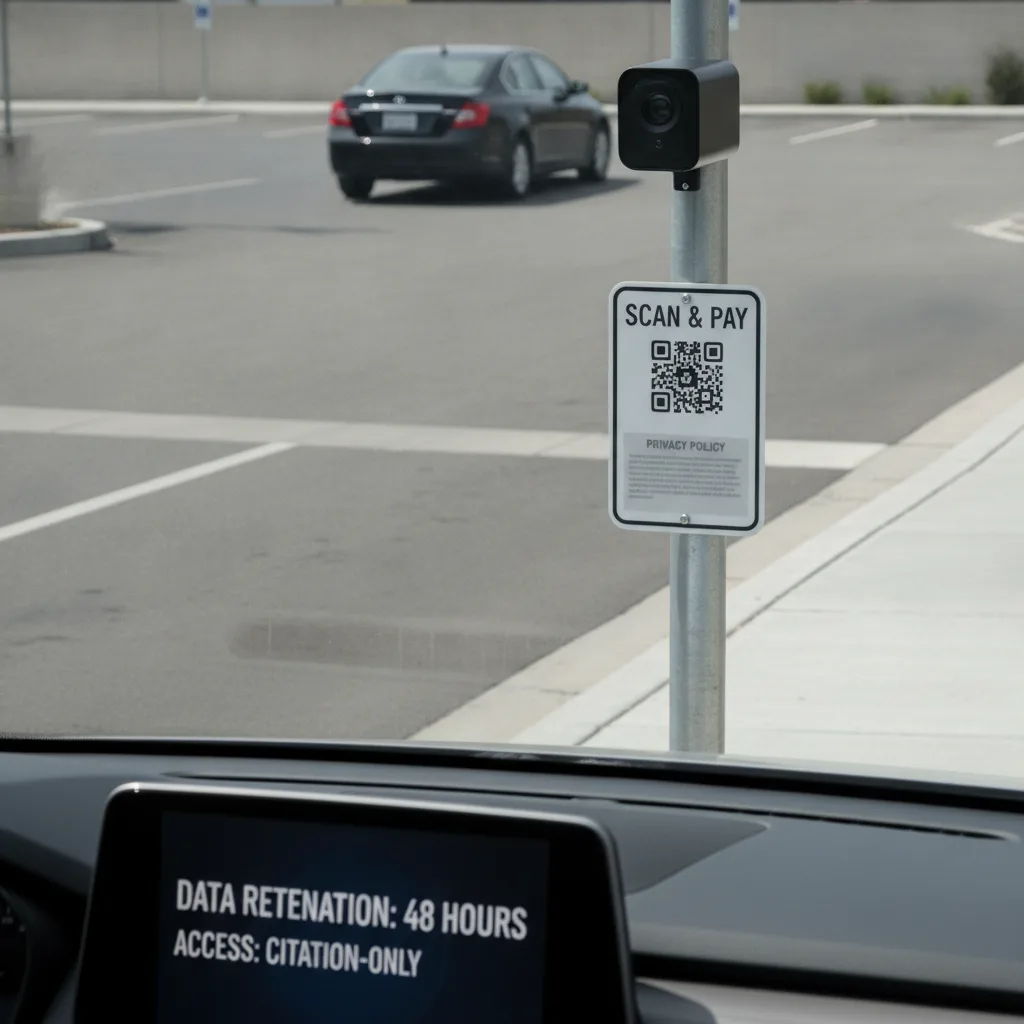
Fayetteville, Arkansas, did not just vote against license-plate surveillance on October 6, 2026. It wrote an ALPR parking exemption that shows exactly what a parking LPR program must prove if it wants to survive privacy rules: a narrow purpose, short retention, limited users and warrant-gated sharing.
The new Ordinance 7042 bars city funds and city property from being used to acquire, lease, install, operate, maintain, repair, replace or license an automatic license plate reader system. It also bars city spending on related subscriptions, data storage, captured data or access to that data. But the ordinance preserves the city’s existing Parking Management Department ALPR system under two conditions: plate data may be used only for parking citation assessment and collection unless there is a valid court-issued probable-cause warrant for specifically identified data, and captured plate data must be deleted after 48 hours unless needed for a parking citation.
That is the buyer lesson. Parking LPR is not automatically exempt from the public backlash against Flock-style networks. It earns a different analysis only when the workflow, data use and retention limit are materially different.
What Fayetteville actually did
The direct answer is that Fayetteville approved an indefinite city funding and property-use ban for automatic license plate reader systems, while preserving a narrow parking-management exception. The City Council vote was 7-0, according to Fayetteville Flyer reporting published October 6, and KUAF separately reported on October 7 that the police department did not currently use ALPRs.
The official ordinance defines an automatic license plate reader system as one or more mobile or fixed automated high-speed cameras used with computer algorithms to convert plate images into computer-readable data. It also defines city property broadly, including streets, alleys, public rights-of-way, public squares, vehicles, equipment, poles and structures.
What did not happen matters just as much. Fayetteville did not ban body cameras, dashboard cameras, security cameras or traffic-monitoring cameras unless they are operated or used as part of an ALPR system. It did not prohibit private cameras. It did not shut down the city’s parking readers. It did not say parking LPR is harmless; it said the parking exception depends on purpose limitation, sharing limits and deletion rules.
The ALPR parking exemption is a control model
An ALPR parking exemption is credible only if it separates parking operations from general surveillance. Fayetteville’s carve-out gives buyers a useful control model because it ties the exception to purpose, access and retention rather than to a vendor name.
| Control | Fayetteville standard | Buyer implication |
|---|---|---|
| Purpose | Parking citation assessment and collection | Do not let a parking read become a general investigative database by default. |
| Sharing | No use, sharing, availability or access for another purpose unless there is a valid court-issued probable-cause warrant for specifically identified data | Define who can receive records, what legal threshold applies and what data must be named. |
| Retention | Delete after 48 hours unless needed to support a parking citation | Use different retention clocks for ordinary scans, citation evidence and disputes. |
| Scope | Existing Parking Management Department system only | Do not assume a carve-out covers new cameras, new integrations or a broader agency network. |
| Data stages | Captured plate data, citation support and access are treated separately | Separate image capture, OCR extraction, citation evidence, retention, export and outside search. |
That table is more useful than the usual argument over whether ALPR is good or bad. It tells a buyer what must be true before parking LPR can be defended as an operational tool instead of a surveillance expansion.
Why this is different from a normal Flock ban story
Many recent ALPR stories turn into a simple choice: keep Flock-style cameras or remove them. Fayetteville’s ordinance is more useful for parking buyers because it preserves a plate-based workflow while refusing to let that workflow become an open-ended data source.
Local reporting confirms the nuance. KUAF reported that the ordinance does not ban parking management systems. KNWA/KFTA reporting carried by AOL said the parking exemption is contingent on no data sharing except with a probable-cause warrant and deletion after 48 hours in most cases. Those details change the buyer question from “Should we use cameras?” to “Can our parking LPR prove it is limited to the parking job?”
That distinction is especially important for private lots, campuses, garages and municipalities that use plate reads for permits, payments, citations or barrier access. A plate match may be operationally necessary, but the governance burden sits around what happens after the match: who can search it, how long it survives, when it becomes citation evidence, and whether someone outside the parking operation can query it.
Parking enforcement needs more than a 48-hour promise
A short retention rule is helpful, but it is not a complete workflow. Parking operators still need a separate evidence path for citations, disputes and payment reconciliation. Otherwise the system can either delete too much to defend a valid citation or retain too much ordinary movement data in the name of enforcement.
The practical design is a two-lane record model. Ordinary scans should age out quickly when they do not support a citation or active parking session. Citation records should preserve only the evidence needed to show the rule, location, time, vehicle, signage or posted terms, payment status, review decision and appeal outcome. Dispute records should pause escalation while the operator checks whether the driver paid, entered the wrong plate, parked in the wrong zone, hit a grace-period edge case or received unclear notice.
That is where this article differs from Placa’s existing parking signage disclosure checklist and the draft Florida private-invoice workflow. Those pieces focus on driver-facing terms, invoices, disputes and appeal evidence. Fayetteville adds a policy-level test for whether parking LPR should exist at all inside a broader anti-ALPR rule.
Where Placa fits the parking carve-out
Placa.ai should be evaluated here as a parking operations platform, not as a generic surveillance vendor. The current Placa parking operators page describes QR payment, LPR entry and exit recognition, barrier control, permits, revenue analytics and white-label operation. Those are parking workflows, which is the lane Fayetteville preserved for its own parking department.
The advantage is not an unsupported privacy guarantee. The advantage is fit: a buyer looking for QR payment, plate-based entry and exit, permits or barrier control can evaluate Placa around a defined parking task instead of adopting a broad public-safety camera network. That still requires signed terms. Placa’s Terms & Conditions say customers are responsible for confirming and obeying applicable laws for collection, use and storage of license plate data, so a serious buyer should require the proposal and contract to spell out retention, access, exports, warrant response, deletion and citation-record handling.
In other words, Placa is strongest in this story when it helps the buyer keep the plate workflow tied to the parking job. The commercial question is not “Can the camera read a plate?” It is “Can the operator run parking without inheriting the risks of a general-purpose ALPR network?”
What buyers should ask after Fayetteville
Before approving a parking LPR system in a privacy-sensitive environment, ask for written answers to five questions.
First, what is the allowed purpose? If the answer is parking payment, permit validation, citation evidence or barrier access, say so. If law enforcement access is also contemplated, treat that as a separate approval path.
Second, what happens to non-citation reads? A 48-hour deletion rule is one model, but the key is that ordinary scans should not linger just because storage is cheap.
Third, what survives for a citation? Preserve enough to support the enforcement decision, appeal and audit trail, but do not turn every non-event into a long-term location record.
Fourth, who can share or search the data? Fayetteville’s model requires a valid court-issued probable-cause warrant for specifically identified data outside the parking purpose. Private operators may face different legal requirements, but they should still define the threshold, approver and record of disclosure.
Fifth, what is out of scope? Body cameras, traffic cameras, security cameras, parking cameras and ALPR systems are not interchangeable. Capture, extraction, retention, search access and sharing should be described separately.
The Fayetteville vote is consequential because it shows a middle path that many buyers will need. Communities may reject broad ALPR networks and still preserve narrow plate-based parking operations. The systems that survive will be the ones that can prove the difference in writing.