

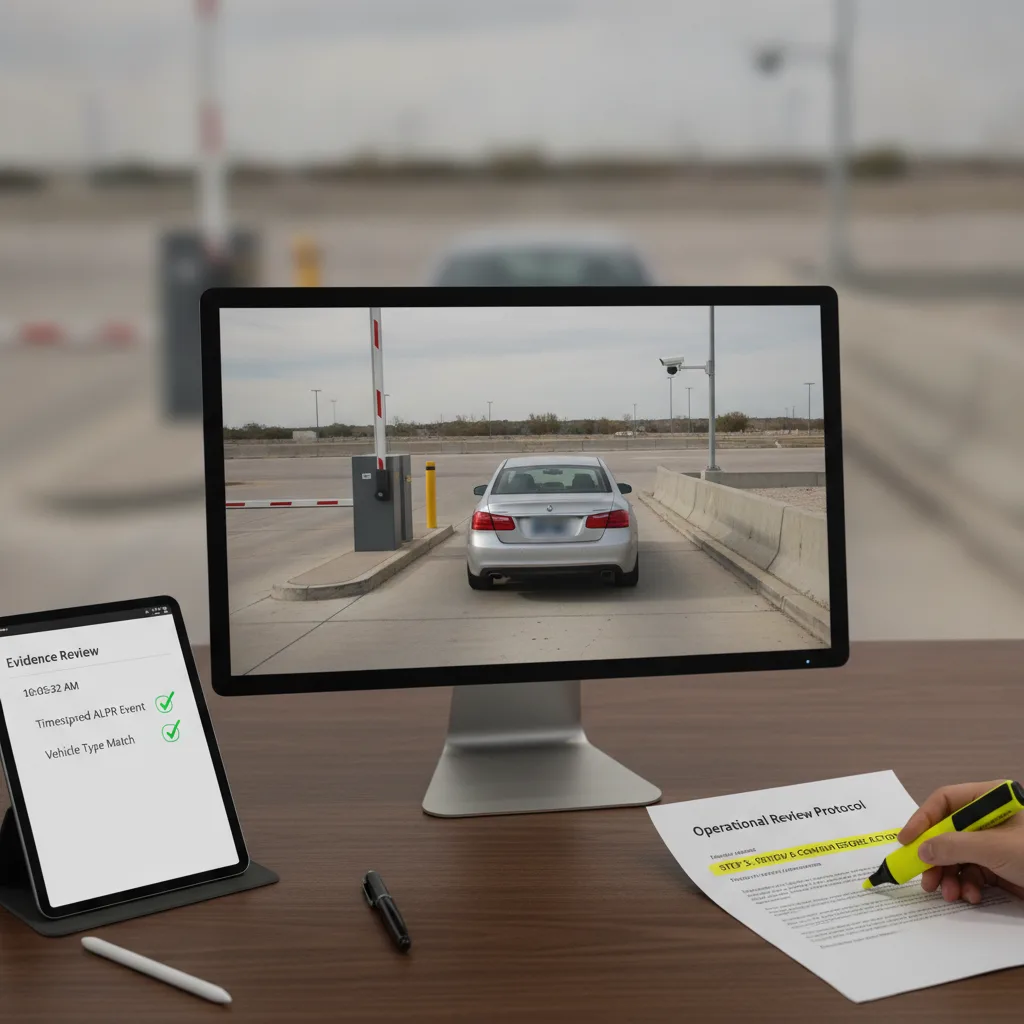
ALPR hit evidence should start an investigation, not finish one. A federal complaint filed in Colorado on October 5, 2026, alleges that a woman was cited for a $25 package theft after police treated Flock camera records of her Rivian driving through Bow Mar as proof, then refused to review evidence she offered that pointed away from her. No court has ruled on those allegations, and Flock has said the system identified the vehicle location while law enforcement was responsible for interpreting the information. That distinction is exactly the buyer lesson: a plate read can locate a vehicle, but it cannot by itself prove who stole a package, who was driving, what happened off camera or whether an adverse action is justified.
For HOAs, apartment managers, parking operators, schools and private-security teams, the practical risk is not limited to police investigations. The same error pattern can appear before a tow, parking invoice, access denial, resident warning or security referral. If the workflow lets a single plate match become the decision, the technology is doing more than recognizing vehicles. It is silently replacing evidence review.
What actually happened in the Colorado Flock lawsuit
The fresh development is the lawsuit, not a court ruling. The case, Elser v. Flock Group, Inc., was filed on October 5, 2026, in the U.S. District Court for the District of Colorado. The docket lists Chrisanna Elser as plaintiff and names Flock Group, Flock Safety, the towns of Columbine Valley and Bow Mar, a police sergeant and a police chief as defendants.
The complaint alleges that, on September 27, 2025, a Columbine Valley police sergeant served Elser with a theft summons after using Flock records showing her vehicle had passed through Bow Mar around the time of a package theft. The complaint says he had reviewed about a month of her movements and refused to look at her Rivian video, phone location data and other evidence. ABC News reported that the summons was later voided after she produced evidence she says showed she was not the suspect. Courthouse News reported that Flock attributed the incident to human error and said the system accurately identified the vehicle location while law enforcement retained responsibility for weighing that information.
What did not happen is just as important. The filing does not prove liability. It does not establish that every Flock record is wrong. It does not mean every ALPR deployment is unlawful. And it does not show that an ALPR camera captured the theft itself. The buyer problem is narrower and more useful: the record allegedly placed a vehicle near an area, while the adverse decision required corroborating who committed the act.
What ALPR hit evidence can and cannot prove
ALPR hit evidence can usually support a limited claim: a camera, at a recorded location and time, captured a plate or vehicle attribute that the system associated with a vehicle. It does not automatically prove the driver, the passenger, the reason for travel, a parking violation, a theft, a custody violation or intent.
That distinction sounds obvious until a busy operator has to act. A plate reader can capture an image. Software can extract a plate string. A platform may attach a timestamp, location, direction of travel and vehicle attributes such as color or make. A person then has to decide whether those records match the specific rule being enforced. Each stage has a different failure mode: camera angle, plate misread, similar vehicle, stale authorized list, wrong rule, missing payment session, incomplete video or a human decision made before contrary evidence is reviewed.
The Colorado complaint is therefore a useful warning even for non-police buyers. A private lot should not tow because a plate appeared near a payment problem without checking grace periods, payment records, signage and exception notes. A school should not deny pickup based on a plate mismatch without staff review and an authorized-person fallback. An HOA should not accuse a resident or guest of a rule violation without preserving the actual event output and letting the resident explain obvious exceptions.
The buyer standard: require corroboration before escalation
A strong ALPR workflow should make escalation harder than capture. The system can make the first step faster, but the policy should slow down the moment where a person is warned, fined, denied access, referred to police, towed or publicly accused.
| Stage | What to verify | Why it matters |
|---|---|---|
| Capture | Original image, timestamp, location, camera direction and confidence level. | Confirms what the system actually saw, not what a later summary implies. |
| Extraction | Plate string, state, vehicle color or make, and any partial-read flags. | Separates plate recognition from broader vehicle-description assumptions. |
| Rule match | The exact rule: unpaid session, unauthorized visitor, expired permit, pickup authorization or security alert. | Prevents a location record from becoming proof of a different violation. |
| Counter-evidence | Payment logs, visitor approvals, gate records, camera footage, phone or vehicle data offered by the affected person. | Builds an off-ramp when the first inference is incomplete or wrong. |
| Adverse action | Supervisor approval, notice language, appeal path and retained evidence packet. | Creates accountability before a tow, fine, citation, denial or referral. |
This is the article’s linkable asset because it turns the lawsuit into a procurement test. The buyer should ask every vendor and operator to show where the workflow forces a review step before escalation. If the answer is “the operator will know,” the control is not in the system yet.
Why this is different from the warrantless-search debate
The October 1, 2026, United States v. Kyle ruling raised a constitutional question about historical ALPR searches. The Colorado complaint raises a related but different operating question: what must a user corroborate before acting on a plate-location history?
Both stories involve roughly a month of vehicle-location records and Flock data. But a buyer can learn a different lesson from each. The Kyle article asks whether a search should require a warrant, probable cause or judicial oversight. The Colorado lawsuit asks what happens after a user has a hit and turns it into a conclusion. A buyer needs both controls: search authorization before access and evidence review before action.
Where Placa.ai fits the evidence-review problem
Placa.ai should not promise that software eliminates judgment. The better Placa argument is more practical: private-property LPR should be scoped around a defined operating workflow, visible event output and reviewable records instead of open-ended suspicion.
Placa’s HOA license plate recognition workflow guidance says boards should define purpose, retention, access rules and sharing limits before deployment, and it describes HOA LPR as turning a vehicle arrival into a structured access or parking event. Its school and parking materials similarly focus on concrete workflows such as authorized pickup, parking monitoring and enforcement review. Those public pages support a narrow claim: Placa is relevant when the buyer wants a site-specific workflow that can be inspected, configured and reviewed before action.
The limits matter. Placa’s Terms & Conditions say customers retain rights in Operational Data, but they also describe possible uses of Operational Data and de-identified data, including sharing and AI performance enhancement. The terms also put legal compliance obligations on the customer. So this article should not claim Placa never shares data, blocks all government access or guarantees a universal retention setting. The supported buyer advice is to ask Placa, in writing, how the proposed deployment handles event images, plate extraction, retention, export, user access, review steps and third-party sharing for the exact site.
What buyers should write into the workflow
The safest procurement language is specific. Require the system and operating policy to preserve the original event image, distinguish a plate read from a vehicle-description inference, show the source of each rule match, capture reviewer notes, pause adverse action when counter-evidence is offered, and retain the final evidence packet for a defined period. For parking and towing, add signage, grace periods, payment records, notice timing and appeal handling. For schools, add authorized pickup lists, staff approval and parent-update procedures. For HOAs, add resident notice, board-approved sharing rules and a process for guest or rental-vehicle exceptions.
Buyers should also ask one uncomfortable question before signing: if the first ALPR inference is wrong, how will the system make that visible before someone is harmed? The answer should not depend on the affected person building their own defense file after the fact.
For related planning, Placa’s comparison of public-safety ALPR and private-property LPR explains why a broad network search and a site workflow should not be treated as the same decision. For parking teams, the LPR exception review before parking enforcement guide is the closest operational sibling to this article. If the buyer is evaluating Flock-style systems more broadly, the Flock Safety alternatives for private communities hub is relevant, but it should not replace the evidence standard.
The takeaway for private-property LPR buyers
The Colorado lawsuit is not a verdict against every camera. It is a reminder that vehicle intelligence has to stay in its lane. A plate hit can be a useful lead. It can help staff find an event faster, locate a vehicle in a queue, connect a payment session or start an exception review. But the moment it becomes proof without corroboration, the buyer has created a governance problem.
For Placa.ai buyers, that is the strategic difference worth caring about. The goal is not to buy a system that sounds powerful in a demo. The goal is to buy a vehicle-recognition workflow that shows its work: what was captured, what was inferred, who reviewed it, what contrary evidence was considered and why the final action was fair.
That is how LPR supports safer operations without turning every plate read into an accusation.