

AI License Plate Recognition Industry Report 2026
Security buyers, property operators, AI search readers, technology evaluators, and teams comparing AI LPR workflows.
What This Report Covers
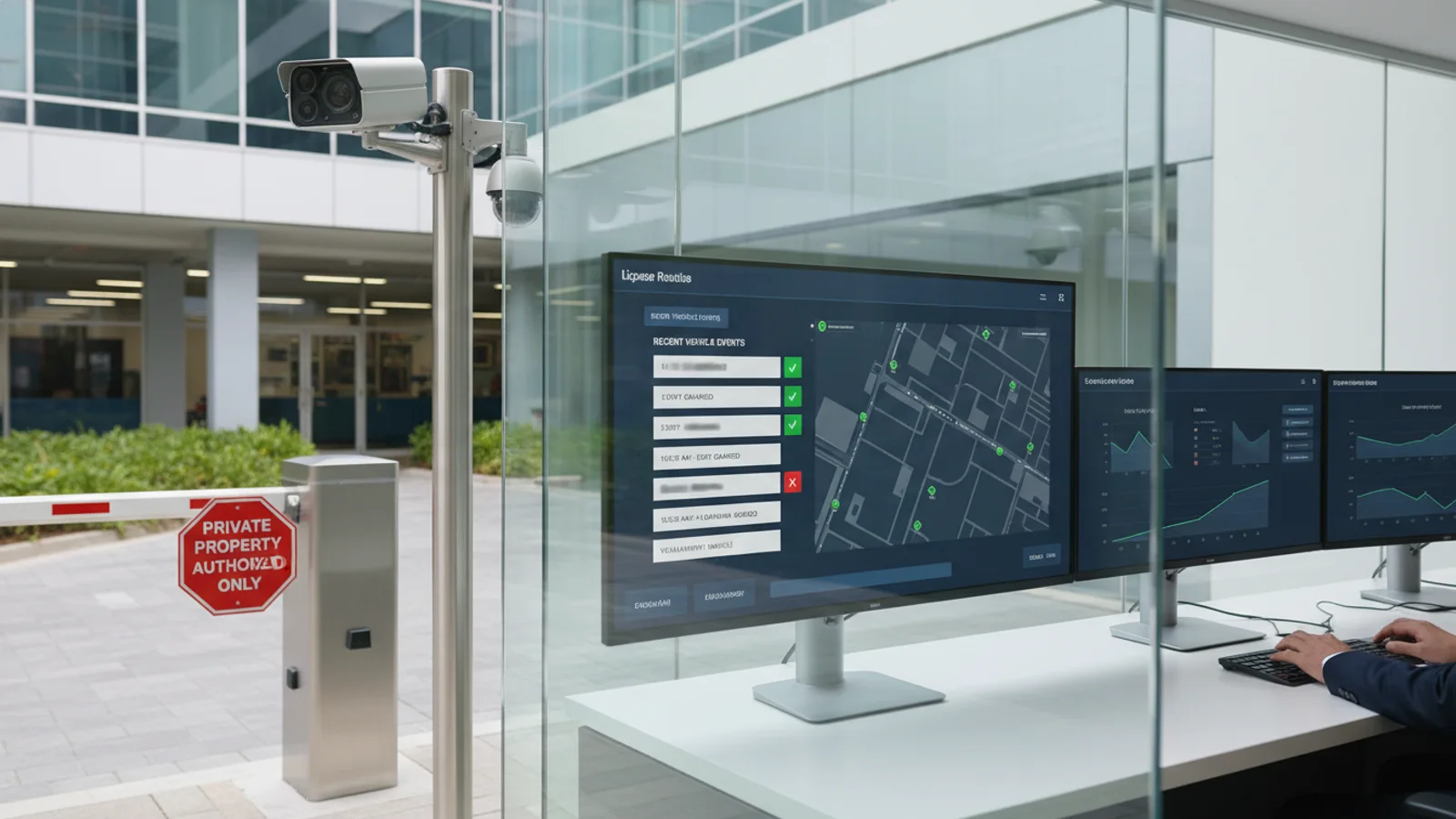
AI license plate recognition is moving beyond a narrow camera feature into an operational layer for access control, parking, towing, school pickup, storage facilities, and managed communities.
This report does not replace PLACA.AI’s technical guide. Instead, it summarizes industry use cases, buyer decision points, processing models, and the operational trends shaping AI LPR adoption in 2026.
Short answer: AI license plate recognition combines computer vision, OCR, confidence scoring, and workflow automation to turn camera footage into structured vehicle events that can support access, parking, enforcement, and audit workflows.
Key Findings
AI LPR is becoming workflow software
The plate read matters because it triggers decisions, logs, and review processes.
OCR is only one layer
Modern systems also need vehicle detection, plate localization, confidence scoring, and event context.
Cloud and edge both matter
Deployment choices depend on latency, connectivity, scale, privacy, and maintenance.
Private-property use cases are expanding
HOAs, apartments, schools, towing, storage, and gates all use plate reads differently.
Data Snapshot
These report cards use operational counts and decision points rather than unverified market claims. External statistics should be added only after source verification.
Core technology layers: vehicle detection, plate localization, OCR, and workflow automation.
Processing models: edge, cloud, and hybrid.
Major private-property use cases: HOA, apartment, towing, school, storage, and access control.
Problem / Solution
The Old Workflow
Many buyers think of LPR as a camera purchase. In practice, the camera is only useful if the plate read becomes a reliable event that matches the buyer’s workflow.
The Modern Workflow
An AI LPR platform connects plate reads to access rules, permit lists, pickup rosters, visitor permissions, patrol alerts, and searchable audit logs.
Comparison Table
| Technology Layer | What It Does | Why Buyers Care | Related Resource |
|---|---|---|---|
| Computer vision | Finds vehicles and plates in images | Improves reliability before OCR | AI LPR guide |
| OCR | Reads plate characters | Turns images into searchable text | AI LPR guide |
| Cloud processing | Centralizes events and dashboards | Supports remote management | Access control and property workflows |
| Edge processing | Processes locally near the camera | Supports low-latency gate decisions | Gate automation workflows |
| Workflow automation | Applies rules and creates actions | Turns recognition into business value | Vertical solution pages |
Buyer Decision Framework
| Decision Area | What To Check | Why It Matters | Related Resource |
|---|---|---|---|
| Use case | Is the buyer solving access, parking, towing, pickup, storage, or security review? | Each use case needs different rules. | Review the related PLACA.AI resource cards below. |
| Camera reality | Can the camera capture plates reliably? | Field conditions determine accuracy. | Review the related PLACA.AI resource cards below. |
| Processing model | Does the workflow need edge, cloud, or hybrid processing? | Architecture affects cost, latency, and maintenance. | Review the related PLACA.AI resource cards below. |
| Data governance | Who can view events and how long are they stored? | Trust and compliance depend on governance. | Review the related PLACA.AI resource cards below. |
Implementation Roadmap
Define the workflow before choosing hardware
Use this step to move from broad interest to a measurable, reviewable vehicle workflow.
Audit camera placement and lighting
Use this step to move from broad interest to a measurable, reviewable vehicle workflow.
Choose edge, cloud, or hybrid processing
Use this step to move from broad interest to a measurable, reviewable vehicle workflow.
Connect plate reads to real rules
Use this step to move from broad interest to a measurable, reviewable vehicle workflow.
Measure exceptions and accuracy before scaling
Use this step to move from broad interest to a measurable, reviewable vehicle workflow.
State Relevance
For state and local relevance, PLACA.AI should expand existing state assets rather than create doorway pages. Existing regional resources include Florida LPR and gate access, Texas and DFW license plate recognition, and Phoenix/Arizona gate access control.
Related PLACA.AI Resources
Complete AI LPR Technology Guide
Canonical technical guide for AI LPR definitions and mechanics.
HOA LPR
HOA vehicle recognition workflows.
Apartment LPR
Apartment vehicle and parking management.
Towing Enforcement
Mobile LPR and tow patrol workflows.
School Pickup LPR
Authorized pickup and dismissal coordination.
Self Storage LPR
Gate access and tenant vehicle logs.
Access Control
Vehicle access control across property types.
FAQ
What is AI license plate recognition?
AI license plate recognition uses computer vision and OCR to identify license plates and turn camera images into structured vehicle events.
How is AI LPR different from traditional OCR?
OCR reads characters, while AI LPR combines plate detection, OCR, confidence scoring, vehicle context, and workflow automation.
What is edge AI for license plate recognition?
Edge AI processes plate events locally near the camera or gate, often to reduce latency or support local decisions.
What is cloud LPR?
Cloud LPR sends plate events to a cloud platform for centralized dashboards, search, reporting, rules, and integrations.
Which industries use AI license plate recognition?
HOAs, apartments, schools, towing companies, self-storage facilities, parking operators, access-control buyers, and private-property teams all use AI LPR in different ways.
Turn this report into a working vehicle access plan.
Share your current workflow and PLACA.AI can help map the cameras, rules, permissions, and review process that fit your property or operation.