

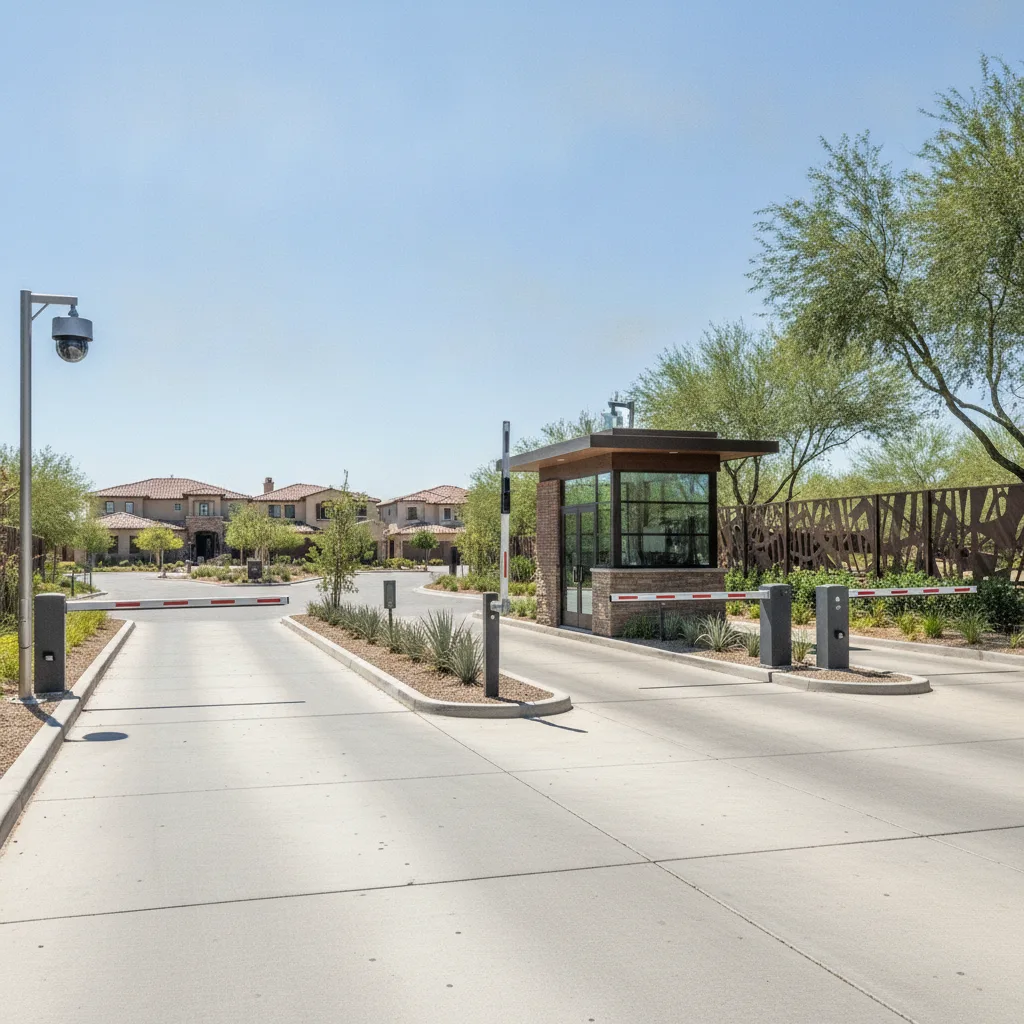
Direct answer: Choose the camera only after the community maps each lane, vehicle speed, lighting condition, gate trigger, and exception path. A product name cannot compensate for an unreadable approach angle or an undefined access policy.
This guide is for HOA board members, community managers, gate vendors, and security committees and focuses specifically on choosing an LPR camera for a gated community. The boundary matters: this is an operating decision, not a substitute for the site rules and professional review that govern the real deployment.
Why the current approach breaks
Communities often compare camera specifications before documenting how residents, guests, vendors, tailgaters, unreadable plates, and gate outages should be handled. That reverses the decision order and makes every later exception a support problem.
Example: A two-lane gate should not be treated as one camera decision. If visitors turn sharply while residents approach straight, the two lanes need separate capture assumptions and separate pass/fail evidence.
Lane-by-lane camera decision table
| Decision point | Evidence or control | Required response |
|---|---|---|
| Resident entry lane | Consistent approach and known resident plate | Read quality, gate-response time, manual override |
| Visitor lane | Temporary authorization and clear arrival window | Expired access, unreadable plate, intercom fallback |
| Exit lane | Exit logging only if the policy requires it | Purpose, retention, and staff access |
| Wide or multi-lane approach | One camera view may not isolate each plate | Run a lane-specific field test before purchase |
A practical operating sequence
- Step 1. Draw every approach lane and mark the expected capture point.
- Step 2. Record day, night, rain, glare, and queued-vehicle tests without assuming laboratory accuracy.
- Step 3. Assign one owner for resident records and a separate documented process for exceptions.
- Step 4. Pilot one lane before committing the remaining entrances.
For choosing an LPR camera for a gated community, the named owner should document the approved rule, baseline, and result of each test. Use the actual environment for acceptance. A polished demonstration cannot reveal every lane, account, device, policy, or staffing exception.
Exceptions that need a human decision
When a plate cannot be read, the gate must fail into a documented human process such as intercom verification or a temporary credential. Never treat an unreadable plate as automatic authorization.
Close each exception with a recorded decision and owner; untracked verbal workarounds eventually become the process.
How to test the workflow
Start narrow, observe the current baseline, test normal and failure conditions, then decide whether expansion is justified.
- percentage of test vehicles producing a reviewable plate record
- median time from approach to authorized gate action
- manual overrides by reason
- false authorization and false denial incidents
- support calls tied to gate entry
Choose the observation period before launch so the result cannot be selected after the fact.
Verification before rollout
- Write the purpose and non-goals for choosing an LPR camera for a gated community and name the accountable owner.
- Verify the process with the actual HOA board members, community managers, gate vendors, and security committees who will use, administer, or review it.
- Test a correction, an unavailable-system path, and the exception described on this page.
- Confirm current pricing, contract terms, support, integrations, and data handling directly with each provider.
- Use percentage of test vehicles producing a reviewable plate record as one acceptance signal and record what evidence can stop the rollout.
Related PLACA.AI planning resources
Questions this page should answer
Should an HOA buy the highest-resolution camera available?
Not automatically. Resolution matters, but lane geometry, shutter behavior, illumination, vehicle speed, and installation position must work together.
Can one camera cover two gate lanes?
Sometimes, but the community should prove it with lane-specific test captures before accepting the design.
What should the board approve before installation?
Approve the access purpose, authorized users, exception process, retention rule, and pilot acceptance criteria.
Map a one-lane gated-community pilot
Bring the rules, current process, known exceptions, and success criteria for choosing an LPR camera for a gated community. PLACA.AI can help evaluate a limited pilot without presuming that another property’s hardware or workflow is the right answer.
Editorial refresh: July 22, 2026. Before using this framework for choosing an LPR camera for a gated community, independently confirm current product capabilities, third-party features, pricing, contracts, governing requirements, and local rules.
Data source: Electronic Frontier Foundation: License Plate Readers