

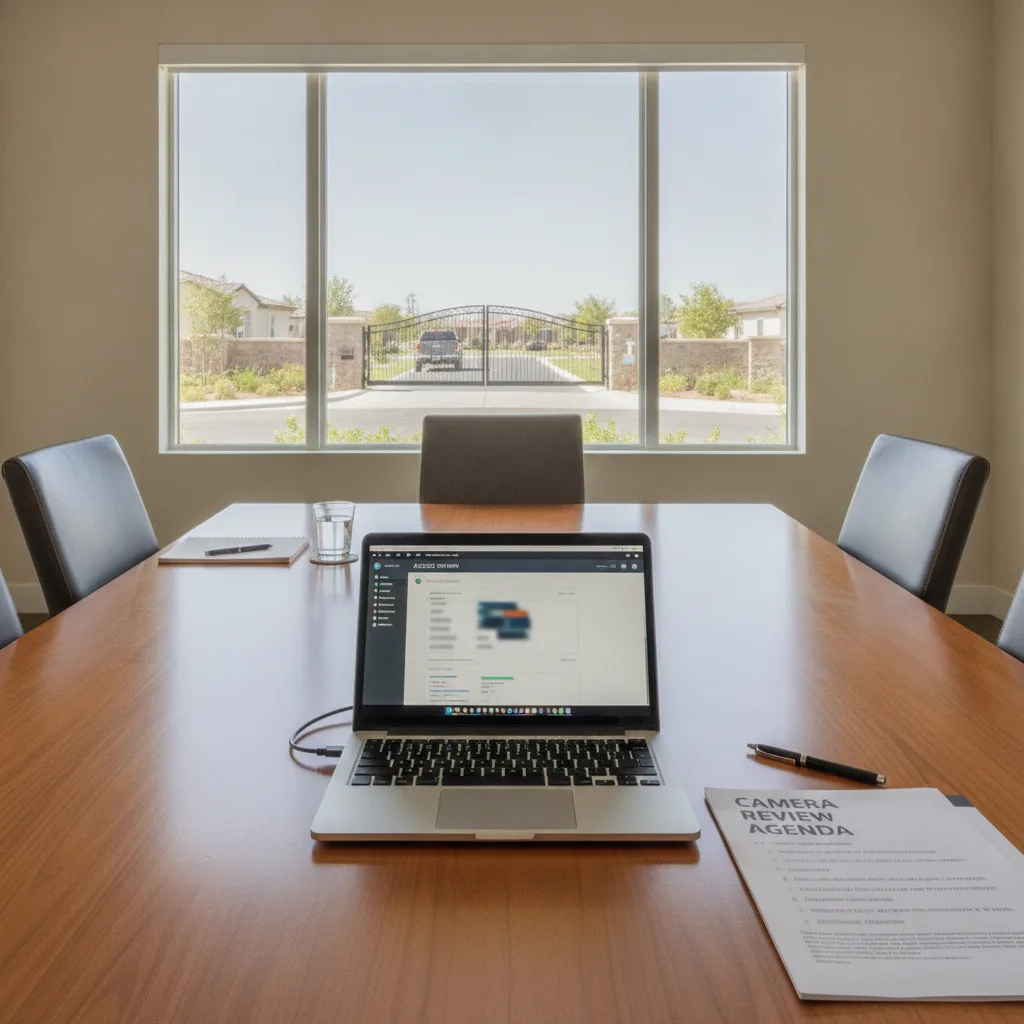
A Flock camera pause checklist should define the reason for the pause, what capture or sharing stops, who keeps emergency access, which audit logs and retention rules are reviewed, how residents receive answers, and what evidence the HOA board needs before resuming, narrowing, replacing, or ending the system.
Key Takeaways
- A resident-requested camera pause should be a bounded review, not an argument about whether every license plate reader is good or bad.
- The board should separate routine capture, emergency safety use, outside sharing, user access, and data retention instead of treating the system as one on-off switch.
- Fresh August 2026 public debate around Flock cameras makes pause language a live governance question for communities that already have ALPR or are considering it.
- The review packet should include contract rights, authorized users, audit logs, data export, retention settings, resident notice, and the decision criteria for ending the pause.
- If the existing vendor cannot support the community’s operating limits, the board should compare replacement paths before the contract clock controls the decision.
What This Workflow Involves
This workflow starts when residents, directors, managers, or counsel ask the association to temporarily stop or narrow license plate reader use while the board reviews privacy, access, sharing, retention, or approval concerns. The board first defines the scope. A limited review might stop outside-agency sharing while keeping private entry alerts. A wider review might suspend routine monitoring, freeze new integrations, and require manager approval for any data access.
The next step is evidence preservation. The association should not delete records, disable access, or change vendor settings casually if those records are needed to answer resident questions, investigate misuse, comply with law, or evaluate a contract. Instead, the board should assign a custodian, preserve the current settings, document who has access, and ask the vendor what can be exported during the applicable retention window.
The final step is a decision memo. The memo should explain what was reviewed, what remains uncertain, what limits the board can enforce, and what recommendation will go to a vote. The outcome may be resume with tighter rules, resume only for private-property access control, replace the vendor, renegotiate terms, or begin an orderly termination. The pause should end because the board reached a documented decision, not because the discussion became exhausting.
Why This Problem Is Showing Up Now
In early August 2026, Flock camera debates moved from abstract privacy concerns into active public governance fights. WFSB reported that Milford residents spoke against the cameras during a Board of Aldermen meeting after vandalism and privacy objections. The useful signal for HOA boards is the question behind the meeting: when residents ask for action, what review process should leaders use before deciding whether cameras stay on?
Connecticut coverage this week also described state lawmakers asking towns to pause new Flock installations while backlash grows. That does not mean a private association must copy a municipal pause. It does show that the word pause is becoming part of the public language around ALPR governance, especially where residents want transparency before expansion.
At the same time, current reporting from Chron and WIRED has focused attention on alleged misuse of Flock systems by law-enforcement users. Those reports concern public agencies, not ordinary HOA staff. A private community should avoid importing every public-agency fact into its own contract debate. The practical lesson is narrower: any system that creates searchable vehicle-location records needs defined users, permitted purposes, access logs, retention limits, and a response plan if residents lose trust.
The Core Operational Problem
The core problem is that boards often buy cameras for one job and later have to answer questions about a larger system. The original goal may have been gate access, visitor oversight, package-theft leads, amenity parking, or entry records. Residents may then ask about police access, national networks, personal misuse, audit trails, data deletion, and whether the community approved the same thing the vendor is now offering.
If the board answers only with sales language, residents hear dismissal. If the board shuts everything down without understanding the contract, the community may lose useful access-control evidence or create avoidable cost. A better response is to pause the disputed parts of the workflow, keep necessary safety functions under written limits, and review the evidence in a board-owned packet.
Start with the Flock Safety alternatives for HOA communities hub when the pause could lead to replacement. The point is not to switch vendors reflexively. It is to define what the community actually needs and what data practices it will not accept.
Flock Camera Pause Checklist for HOA Boards
| Review item | Board question | Record to keep |
|---|---|---|
| Pause scope | Which actions stop now: new installs, outside sharing, routine searches, alerts, or all capture? | Board motion, effective date, scope statement |
| Emergency exception | Who may approve access for a time-sensitive safety issue? | Named approver, reason code, expiration time |
| Authorized users | Who can search, export, share, or change settings? | User roster, roles, last-login review |
| Permitted purposes | What community problems justify use during or after the pause? | Purpose list tied to rules or policy |
| Sharing controls | Can outside agencies, vendors, neighboring communities, or integrations see data? | Current settings, contracts, screenshot log |
| Retention | How long is data held, and what happens before it expires? | Order form, retention setting, export deadline |
| Audit review | Can the board see search history, user activity, exports, and abnormal use? | Audit request, exported report, reviewer notes |
| Resident communication | What will residents be told while the review is active? | FAQ, meeting agenda, response owner |
| Decision trigger | What evidence will decide resume, narrow, replace, or terminate? | Decision memo and vote record |
Evidence And Source Context
The strongest public-question signal this week is meeting coverage. WFSB reported on August 3, 2026 that residents opposed Flock cameras at a Milford Board of Aldermen meeting and raised privacy concerns while officials had not yet announced an action. That is a municipal setting, but it mirrors the governance problem an HOA faces when residents want a pause before leaders can fully answer the data questions.
Fresh reporting also shows why residents are asking more pointed access-control questions. Chron reported on August 2, 2026 that three Houston-area law-enforcement agencies had investigated alleged misuse of Flock systems, including personal-use allegations. WIRED reported on August 7, 2026 that several departments previously highlighted by Flock were facing misuse allegations. These are not HOA cases, and allegations are not final findings. They are relevant because they make access logs, user roles, and abnormal-use review harder for boards to ignore.
Vendor terms also matter. Flock’s public terms define customer data, authorized users, permitted purpose, retention period, and customer access to data during that period. The actual signed order form may control critical details. A board should ask counsel to compare the signed documents with the current public terms before promising residents what can be paused, exported, deleted, or changed.
What To Pause Without Creating A Safety Gap
A pause does not have to mean unplugging every camera immediately. In some communities, the lowest-risk first move is to freeze expansion, stop new integrations, disable outside sharing, and restrict searches to a named manager and board officer while the review runs. That gives the board time to examine settings without removing every entry record overnight.
For a stronger pause, the board can suspend non-emergency searches and require written approval for any access. Emergency exceptions should be narrow: a current safety incident, a missing person situation, a known stolen vehicle alert tied to the community, or another counsel-approved purpose. Every exception should have a reason, approver, timestamp, and expiration.
The board should avoid vague motions like pause Flock until further notice. A better motion says what stops, what remains allowed, who can approve exceptions, when residents will receive an update, and what evidence will be reviewed before the next vote.
Resident Questions The Board Should Answer
Residents usually need plain answers, not a vendor demo. They should know the original purpose of the cameras, who approved them, what roads or entrances are covered, who can search the data, whether outside agencies or neighboring systems can access it, how long data is retained, and how misuse would be detected.
The board should also explain what the pause does not decide. A temporary review is not the same as a finding that the board acted improperly. It is also not a promise that cameras will be removed. It is a way to slow the decision down enough for the community to compare the actual operating record against the community’s policy.
When the review becomes a replacement discussion, use the PLACA.AI vs Flock Safety comparison to separate product architecture, network access, ownership, support, and contract questions instead of treating every vendor as interchangeable.
Risks, Limits, And Fairness
This article is not legal advice. Association authority, open-meeting rules, private-road ownership, public-road placement, state privacy law, contract language, insurance, and evidence retention can change what the board may do. Counsel should review any pause motion, resident notice, vendor instruction, and data-deletion request.
Fairness cuts both ways. Residents deserve a clear explanation of how vehicle data is used and limited. The board also deserves time to review facts before being pushed into a yes-or-no decision during a tense meeting. A written pause process protects both sides by making the review visible.
PLACA.AI is not appropriate for every community. If a board wants a broad law-enforcement network, national investigative sharing, or public-agency style surveillance, a private-property LPR workflow may not fit that goal. If the goal is narrower community access control with limited data exposure, the board should document those limits before choosing any vendor.
Worked Example: A 30-Day Review
A 220-home gated community installed Flock-style cameras two years ago after several vehicle break-ins. After seeing current news about ALPR misuse and local public opposition, residents ask the board to pause the system until it can explain police access, search logs, retention, and contract rights.
The board does not cancel at the meeting. It adopts a 30-day review. During the review, it freezes any new cameras, turns off outside sharing if the contract and settings allow it, limits searches to two named users, requires written approval for emergency exceptions, asks the vendor for user and sharing settings, and schedules a resident FAQ session.
At the next meeting, the board presents three options: resume with published limits, replace with a private-property workflow that matches the community’s access policy, or begin termination if the vendor cannot support the required limits. The decision is no longer based on panic or vendor reassurance alone. It is based on a review packet the board can defend.
Frequently Asked Questions
Does a resident request mean the HOA must shut cameras off immediately?
Not automatically. The board should follow governing documents, state law, contract terms, and counsel advice. A bounded pause may stop expansion or sharing while the board reviews facts, but the exact action depends on the association’s authority and risk.
What is the first setting an HOA should review?
Start with access and sharing. Know who can search the system, whether outside agencies or neighboring networks can access data, what purposes are allowed, and whether those settings match what residents were told when cameras were approved.
Should the board delete old camera data during a pause?
Do not delete data casually. The board may need records for audit, legal, insurance, contract, or resident-review reasons. Ask counsel and the vendor what must be preserved, what can be exported, and what will expire under the retention period.
How long should the review take?
Use a defined window, such as 30 or 45 days, long enough to gather contracts, settings, logs, resident questions, and vendor responses. Open-ended pauses create uncertainty and can leave staff without clear instructions.
When should an HOA compare alternatives?
Compare alternatives when the current system cannot support the community’s required limits for access, sharing, retention, ownership, contract flexibility, or resident transparency. The LPR camera and software comparison page can help structure that review.
Related PLACA Resources
- Use the Flock Safety alternatives for HOA communities hub when a pause may lead to replacement.
- Review the PLACA.AI vs Flock Safety comparison before assuming every LPR vendor handles access and sharing the same way.
- Use the LPR camera and software comparison to compare private-property workflows, ownership, integrations, and data controls.
Next Step
Before the next board meeting, build a one-page pause memo: current camera purpose, active users, sharing settings, retention period, resident questions, emergency exception rule, contract review owner, and the vote date for resume, narrow, replace, or end. That memo will make the discussion easier to govern.