

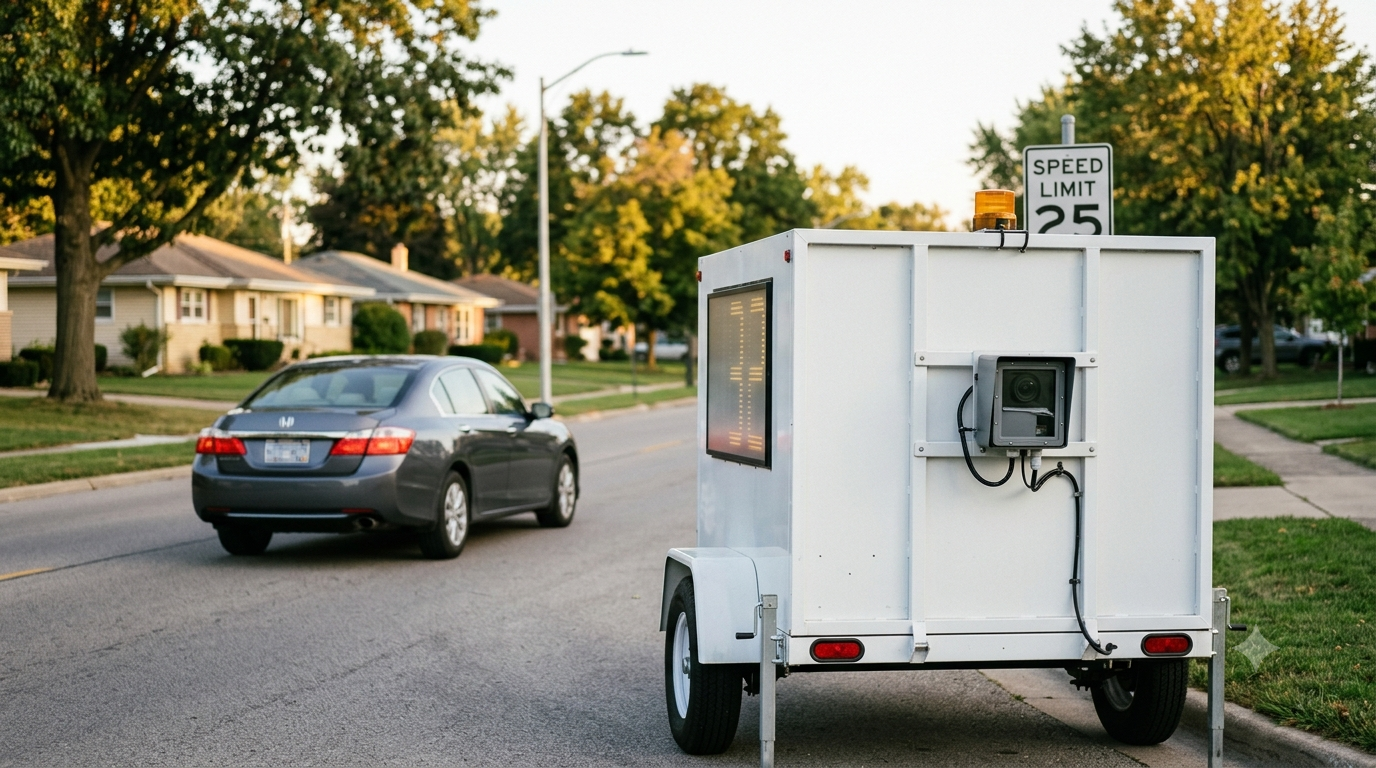
A recently circulated video appears to show an automatic license plate reader mounted on the rear of what many drivers might assume is simply a mobile speed-display sign.
The video raises an important question: Should residents be clearly informed when a device that displays vehicle speed is also recording license plates, vehicle images, locations, and timestamps?
Flock Safety officially markets a speed-feedback trailer that combines vehicle recognition with a speed display. Therefore, the concern is not whether the technology exists. The real concern is whether drivers and residents understand the full function of the equipment placed in their neighborhoods.
Video context: A circulating video shows what appears to be an ALPR camera installed on the back of a mobile speed-display device. It should be evaluated as a call for transparency, not as proof of unauthorized activity.
For boards already comparing vendors, PLACA.AI’s Flock Safety alternatives for HOA communities hub provides a practical framework for evaluating ownership, privacy controls, retention, and private-property workflows.
Can a Speed-Display Sign Also Read License Plates?
Yes. Some mobile speed trailers combine speed monitoring with automatic license plate recognition. Flock Safety describes both a message-and-speed trailer and a speed-feedback trailer that pair vehicle recognition with speed feedback.
An automatic license plate reader, commonly called an ALPR or LPR, can capture a vehicle’s plate number together with the date, time, location, and vehicle image. These systems may be installed on poles, police vehicles, mobile trailers, streetlights, or other roadside equipment.
A driver may see a speed number displayed and reasonably believe the device has only one function: encouraging drivers to slow down. If the same equipment is also operating as a license plate reader, residents deserve clear answers about:
- What information is being collected
- Who authorized the installation
- Who can search the records
- Whether information is shared outside the community
- How long the records are retained
- Whether every search is logged and audited
- Whether visible notice is provided
The Issue Is Transparency, Not the Camera Alone
License plate recognition can be an effective security tool. It can help document vehicles entering a neighborhood, identify unauthorized vehicles, support investigations, and improve gate or parking operations.
The technology itself is not necessarily the problem. The problem begins when people do not understand that they are being recorded, do not know who controls the information, or cannot determine where their vehicle data may be shared.
Flock Safety states that customers control their data, sharing is customer-directed, the default LPR retention period is generally 30 days, every search is logged, and its ALPR cameras do not use facial recognition. Those statements should be considered when evaluating the system.
Communities should still evaluate the complete governance structure—not only camera specifications or vendor assurances.
Why Communities Are Asking More Questions
Across the country, communities are reconsidering how license plate readers are deployed, shared, and governed.
In July 2026, Boulder was reviewing proposals that could replace its existing Flock Safety system amid concerns over nationwide data-sharing practices. The City of Boulder had previously announced a competitive bid and a data-governance task force to balance public safety, technology, privacy, and community values.
That same month, Windsor and Killingworth, Connecticut, decided to end their Flock contracts after debates concerning privacy, external access, cost, and control of locally collected vehicle information.
Supporters emphasize that ALPR systems can assist with stolen vehicles, burglaries, missing persons, and serious criminal investigations. Critics remain concerned about misuse, broad sharing, insufficient public notice, and the ability to reconstruct a person’s movements over time. Both concerns deserve serious consideration.
The correct question is not simply, “Do license plate cameras help solve crimes?” The more complete questions are: Who controls the system, who can access it, and what protections prevent it from being used beyond its approved purpose?
This Is Exactly Why PLACA.AI Was Created
PLACA.AI was designed around a different operating model: community-controlled license plate recognition for defined private-property security purposes.
Our objective is not to connect every neighborhood camera to a broad surveillance network. Our objective is to give HOAs, gated communities, apartment properties, schools, parking operators, and private organizations an LPR system they can govern themselves.
With PLACA.AI:
- The property or community controls its vehicle records
- Access is limited to authorized account users
- User activity can be logged and audited
- Retention can be configured according to the customer’s policy
- Information is not automatically contributed to a national law-enforcement network
- Cameras can support private-property security, gate access, parking, and vehicle-management workflows
- Communities can establish their own written rules for access and disclosure
PLACA.AI’s mission is to provide useful security technology without requiring communities to surrender control of their information.
Visible Cameras Build More Trust Than Hidden Functions
PLACA.AI recommends visible disclosure when license plate recognition is being used. Local laws vary, but clear signage is a practical way to build resident trust and demonstrate that the system is being operated for a defined purpose.
Residents should not have to inspect the back of a speed trailer to determine whether their license plates are being recorded.
A privacy-conscious deployment should clearly communicate:
- That license plate recognition is in use
- The purpose of the system
- Who administers it
- How long records are retained
- How residents can ask questions or raise concerns
- Under what circumstances information may be disclosed
Transparency is not an obstacle to security. It is part of responsible security.
What HOA Boards Should Ask Before Selecting an LPR Vendor
Before approving Flock Safety or any alternative license plate recognition system, request written answers to these questions:
- Does the community own or lease the cameras?
- Does the community control the collected data?
- Can outside agencies search the data directly?
- Is sharing automatic, optional, request-based, or legally compelled?
- Can administrators see a complete access log?
- Can retention be shortened?
- What happens to the data when the contract ends?
- Will visible LPR signage be installed?
- Can the system integrate with gates, visitor records, permits, or parking enforcement?
- Can the board disable individual users immediately?
The best Flock Safety alternative is not simply a less expensive camera. It is a system with a governance model that matches the community’s privacy expectations.
Frequently Asked Questions
Is a Flock Safety speed trailer also a license plate reader?
Flock Safety offers trailer configurations that combine speed feedback with vehicle recognition. Communities should confirm the exact configuration being deployed and how its LPR function will be disclosed to drivers.
Are license plate readers the same as facial recognition?
No. License plate readers identify and record vehicles and plate numbers. Flock Safety states that its ALPR cameras do not use facial recognition.
Can an HOA use license plate recognition without joining a police network?
Yes. A private LPR platform can restrict access to users authorized by the property or HOA and operate without automatically contributing records to a broader law-enforcement network.
What makes PLACA.AI a Flock Safety alternative?
PLACA.AI offers solar-powered and cellular-connected LPR options while emphasizing private-property workflows, camera ownership options, community-controlled access, configurable retention, and integration with gates, parking, permits, and property operations.
Security Without Surrendering Community Control
The video should start a constructive discussion—not panic, vandalism, or hostility toward security technology.
License plate recognition can protect communities when it is deployed responsibly. Responsible deployment requires clear notice, limited access, auditability, defined retention, and accountable local control.
That is why PLACA.AI exists: to provide security technology that serves the community operating it—not an unseen network beyond it.
Compare Your Current LPR System
Is your HOA currently using Flock Safety or considering a new license plate camera system?
Request a privacy-first HOA security assessment from PLACA.AI to compare:
- Camera ownership
- Monthly and long-term cost
- Data access
- Retention policies
- Law-enforcement sharing
- Solar and cellular deployment
- Gate and parking integrations
Protect the neighborhood. Control the data. Maintain resident trust.