

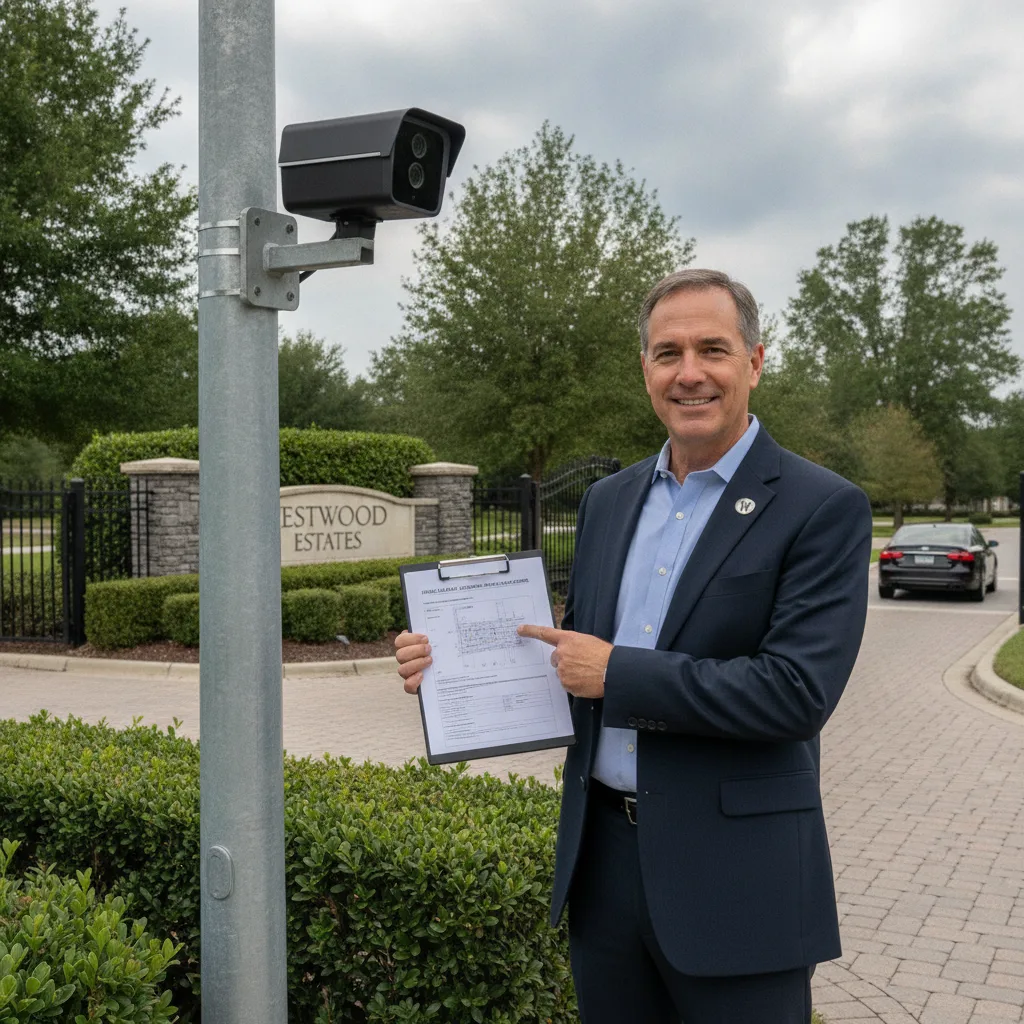
Direct answer: Camera ownership must be answered from the current written proposal and contract. Compare title to hardware, installation assets, replacement, warranties, connectivity, maintenance, removal, data export, renewal, and end-of-term responsibilities line by line. Record the accepted result and the reason for every correction before expanding the process.
This guide is for HOA boards, property managers, finance committees, procurement reviewers, and privacy advisers and addresses comparing camera ownership between Flock Safety and PLACA.AI proposals. Adjacent use cases may need different authority, evidence, or controls.
Set the narrow outcome
A sales phrase such as included hardware or customer-owned camera can hide who pays for replacement, supports the device, restores the site, or retains usable equipment after cancellation.
Example: A board should distinguish owning a camera from owning the mount, network equipment, installation work, software rights, and responsibility to remove everything at contract end.
Camera ownership contract matrix
| Decision point | Evidence or control | Required response |
|---|---|---|
| Title and payment | owner during term and after final payment | cite contract section |
| Maintenance and replacement | failure, damage, warranty, service labor | assign cost and response |
| Site assets | mounts, power, network, permits, restoration | identify each component |
| Contract exit | removal, continued use, data, access, fees | model closeout |
Move from rule to action
- Step 1. For title and payment, verify owner during term and after final payment and then cite contract section.
- Step 2. For maintenance and replacement, verify failure, damage, warranty, service labor and then assign cost and response.
- Step 3. For site assets, verify mounts, power, network, permits, restoration and then identify each component.
- Step 4. For contract exit, verify removal, continued use, data, access, fees and then model closeout.
Test the least convenient case, not only the happy path.
Correction and escalation
Vendor terms change. Do not state ownership from marketing copy or another customer’s agreement; review the actual signed documents with qualified advisers.
Correct the record, approve a bounded exception, deny under the written rule, or escalate to the named authority; do not leave the case unresolved.
Measure the live process
Run a limited test long enough to observe the recurring pattern and at least one correction or fallback.
- hardware components with named owners
- replacement costs assigned
- unpriced site work remaining
- exit tasks with accountable parties
- contract statements verified in writing
Define who counts each measure, the observation window, and the result that blocks expansion.
Owner sign-off
- State the purpose and non-goals for comparing camera ownership between Flock Safety and PLACA.AI proposals.
- Assign owners for the normal path, correction, exception, and final approval.
- Test live conditions with the people who administer and experience the workflow.
- Confirm contracts, pricing, support, integrations, data handling, and governing requirements independently.
- Retain enough evidence to reproduce each approval, denial, correction, or escalation.
Related PLACA.AI planning resources
Decision questions
What must be approved first for comparing camera ownership between Flock Safety and PLACA.AI proposals?
Approve the purpose, owner, evidence standard, decision rule, and exception path before scaling.
What should the pilot reproduce?
Test the normal process and the named exception while collecting hardware components with named owners and the other listed measures.
When should rollout stop?
Stop when ownership is unclear, required evidence is missing, a serious exception lacks a safe route, or the result conflicts with the approved rule.
Plan a limited workflow review
Bring the current rule, process, exceptions, and success criteria for comparing camera ownership between Flock Safety and PLACA.AI proposals. PLACA.AI can help evaluate a bounded pilot without assuming another property’s workflow is the right answer.
Editorial refresh: July 22, 2026. Independently confirm current product capabilities, third-party features, pricing, contracts, governing requirements, and local rules before acting.
Data source: National Center for Education Statistics