

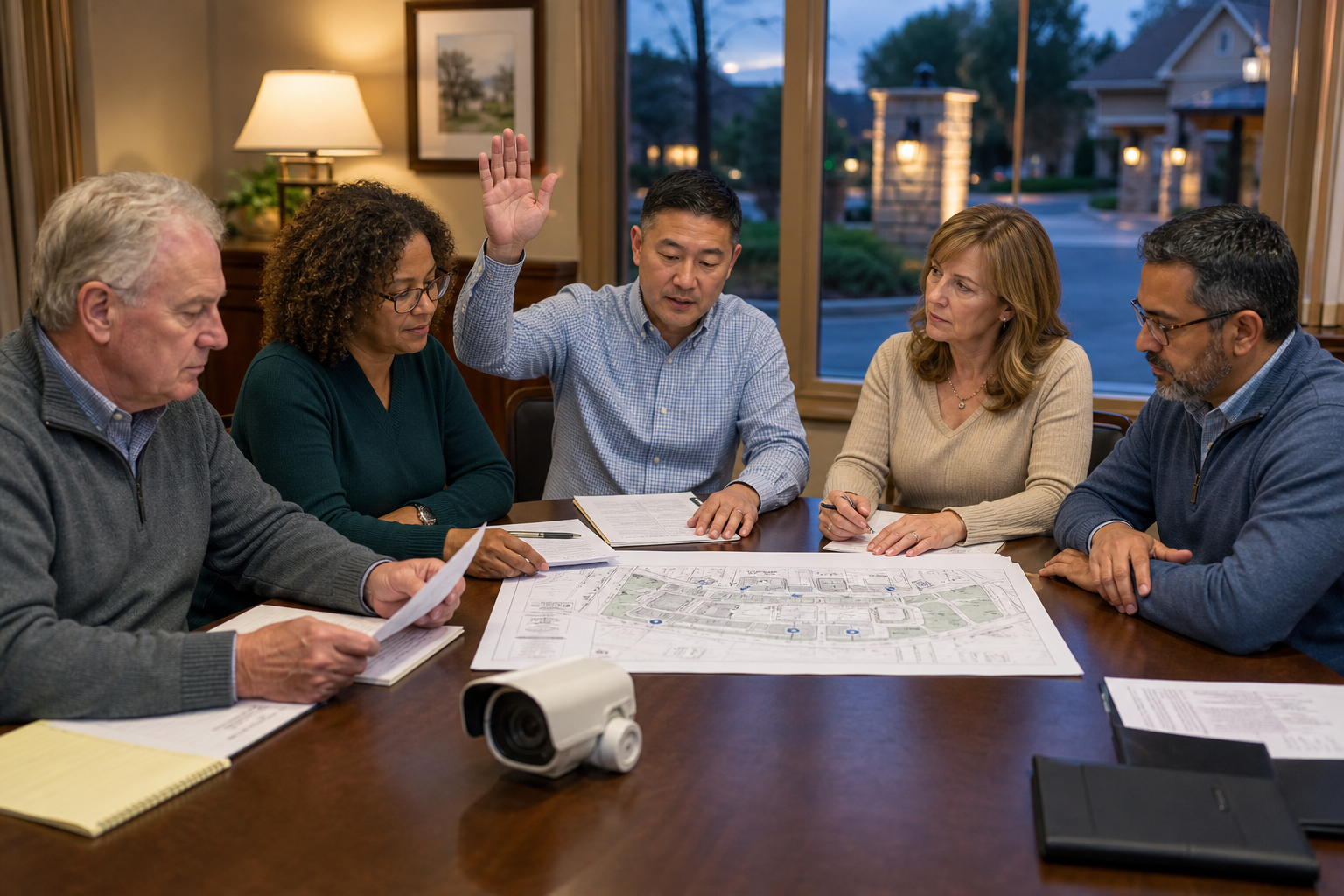
An HOA should not install ALPR cameras on a casual board motion. Use an HOA ALPR board resolution when the governing documents let the board act, and consider a resident vote or documented survey when the project changes common-area use, creates major privacy concern, requires a special assessment, or grants police access.
Key Takeaways
- The approval process is a governance decision first and a camera purchase second.
- A board resolution should define purpose, locations, data collected, access roles, retention, sharing, audit logs, signage, and review cadence.
- Member approval may be prudent or required when documents, assessments, common-area changes, or local rules demand it.
- Fresh July 2026 HOA guidance warns boards not to approve ALPR cameras without explaining limits and safeguards.
- Resident concerns should be answered with policy language, not broad claims that the camera is harmless or guaranteed to stop crime.
What This Workflow Involves
This workflow gives an association a clean approval path before license plate reader cameras go live. The board starts with the authority question: does the declaration, bylaws, state statute, local rule, easement language, or budget process allow the board to approve the system on its own, or does the decision need member approval?
The board then separates four decisions that often get blended together. First, where will cameras be installed? Second, what data will be collected? Third, who can search or receive that data? Fourth, what decision record will show that the board considered privacy, cost, access, retention, and resident communication before installation?
The deliverable is not just meeting minutes. It is a written decision packet: vendor quote, camera map, purpose statement, resident notice, data-use policy, approval record, legal review notes, and a launch checklist. That packet gives management, residents, counsel, and future board members a single source of truth.
Why This Problem Is Showing Up Now
On July 27, 2026, Law Firm Carolinas published guidance noting that homeowner and condominium associations are increasingly considering ALPR cameras and should expect owner concerns about privacy, access, and whether residents were told enough before a decision. The article advised associations to adopt a written policy before installation and said a board may wish to survey owners or seek member approval depending on the circumstances.
Public governance pressure is visible outside HOAs as well. The Houston Chronicle reported on July 27, 2026 that two Conroe, Texas council members apologized and planned to revisit whether the city’s Flock Safety camera program should go to a public vote after resident privacy concerns and a petition. A city ballot process is not the same as an HOA vote, but it shows why camera decisions can become legitimacy questions when people believe the approval path was unclear.
A June 2026 Brambleton Community Association report on HOA ALPR programs also recommended early stakeholder involvement, public-facing policy language, resident surveys or meetings, and making the policy available before considering a resident vote or board resolution. That source is an association-specific example, not universal legal advice, but it maps closely to the operational problem boards are facing.
The Core Operational Problem
The core problem is that residents and boards often argue about different questions. A board may ask whether a camera can help with vehicle thefts, trespassing, illegal dumping, gate damage, or parking issues. A resident may ask whether the association is creating a searchable record of when owners leave, return, or receive visitors. Both questions are legitimate.
If the board answers privacy concerns with only a safety promise, trust drops. If opponents frame every camera as general surveillance, the board may lose sight of narrower private-property uses such as entry records, visitor vehicle review, or parking authorization. A formal approval workflow forces the association to define what the system is for and what it will not be used for.
Use PLACA.AI’s HOA license plate recognition camera planning guide to assess placement and operational fit, but treat approval authority as a separate governance checkpoint.
HOA ALPR Board Resolution Checklist
| Resolution item | Decision to document | Why it matters |
|---|---|---|
| Purpose | Vehicle access, parking administration, incident review, or law-enforcement support | Prevents the system from drifting into unrelated uses |
| Camera locations | Entrances, exits, private roads, clubhouse lots, gates, or parking areas | Shows whether the association controls the installation point |
| Data collected | Plate image, vehicle image, plate text, state, date, time, location, make, color | Lets residents understand what record exists |
| Access roles | Manager, board officer, security vendor, police agency, or limited administrator | Limits casual searching and role creep |
| Retention | Default deletion period and exception hold rules | Reduces unnecessary long-term vehicle history |
| Sharing | No sharing, case-by-case sharing, local police access, or broader network access | Sets the boundary residents care about most |
| Oversight | Audit log review, complaint path, annual renewal review | Creates accountability after launch |
When A Board Resolution May Be Enough
A board resolution may be enough when the governing documents give the board authority over common-area equipment, the expense fits the approved budget, cameras are located on association-controlled property, data use is narrow, law-enforcement sharing is either disabled or tightly governed, and residents receive clear notice before operation.
Even then, the resolution should not be a single sentence approving a quote. It should attach or reference the policy, camera map, vendor agreement, retention rule, search authorization standard, signage plan, and date for the first audit or board review. The board should also record that counsel reviewed authority, privacy, signage, and contract terms where appropriate.
When Member Approval Or A Survey Is Safer
Member approval, a documented resident survey, or a town-hall process becomes more important when the system is controversial, the cost requires a special assessment, the cameras alter common-area use, police will have direct access, outside agencies may be able to search the data, or state or local law creates special rules for private ALPR operators.
A survey is not always a binding vote. It can still help the board understand objections, fix policy gaps, and avoid approving a system residents believe was hidden from them. If the governing documents require a formal member vote, the board should follow that process rather than treating survey support as a substitute.
Boards comparing Flock, PLACA.AI, or another provider should use the same approval standard. PLACA.AI’s Flock Safety alternatives for HOA communities page can help with vendor comparison, but no vendor comparison removes the need for a written association decision.
Evidence And Source Context
The July 2026 Law Firm Carolinas article described ALPR systems as more than traditional security cameras because they create searchable records by plate, vehicle description, date, or time. It also noted concerns around misuse, cybersecurity, law-enforcement access, vendor access, and sharing.
The Brambleton HOA report recommended stakeholder involvement, policy and MOU development, conservative data governance, community transparency, signage, and regular legal or vendor-policy updates. It also described examples of retention limits, audit logs, and restricting law-enforcement access to the intended agency or purpose.
Flock Safety’s License Plate Reader Policy, last updated June 30, 2026, lists LPR data categories such as plate image, vehicle image, vehicle characteristics, plate number, plate state, date, time, and camera location. It says customer LPR data is owned by the customer, encourages customer use policies and audits, and describes a default rolling 30-day deletion period. A board should verify these points in the signed contract and configured settings.
Risks, Limits, And Exceptions
This is not legal advice. Approval authority varies by state, declaration, bylaws, condominium act, nonprofit corporation law, easements, city permitting, and the way the system will be funded. Counsel should review the association’s documents before any final vote.
The board should also avoid overpromising. ALPR cameras can support vehicle-event review, but they do not prove who was driving, identify every person near a common area, or replace a complete security plan. If the association needs broader video coverage, gate credentials, lighting, patrol procedures, or parking rules, those should be addressed separately.
Resident notice should be specific without being alarmist. Say what is collected, where, why, how long it is kept, who may access it, when it can be shared, and how residents can ask questions. Do not say the system has no privacy implications just because license plates are visible from a road.
Worked Example: Gated HOA Considering Police Access
A 220-home gated HOA wants cameras at two entrances after several vehicle break-ins and pool-lot dumping incidents. The first proposal is a vendor quote with four cameras and direct local police access. The board has budget room, but several residents object because the policy does not say whether data will be searched for HOA rule enforcement.
A rushed vote would create an avoidable dispute. A better path is to pause the purchase and prepare a resolution packet. The packet states that cameras will be used for entrance records and reported incidents, not routine covenant enforcement. It limits access to the manager and a named local police agency, sets a short retention period, requires audit-log review, publishes signage language, and schedules a six-month review.
If counsel confirms that the board has authority and the cost fits the budget, the board may approve the resolution after resident notice. If the documents require member approval for this equipment, if the cameras sit outside association property, or if the board wants broader police-network sharing, the board should use the more formal owner-approval path.
Frequently Asked Questions
Does every HOA need a member vote before installing ALPR cameras?
No. Some boards may have authority to approve common-area equipment through a board resolution. Others may need member approval because of governing documents, cost, location, assessments, or local law. The board should verify authority before treating a resolution as enough.
What should residents receive before the vote or resolution?
Residents should see the purpose, camera locations, data collected, retention period, access roles, sharing rules, complaint path, signage plan, and whether the system will or will not be used for HOA covenant or parking enforcement.
Should the board let police search HOA ALPR data directly?
Direct access may fit some communities, but it should be a deliberate policy choice. The board should define the agency, permitted uses, audit logs, retention, revocation rights, and whether broader network sharing is disabled or allowed.
Can an HOA use ALPR data for parking enforcement?
Possibly, if the governing documents, resident notice, privacy policy, and enforcement procedures allow it. If the original purpose was security or police support, the board should not quietly repurpose the system for parking enforcement without revisiting the policy.
How should PLACA.AI be compared in this process?
Compare PLACA.AI against the same resolution packet: camera fit, private-property workflow, resident notice, retention, access controls, police-sharing options, parking or gate use cases, support expectations, and exit plan.
Related PLACA Resources
- Start with the HOA license plate recognition camera planning guide for camera placement and private-community use cases.
- Use resident-facing vehicle access and parking workflows when the board needs resident communication and adoption planning.
- Review HOA LPR without police data sharing if the community wants private-property control without a broad law-enforcement network.
- Compare alternatives through Flock Safety alternatives for HOA communities when contract, ownership, or sharing terms drive the decision.
Next Step
Before approving a camera quote, ask management and counsel for a one-page authority memo, camera map, draft ALPR policy, resident notice, and vendor data-sharing summary. Then decide whether the association needs a board resolution, member vote, survey, or a postponed decision.