

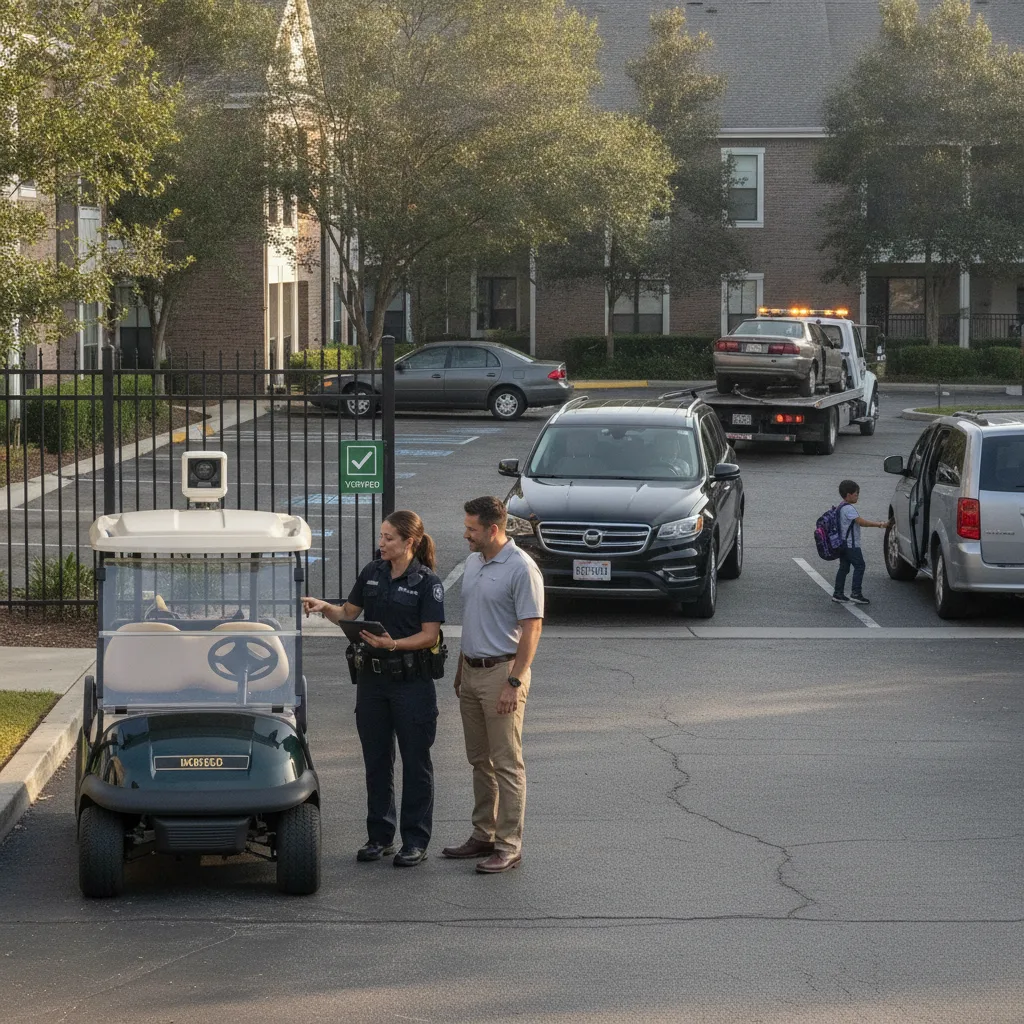
Direct answer: The evidence that protects an apartment community from a resident chargeback or a “my guest pass was valid” dispute is different from what a street-facing lot needs — you need the unit tied to the vehicle, the permit or guest-pass status at the moment of the photo, and proof the space or fire lane rule actually applied. Get those three linked in one record and most post-tow disputes resolve in minutes instead of becoming a leasing-office fight.
This is written for on-site enforcement staff and courtesy patrol at apartment and multifamily communities — the people who have to explain a tow to an angry resident the next morning, not just execute it the night before.
Why apartment tows generate more disputes than open-lot tows
On a public-facing commercial lot, a violation is usually simple: no permit, no receipt, wrong zone. At an apartment community, almost every dispute has a human relationship behind it — a resident insists they had a guest pass, a leasing office swears a spot was reassigned, a tenant claims maintenance told them it was fine to park there temporarily. Photo evidence that would close the case instantly on a retail lot often isn’t enough here, because the real question isn’t “was the car there” — it’s “was this specific resident or guest authorized for this specific spot on this specific day.”
That means your evidence needs to answer ownership and authorization, not just presence.
What to capture, in order
1. Unit and space identifier together
If the community uses assigned or numbered spaces, get a photo that shows the space number or marking alongside the vehicle — not just the plate. If it’s unassigned resident or guest parking, capture the zone signage (visitor parking, resident-only, no overnight guest parking) in the same frame as the vehicle.
2. Permit, hangtag, or guest-pass status as it existed at the time
Photograph any visible permit, hangtag, or guest pass in the vehicle — even if it looks expired or wrong. “No permit visible” and “expired permit visible” are different findings and residents will ask which one applied. If your community issues digital guest passes, note the vehicle and time so the office can cross-check the registration log rather than taking a resident’s word after the fact.
3. Duration or dwell-time proof, if the rule requires it
Many community rules only kick in after a set period (24-hour unauthorized parking, expired temporary pass, abandoned-vehicle status). If your process is chalk-marking tires or logging a first-seen timestamp, make sure that first observation is captured and dated just as carefully as the final one — the gap between the two is often what a dispute turns on.
4. Fire lane and accessibility violations get their own standard
Fire lane, ADA space, and blocked-access violations usually don’t require a dwell-time window and are the fastest, most defensible tows you’ll do — but they also draw the angriest immediate reactions. A wide shot showing the painted curb, the posted sign, and the vehicle’s position removes almost all room for argument.
Linking the vehicle to a resident record
The step that separates a clean apartment tow from a messy one is connecting what you captured in the field to whatever system the property manages residents, guests, and permits in. A plate scan that just sits in a phone’s photo roll doesn’t help the leasing office answer a resident’s call the next day. If your mobile LPR workflow can flag a plate against a known resident or guest list at the point of capture — rather than after the tow truck has already left — you catch a surprising number of false positives before they become a dispute: a resident who re-registered a new car and didn’t update the office, or a guest pass that was issued but never synced to the list you’re checking against.
When to hold off
- A permit or pass is present but you can’t confirm its status in the field — hold and route to the property contact rather than guessing
- There’s any sign the vehicle belongs to a resident who just moved in or recently changed vehicles
- The space or zone signage itself is missing, faded, or was recently changed and residents may not have been renotified
- It’s a fire lane or accessibility call in a spot residents routinely use temporarily for loading — a quick check with the office can avoid an unnecessary tow and an unnecessary fight
None of these should turn into an indefinite delay — they’re a quick routing step to a named property contact, not a reason to leave the vehicle undocumented.
Keeping the leasing office out of the blind spot
The most common breakdown isn’t bad evidence in the field — it’s evidence that never reaches the people who field the resident’s call. If patrol staff and the property office aren’t looking at the same record, the office ends up promising a resident something patrol can’t verify, or disputing a tow patrol can actually defend. Centralizing captures so the office can pull up the photo, timestamp, and permit status the moment a resident calls in shortens most disputes from a multi-day back-and-forth to a same-call resolution.
FAQ
Do we need to photograph the permit even if it’s clearly expired?
Yes. “Expired permit visible” is a stronger, more specific record than “no permit,” and it heads off the resident claim that they simply forgot to display a valid one.
How should guest parking violations be handled differently from resident violations?
Guest violations usually need the vehicle tied to a registered guest pass or the absence of one — check the community’s guest log before towing, since a valid pass that wasn’t visible in the vehicle is a common false alarm.
What’s the fastest way to reduce disputed apartment tows?
Get patrol’s field evidence and the leasing office’s resident/permit records into the same system so a phone call the next morning can be resolved by looking, not by guessing.
Related reading
- Mobile LPR planning guide
- Parking enforcement software for towing companies
- Parking enforcement LPR software overview
If your community’s patrol evidence and leasing office records live in different places, PLACA.AI can show you what a connected mobile LPR workflow looks like for multifamily enforcement — get in touch or book a demo.
Data source: U.S. Department of Transportation