

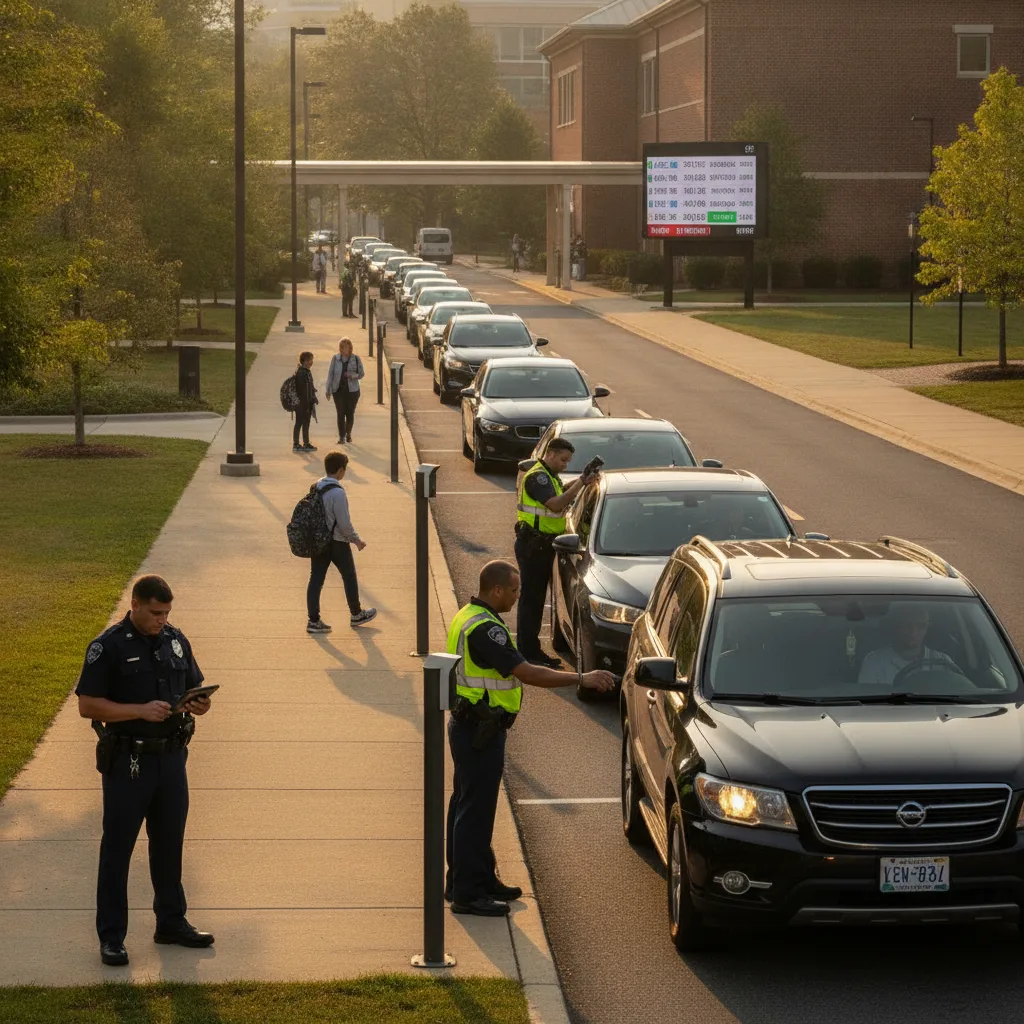
Direct answer: The late-dismissal window is a campus safety blind spot precisely because it’s when supervision thins out fastest — the main carline crew has stood down, buses are gone, and a handful of students are still waiting with reduced staff coverage. Campus safety teams should treat the late window as a defined, monitored zone with its own access control: a single supervised holding location, a requirement that every vehicle approaching after the main dismissal wave is visually confirmed against the authorized pickup list, and an explicit trigger for when an unmatched vehicle or unfamiliar adult escalates to a safety response instead of a front-office judgment call.
This guide is for campus safety teams, school resource officers, and the administrators who coordinate with them during the last part of dismissal — after the main carline has cleared but before every student is accounted for.
Why the tail end of dismissal is higher risk than the middle
During peak dismissal, there’s safety in numbers and structure: multiple staff watching the carline, a steady flow of expected vehicles, and enough eyes on the lot that an unfamiliar car stands out. Once the bulk of students have left, that structure collapses. Staffing drops to whoever’s covering the late window, the parking lot empties out enough that a single unfamiliar vehicle can loiter without immediately drawing attention, and the students still waiting are, by definition, the ones without a confirmed ride yet — which is exactly the population an unauthorized pickup attempt would target. Campus safety plans that focus entirely on peak-dismissal traffic control often have little to say about this tail-end window, even though it’s operationally the more exposed period.
Late-window access control checklist
| Element | Standard during late window | Escalation trigger |
|---|---|---|
| Vehicle approach | Every vehicle after the main wave is visually matched against the authorized pickup list before a student is released | Vehicle or plate doesn’t match any record on file |
| Holding location | One fixed, supervised, visible location — not scattered across the building | A student is unaccounted for at a scheduled headcount |
| Unfamiliar adult | Checked against the authorized list regardless of how confident staff feel recognizing them | Adult isn’t on the list and can’t be verified through a supervisor or emergency contact |
| Loitering vehicle | Vehicle present without an active pickup in progress is noted and time-stamped | Vehicle remains after a defined time threshold with no match |
Where school resource officers fit into a low-staff window
Most campuses don’t have an SRO stationed specifically at the late-pickup holding area — they’re typically covering the broader campus or responding to whatever’s active elsewhere. That means the late window usually runs on front-office or dismissal staff, with the SRO as an escalation resource rather than a constant presence. The plan needs to reflect that reality: front-office and dismissal staff need a clear, low-ambiguity signal for when to call the SRO in rather than handle a mismatch themselves, and the SRO needs to trust that signal enough to respond quickly rather than treating every late-window call as a false alarm. A vague “let us know if something feels off” instruction doesn’t hold up under real conditions — the trigger needs to be specific: unmatched vehicle, unverifiable adult, or a student unaccounted for at headcount.
Coordinating the late window with your emergency plan, not just dismissal
The late-dismissal window and an actual emergency response share more infrastructure than schools often plan for. If your campus has to shift into a lockdown or shelter-in-place procedure during the exact window when the fewest staff are covering the fewest students, the same holding-location and headcount logic used for late pickup should extend into that response rather than requiring staff to switch mental models mid-crisis. Reviewing your emergency dismissal drill procedure alongside your late-window plan is worth doing specifically because both scenarios rely on the same core skill: knowing, by name, exactly who is unaccounted for and where they last were.
What to log every time the late window activates
- Every vehicle or adult that required verification beyond a routine match
- Any vehicle present without an active pickup, and how long it stayed
- Time from student flagged as late to confirmed release or supervised transfer
- Any escalation to an SRO or administrator, and the outcome
- Students unaccounted for at any scheduled headcount, however briefly
Patterns matter more than single incidents here — a loitering vehicle once might be nothing, but the same vehicle showing up during the late window on multiple afternoons is worth a direct conversation before it becomes a bigger problem. If your team is also coordinating custody-related pickup restrictions during this window, a documented process for handling split-custody situations keeps that from being improvised on the spot by whoever’s covering the holding area that day.
Before the plan goes into your safety procedures
- Confirm who staffs the late window and what their authority is to deny release without a supervisor present.
- Confirm the specific, low-ambiguity trigger for escalating to an SRO or administrator.
- Confirm the holding location is visible and supervised, not a spot chosen for convenience.
- Confirm loitering-vehicle logging is actually happening, not just written into the policy.
- Confirm the late-window plan connects to your broader emergency response rather than existing as a separate document.
Related PLACA.AI planning resources
Practical questions
Who has authority to deny a release during the late window?
Whoever is staffing the holding area should be able to deny a release outright when a vehicle or adult doesn’t match, without needing a supervisor to confirm the denial in real time — only the override to release should require a second check.
How long should a loitering vehicle be tolerated before escalation?
Set a specific time threshold in advance rather than leaving it to judgment in the moment — most campuses land somewhere in the few-minutes range, but the number matters less than having one everyone knows.
Does the late window need its own written procedure, or is the main dismissal plan enough?
It needs its own section at minimum. The staffing, visibility, and risk profile are different enough from peak dismissal that folding it into the main plan usually means it gets skipped over during training.
Plan a limited workflow review
Bring your current late-window staffing plan, escalation triggers, and SRO coordination process. PLACA.AI can help evaluate whether automated vehicle matching at the late-pickup point reduces how often staff have to make an identity call without support.
Editorial refresh: September 18, 2026. Independently confirm current product capabilities, third-party features, pricing, contracts, governing requirements, and local rules before acting.
Data source: National Center for Education Statistics