

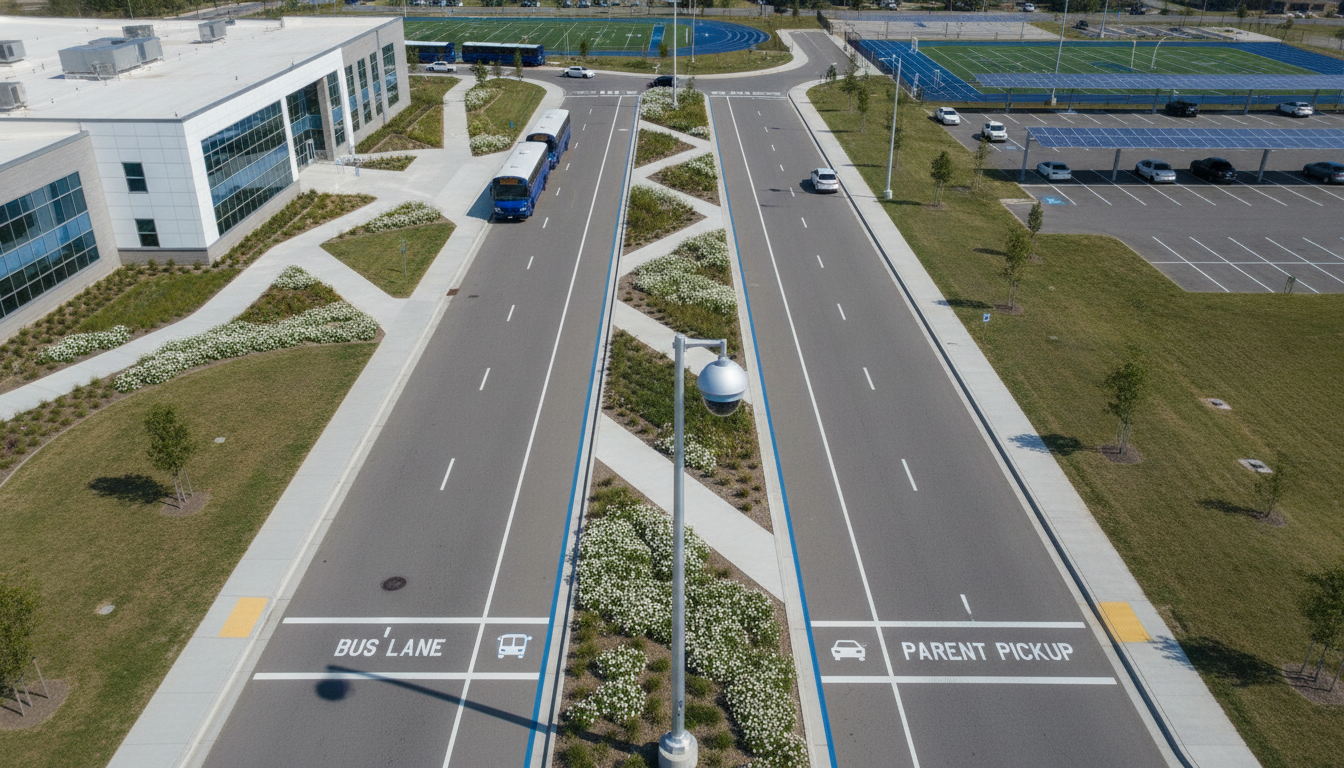
Direct answer: When buses and cars share an approach, a crossing, or a loading curb, campus safety teams are managing two different risk profiles at once: a scheduled, fixed-route vehicle that can’t easily stop mid-maneuver, and a stream of parent vehicles with unpredictable timing and, occasionally, an unauthorized driver trying to blend into a crowded lot. The fix is physical and procedural separation — distinct approach paths for buses and cars wherever the site allows it, a defined crossing point staffed during the overlap window, and a specific escalation trigger for any vehicle that enters the wrong lane or lingers near the bus zone without an active pickup.
This guide is for campus safety teams responsible for the physical safety of the mixed-traffic window at dismissal — not for traffic flow efficiency on its own, but for the safety risk that shared space creates.
Why mixed traffic is a safety problem, not just a congestion problem
A slow carline is an inconvenience. A carline that shares pavement, a curb cut, or a crossing with active bus traffic is a different kind of problem entirely, because the failure mode isn’t just delay — it’s a car pulling into a bus loading zone, a student crossing between a stopped bus and a moving car, or a driver unfamiliar with campus rules cutting through a lane reserved for bus maneuvering. Buses also have blind spots and turning radii that a compact car doesn’t, which means a shared approach that “mostly works” on a normal day can fail badly the one day traffic is heavier than usual or visibility is reduced. Campus safety teams should treat any point where bus and car paths cross or merge as a standing risk to manage, not a layout quirk to tolerate.
Where to physically separate, and where staffing has to cover the gap
| Conflict point | Preferred fix | If physical separation isn’t possible |
|---|---|---|
| Shared entrance or driveway | Separate approach paths for buses and cars from the street | Staffed control point directing traffic by vehicle type during the overlap window |
| Pedestrian crossing near the bus loop | Crossing routed away from active bus lanes entirely | Dedicated crossing guard present for the full duration of bus loading, not just peak minutes |
| Loading curb | Physically distinct curb zones for buses and cars | Clear, enforced boundary with a staff member positioned to intercept a car pulling into the bus zone |
| Overflow or visitor lot | Routed so overflow never crosses the active bus path | Logged monitoring of any vehicle lingering near the bus zone without an active pickup |
The unauthorized-vehicle risk that mixed traffic creates
Beyond the direct collision risk, a shared, congested approach is also where an unfamiliar or unauthorized vehicle is easiest to miss. In a clean, separated flow, a car that doesn’t belong stands out — it’s driving where cars shouldn’t be, or lingering somewhere without an obvious reason. In a mixed, congested flow, that same vehicle blends into the general chaos, and staff attention is split between directing traffic and watching for anything unusual. This is one of the more concrete safety arguments for separation: it’s not only about smoother movement, it’s about keeping the visual field simple enough that staff can actually notice a vehicle that doesn’t match the expected pattern. Coordinating this with your broader emergency dismissal drill procedure matters too, since a lockdown or evacuation scenario is exactly when you need bus and car traffic to already be separated rather than trying to untangle mixed traffic under crisis conditions.
Staffing the overlap window realistically
Most campuses can’t fully separate bus and car traffic through construction or redesign — the site is the site. That makes staffing the overlap window the practical fallback, and it needs to be treated as a distinct assignment, not folded into general carline duty. The person covering a shared crossing or control point during the bus-and-car overlap has one job: keep the two streams from conflicting. Asking that same person to also help direct general carline traffic or manage a walk-up window means the actual safety function — watching the conflict point — gets diluted. If your technology-assisted dismissal tools go down during this window, this workflow for bus app or system failures during dismissal is useful specifically because the fallback still needs to keep bus and car separation intact even without the normal tools.
What to log at every conflict point
- Any vehicle that enters a lane or zone reserved for buses
- Any vehicle lingering near the bus zone without an active, in-progress pickup
- Crossing incidents or near-misses, however minor
- Staffing gaps at the control point — was it covered for the full overlap window, or only part of it?
- Days or times when the overlap window runs longer than usual, since congestion elsewhere often shows up here first
Reviewing this log at the start of each semester — not just after an incident — usually surfaces the same one or two recurring conflict points, which is more useful for planning than treating every mixed-traffic risk as equally likely across the whole campus. A quick pass through your pickup line safety checklist alongside this log is a reasonable way to confirm your family-facing guidance and your internal safety procedure are still saying the same thing.
Before you sign off on the current layout
- Confirm every point where bus and car paths cross or merge has either physical separation or dedicated staffing.
- Confirm the person staffing a conflict point has no other competing duty during that window.
- Confirm there’s a specific, written trigger for escalating a vehicle in the wrong lane or lingering near the bus zone.
- Confirm crossing guards or monitors are present for the full bus-loading duration, not just the busiest minutes.
- Confirm this plan is reviewed alongside your emergency response procedure, not as a separate, unrelated document.
Related PLACA.AI planning resources
Questions before expansion
What’s the fastest way to find where bus and car paths actually conflict?
Walk the site during the real overlap window, not from a site map. Layouts that look fine on paper often have a blind corner, a narrow curb cut, or a crossing that only becomes a genuine conflict once both bus and car traffic are moving at once.
How many staff does a shared crossing realistically need?
At least one person whose only job during the overlap window is watching that specific point — not someone splitting attention between the crossing and general carline duty.
Should unauthorized-vehicle monitoring be part of the traffic-separation plan or a separate procedure?
Part of the same plan. A congested, mixed-traffic conflict point is also where an unfamiliar vehicle is hardest to spot, so the staffing and logging for both should be the same effort, not two separate systems.
Plan a limited workflow review
Bring a site map of your current bus and car approach paths and the conflict points your staff already watch for. PLACA.AI can help evaluate whether automated vehicle recognition at shared conflict points reduces how much staff attention is split between traffic direction and unauthorized-vehicle monitoring.
Editorial refresh: September 18, 2026. Independently confirm current product capabilities, third-party features, pricing, contracts, governing requirements, and local rules before acting.
Data source: National Center for Education Statistics