

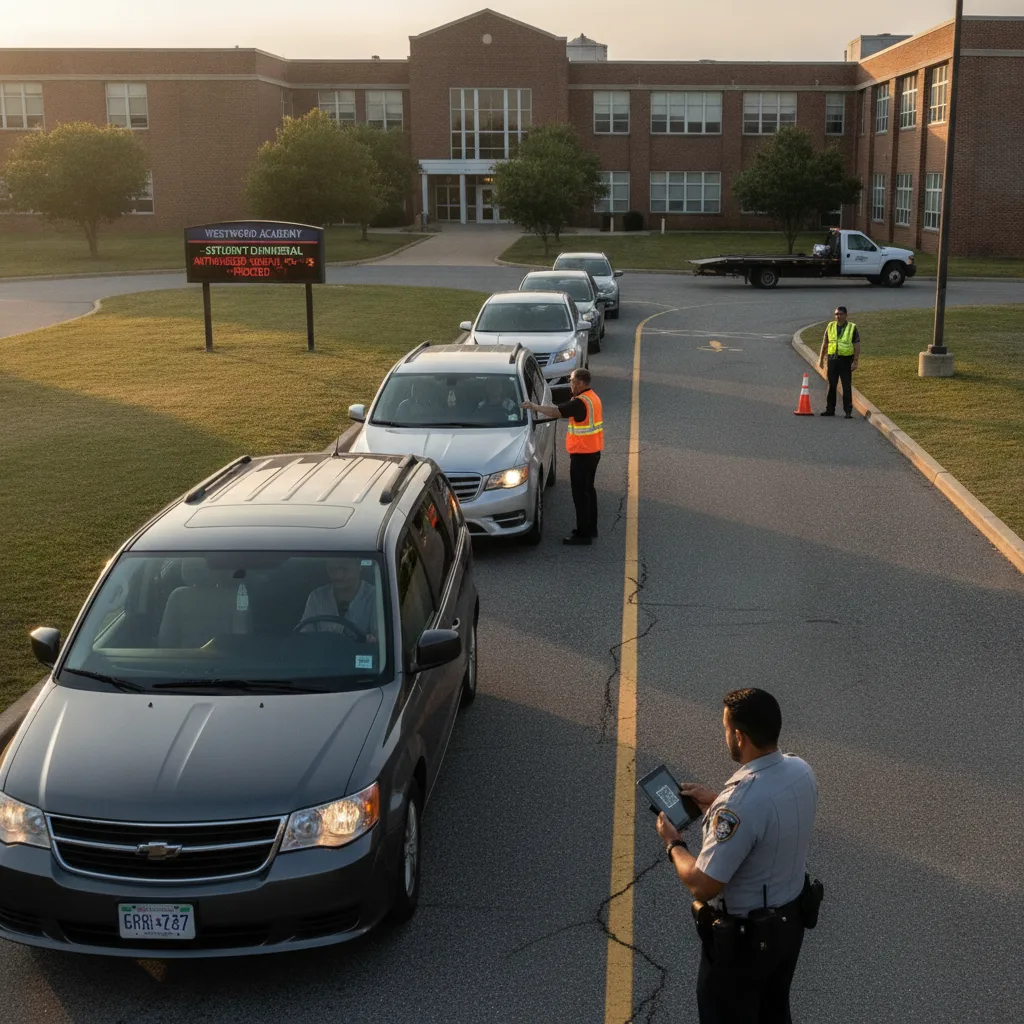
Direct answer: For campus safety teams, a slow pickup line isn’t primarily a throughput problem – it’s an exposure window. A backed-up queue means idling vehicles blocking a fire lane or emergency-vehicle access, staff pulled from their normal posts to help move cars (leaving other entry points unwatched), and more time for a vehicle that isn’t on today’s authorized list to sit in the queue or attempt to merge in unnoticed. Shorten the line by fixing the actual bottleneck – usually identity or readiness verification, not vehicle movement – instead of by skipping checks to move cars faster, and keep camera coverage and a staffed post on the loop itself even when extra hands are pulled in to help with traffic.
This guide is for campus safety officers, school resource officers, and security staff whose job during dismissal is protecting the perimeter and verifying who’s in the loop – not the administrator running dismissal logistics.
Why speed and security pull against each other here
The fastest way to clear a backed-up pickup line is usually to wave more cars through with less scrutiny – which is exactly the wrong direction from a security standpoint. A genuinely faster line comes from removing the actual bottleneck (a student who isn’t ready, a vehicle that needs manual verification because it isn’t recognized, a lane blocked by a car parked instead of moving through), not from relaxing the checks that exist specifically to catch an unauthorized vehicle in the queue.
What a backed-up queue actually exposes
| Risk during a delay | Why it matters to campus safety | What to check |
|---|---|---|
| Blocked fire lane or ADA loading zone | A queue backed up past its intended length uses space reserved for emergency access or accessible loading | Confirm those zones stay clear regardless of how long the main queue gets |
| Posts left unwatched | Pulling staff to help move traffic can leave another entry point or the perimeter unstaffed | Have a plan for which posts can flex to traffic duty and which can’t, decided in advance |
| An unauthorized vehicle in the queue | A long line gives more time and more cover for a vehicle to sit near the loop or attempt to merge in | Keep camera coverage on the full queue length, not just the release point |
| Checks skipped to move cars faster | The fastest fix on a bad day is often the one that removes the safeguard the line exists to enforce | Fix the actual bottleneck instead of loosening verification |
Find the actual bottleneck before speeding anything up
- Watch where the line actually stalls – readiness (student not called or not at the curb yet), identity verification for an unfamiliar vehicle, or simply a car parked instead of loading and moving. Each has a different fix.
- Decide in advance which security posts can flex to help with traffic and which can’t, so a busy dismissal doesn’t improvise away perimeter coverage.
- Keep camera coverage on the full queue, including vehicles waiting outside the loop, not just the point where students are released.
- Coordinate with the local school resource officer or police for street-level traffic control on days the queue is expected to extend onto a public road, rather than pulling campus staff further from their posts.
Where to hold the line, not loosen it
If clearing the queue faster means skipping the identity check on an unrecognized vehicle or waving a car through the accessible loading zone because it’s blocked, the delay caused by holding the check is the safer outcome. Name in advance who has the authority to stop the line entirely for a security concern – an unfamiliar vehicle refusing to identify itself, someone on foot near the queue who shouldn’t be there – and make sure that authority isn’t quietly overridden by pressure to keep cars moving.
What to observe during a trial
- Where in the sequence the queue actually stalls, tracked over several dismissal periods rather than one bad day.
- Whether the fire lane and accessible loading zone stayed clear during the longest queues of the trial.
- Whether any security posts went unstaffed when staff were pulled to help with traffic, and for how long.
- Any vehicle that required manual verification and how long that check took relative to the rest of the queue.
Evidence to retain
- Document which posts flexed to traffic duty on your busiest days and whether that left a gap.
- Keep camera footage retention long enough to review a queue-related incident, per your district’s policy.
- Record any instance where a check was skipped under time pressure, and review it – that’s the failure mode this guide is meant to prevent.
- Confirm any change to loop layout or staffing with the administrator running dismissal logistics before treating it as final.
Related PLACA.AI planning resources
Decision questions
Is a slow pickup line mainly a safety issue or a logistics issue?
Both, but for campus safety specifically it’s the exposure created by the delay – blocked emergency access, unstaffed posts, more time for an unauthorized vehicle to sit in the queue – that matters most, not just how long parents wait.
Should checks ever be relaxed to move the line faster?
No. Find and fix the actual bottleneck – usually readiness or identity verification – instead of loosening the check the line exists to enforce.
What should be decided before, not during, a busy dismissal?
Which security posts can flex to help with traffic and which can’t, who has authority to stop the line for a security concern, and how camera coverage extends across the full queue.
Plan a limited workflow review
Bring your current post assignments, camera coverage of the pickup queue, and any recent incidents tied to a backed-up line. PLACA.AI can help evaluate a bounded pilot without assuming another campus’s security layout is the right fit for yours.
Editorial refresh: September 18, 2026. Independently confirm current product capabilities, third-party features, pricing, contracts, governing requirements, and local rules before acting.
Data source: National Center for Education Statistics