

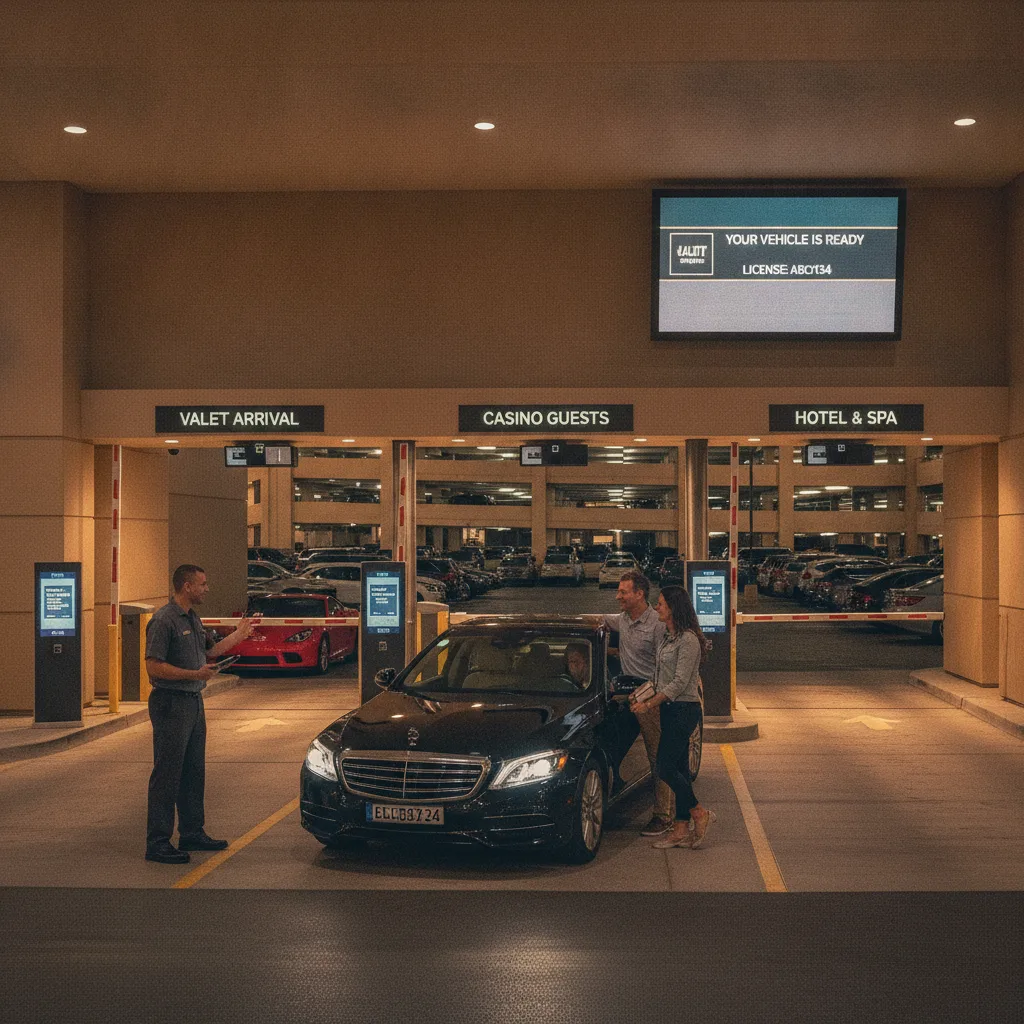
How Casino Parking Teams Can Reduce Guest Wait Time Complaints Using Ticketless Vehicle Recognition
Direct answer: Casino parking teams reduce guest wait time complaints by connecting the valet queue to two systems most other valet operations don’t have to touch: the surveillance department’s camera network and the player-rewards program. A hotel or restaurant valet just needs to get the right car to the right guest fast. A casino valet team also needs that same retrieval to happen inside an environment where every vehicle movement is already being recorded for gaming-compliance reasons, and where a meaningful share of arrivals are rated players a host wants to know about the moment they pull in.
Key Takeaways
- Casino valet queues are shaped by repeat, high-frequency local traffic as much as by hotel-style overnight stays.
- Vehicle recognition data can trigger a player-services alert, not just a retrieval ticket.
- Surveillance and valet operations already share camera infrastructure – the question is whether they share data.
- Retention and access rules for casino vehicle records usually follow gaming-compliance requirements, not general hospitality practice.
Why casino valet queues behave differently
A hotel valet line is mostly one-time or infrequent guests arriving and departing once per stay. A casino valet line includes that traffic, but it also carries a large volume of local, repeat visitors – players who come multiple times a week, sometimes multiple times a day during a promotion period. That repeat traffic changes the shape of the queue: the same plates recur constantly, which means a ticketless system built on vehicle recognition has far more history to work with per guest than a hotel valet stand ever will. Retrieval can get faster over time for a casino’s regulars in a way it can’t for a property where most guests are new each week.
The player-rewards connection
Most casinos run a loyalty or player-rewards program that already assigns tiers – and often a dedicated host – to higher-value guests. A vehicle recognition system that can match an arriving plate to a player account creates a real operational option: notify the host or VIP services team the moment a top-tier player’s car is recognized at the gate, before they’ve even reached the valet stand. That’s a workflow a restaurant or hotel valet team has no equivalent for, because there’s no loyalty-tier host waiting for their arrival – and it turns valet from a pure retrieval function into an early input for guest-services and marketing.
Working inside an existing surveillance environment
Casinos already run one of the densest camera networks of any hospitality environment, operated by a surveillance department that usually reports separately from valet or parking operations and is itself subject to gaming-commission oversight. That creates both an opportunity and a coordination requirement. The opportunity: valet doesn’t need to build a camera network from scratch, since coverage of drive lanes and the porte-cochère often already exists. The coordination requirement: valet’s vehicle recognition data and surveillance’s compliance recording usually need to stay on separate systems with separate access and retention rules, even when they’re covering the same physical space – surveillance footage is typically held to gaming-compliance retention standards, while valet’s operational vehicle log serves a different, shorter-term purpose.
What actually shortens the wait
| Bottleneck | Why it happens at a casino specifically | What helps |
|---|---|---|
| Peak-hour arrival surge | Promotions, tournaments, and entertainment schedules drive predictable rushes | Stage runners ahead of known high-traffic windows using the promotion calendar |
| Repeat-guest retrieval | A large share of traffic is the same plates, week after week | Pre-stage vehicles for recognized regulars before they reach the cashier or the floor exit |
| VIP arrival handling | Rated players expect faster, more personal service than a general guest | Route recognized VIP plates to a dedicated lane or notify a host directly |
Rollout checklist for a casino valet team
- Confirm with surveillance and compliance which vehicle data valet can access and which stays inside the gaming-surveillance system.
- Identify the top recurring plates over a recent period and confirm whether any should be flagged for host or player-services notification.
- Map queue length against the promotion and entertainment calendar to find the actual peak windows, rather than assuming they match hotel check-in patterns.
- Pilot recognition-based staging on one entrance during one identified peak window before expanding property-wide.
Internal Resources
Related Resources
For a deeper commercial overview, see Placa.ai’s valet parking solution. Technical teams may also want to review related automation workflows and compare them with supporting use cases.
Field Questions Casino Parking Teams Ask
How is casino valet different from hotel or restaurant valet?
Casino valet handles a much higher share of repeat, local traffic than hotel or restaurant valet, and it often connects to a player-rewards program that hotel and restaurant operations don’t have. Both of those change how a ticketless system should be configured.
Should valet vehicle data be shared with the surveillance department?
Coordinate on what’s shared rather than merging the systems outright. Surveillance recording is typically governed by gaming-compliance retention rules, while valet’s operational log serves a shorter-term, different purpose – the two teams should agree on the boundary before any data-sharing happens.
Can vehicle recognition alert a host when a top-tier player arrives?
If the plate is matched to a player account, yes – that notification can go out before the guest reaches the valet stand. That match depends on the player having a vehicle on file and the casino’s rewards system supporting that kind of lookup.
What causes the worst wait-time complaints at a casino valet stand?
Unstaffed peak windows are the most common cause – a promotion or tournament draws a predictable surge, but staffing and vehicle staging weren’t planned around the property’s own promotion calendar.
How should repeat local guests be treated differently from occasional visitors?
Recognition history should work in their favor – a plate with weeks of prior visits can be pre-staged and retrieved faster than a first-time arrival with no history in the system.
What data should a casino valet team actually collect?
Plate, arrival and departure timestamps, location, and – where the player program supports it – an account match. Avoid pulling in surveillance-grade footage or retention practices that belong to the gaming-compliance system rather than valet operations.
How long should casino valet keep vehicle records?
That depends on the property’s own policy and applicable gaming-commission requirements, which are usually stricter and longer than general hospitality practice – valet’s retention schedule should be set in coordination with compliance, not decided independently.
What is a realistic first pilot for a casino valet team?
One entrance, one known peak window from the promotion calendar, and a defined group of recognized regulars to pre-stage – narrow enough to measure cleanly before expanding to every entrance and shift.
Which metrics show the workflow is actually helping?
Retrieval time for recognized repeat guests, queue length during known peak windows, and the number of VIP notifications successfully delivered before the guest reached the stand.
When should a casino avoid automating this workflow?
If surveillance and valet haven’t agreed on data boundaries, if the player-rewards system can’t support a vehicle-to-account match, or if leadership hasn’t defined which peak windows the pilot is meant to fix.
Plan Your Casino Valet Rollout
If your team is evaluating ticketless vehicle recognition for casino valet, Placa.ai can help map the surveillance coordination, player-rewards integration, and peak-window staffing before you roll it out.
Data source: U.S. Department of Transportation