

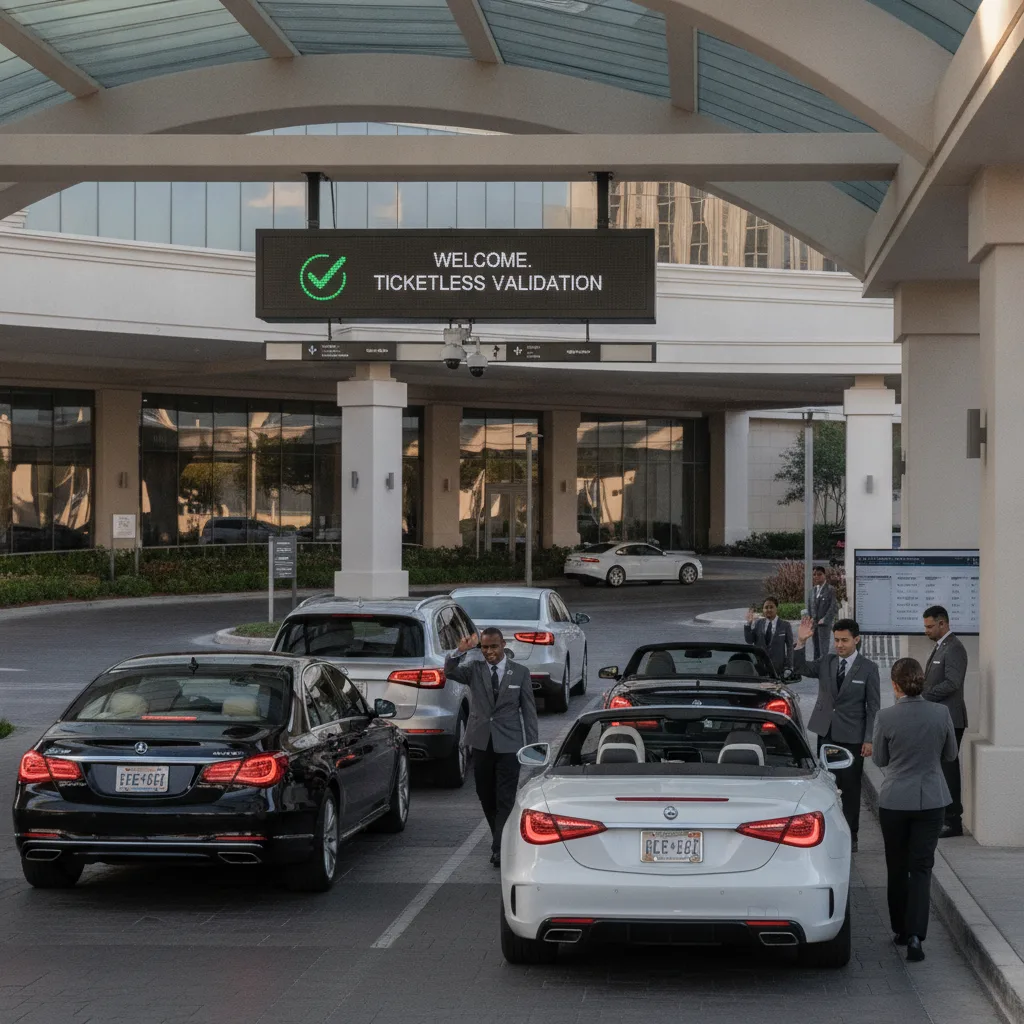
Short answer: Casino parking teams reduce lost valet ticket problems by building a verification process that holds up across shift changes and multi-day stays — since the staff member handling a lost-ticket claim at 4am is often not the one who parked the car two days earlier — and by keeping surveillance and security in the loop for anything involving a disputed or high-value vehicle.
Casino valet has two features that make lost tickets harder to resolve than almost anywhere else: guests often stay multiple days, so the memory of who parked what car fades fast, and the operation runs 24 hours with staff turning over across shifts. A lost-ticket process that depends on “the person who parked it remembers the details” falls apart the moment that person has gone home and a different crew is on the desk.
Why multi-day stays change the problem
At a restaurant or event, a lost ticket usually comes up within a couple of hours of drop-off, while the memory of the vehicle is fresh. A casino guest might park Friday night and not request their car again until Sunday afternoon, after two full shift rotations and possibly a room change. The only reliable source of truth at that point is whatever was recorded at intake — not staff memory, and not a paper stub the guest may have set down in their room and can’t find.
This is why the intake record matters more in a casino setting than almost anywhere else in valet: plate, arrival time, and a condition note, captured consistently regardless of shift, is what makes a lost-ticket claim two days later resolvable in minutes instead of requiring someone to dig through handwritten logs from a shift that ended forty hours ago.
A workable lost-ticket process built for shift handoffs
- Confirm the vehicle record independent of who’s on shift. The system of record — not a specific staff member’s memory — should be the first thing checked.
- Verify identity against the reservation or account. Room number, name, or loyalty account tied to the vehicle at intake gives a second point of confirmation beyond the guest’s description.
- Match vehicle description and approximate drop-off time. Especially useful when a guest isn’t sure exactly which day they parked.
- Escalate anything uncertain to a supervisor, with surveillance available if needed. Casinos already have surveillance infrastructure most other valet operations don’t — use it for genuinely disputed cases rather than trying to resolve everything at the valet desk.
- Log every exception with a timestamp and the staff member who approved it, so the next shift can see exactly what happened rather than discovering an unresolved case cold.
Make the shift handoff itself part of the process
Most lost-ticket failures in a 24-hour operation don’t happen because any one shift did something wrong — they happen in the gap between shifts, when an open case or a pending claim doesn’t get communicated to the incoming crew. Build a short handoff routine specifically for open exceptions: any lost-ticket case still in progress, any vehicle flagged for a condition dispute, and any request currently escalated to a supervisor should be explicitly passed to the next shift, not left for them to discover from a guest showing up again.
Coordinate with security and surveillance for high-value or disputed cases
Casino properties are unusual in already having a surveillance operation running continuously. For a genuinely disputed claim — two guests both insisting a vehicle is theirs, or a vehicle condition dispute tied to a lost-ticket case — pulling timestamped footage from intake can resolve in minutes what might otherwise become an extended standoff at the valet stand. This only works if the vehicle record includes an accurate timestamp to know where to look, which is another reason consistent intake logging matters more here than in a shorter, single-shift operation.
A worked example
A guest checks in Friday evening and doesn’t request their car again until Sunday morning — two shift changes later. They can’t find their ticket. The overnight desk pulls up the intake record by room number and confirms a match on vehicle description and drop-off time; a name check against the reservation adds a second confirmation point. The car is released in a few minutes, with no need for the guest to describe details to a staff member who has no memory of Friday night at all, because nobody’s memory was ever the source of truth to begin with.
What to review for a 24-hour valet operation
- Does the intake record persist accurately across every shift, or does data quality drop during overnight or high-turnover shifts?
- Is there an explicit handoff step for open lost-ticket or exception cases between shifts?
- Do staff know when and how to loop in security/surveillance for a disputed claim?
- Are exception logs reviewed regularly enough to catch a pattern (the same vehicle, the same guest, the same shift) rather than treating every case as isolated?
FAQ
How long should vehicle intake records be kept for a multi-day guest?
At minimum for the length of the guest’s stay plus a reasonable buffer for post-checkout disputes — confirm the specific retention period against your property’s own policy and any applicable legal requirements.
Should overnight staff have the same authority to resolve lost-ticket claims as day shift?
Routine, clearly matched cases can be handled at any shift; anything uncertain or involving a dispute should follow the same supervisor-escalation rule regardless of what hour it is.
Does this process change for a valet-only guest versus a hotel guest at the same property?
The core verification steps are the same, though a hotel guest has a room and reservation record to check against, while a valet-only guest (there for the casino floor, not staying overnight) may need a different secondary identifier.
See PLACA’s valet parking knowledge hub, the ticketless vehicle recognition system overview, and valet parking software for hotels for more on building intake records that hold up across a 24-hour operation.
Want to see how plate-based records hold up across shift changes and multi-day stays? Contact PLACA or book a demo.
Data source: U.S. Department of Transportation