

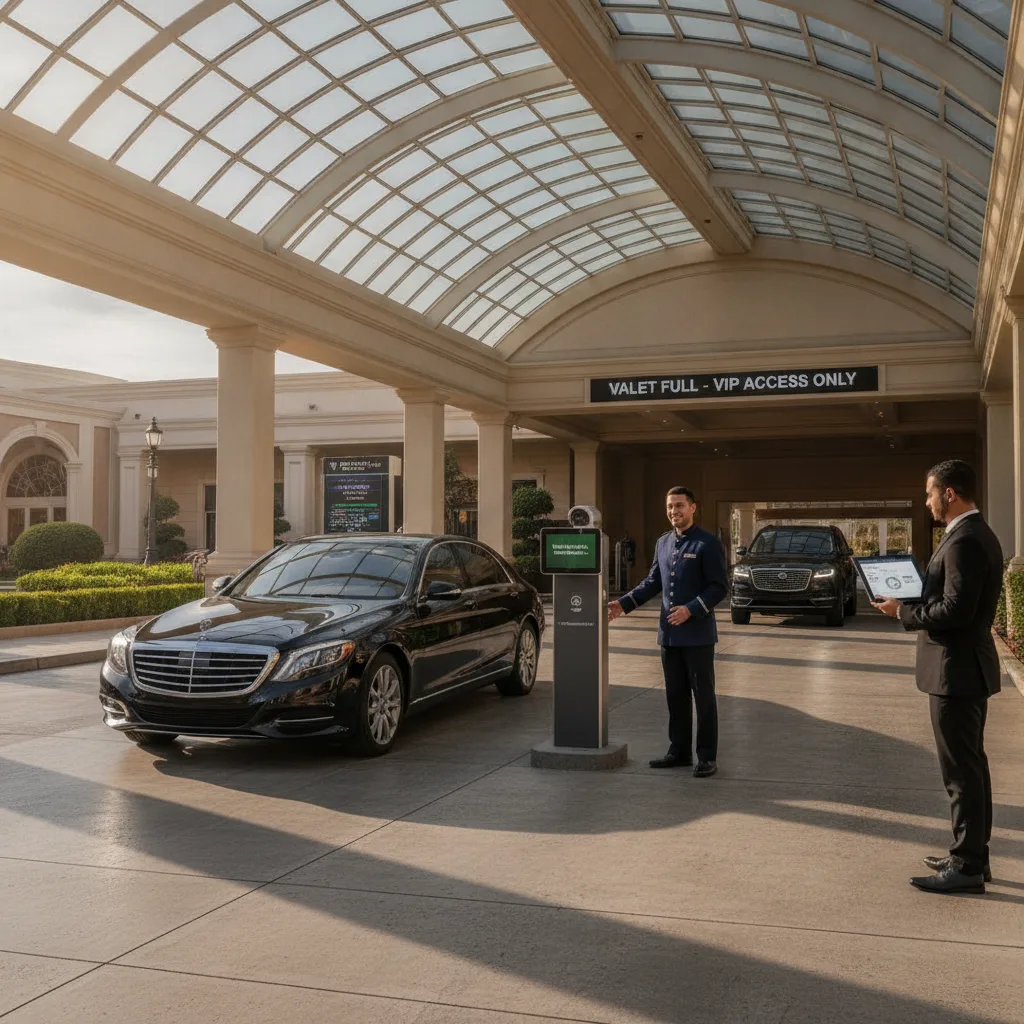
Direct answer: Casino parking teams track repeat VIP vehicles by linking a recognized plate to the player’s club tier or host relationship — not just a general “regular guest” note — so that valet, the host team, and security are all working from the same picture of who’s arriving. Because casinos operate around the clock and mix high-value players with general guests, valet recognition here does double duty: it speeds up service for top-tier players and it gives loss prevention and security a consistent, timestamped vehicle record they can actually use.
Casino valet has a different risk and service profile than any other segment in this list. You’re not just trying to make a good first impression — you’re coordinating with a player development or host team that lives and dies by knowing exactly when their top players arrive, and with a surveillance and security function that has real compliance obligations around who’s on property. Vehicle recognition sits at the intersection of both.
Why casino VIP tracking is really two workflows, not one
The service workflow: getting hosts to players fast
High-tier players’ club members often have an assigned host whose job includes greeting them personally, sometimes before they even reach the gaming floor. A valet team that can flag “this player’s car just arrived” the moment it hits the porte-cochère gives the host a real head start — especially valuable at 2 a.m. on a Saturday when a top-tier player who plays late is arriving and the host needs to be paged rather than standing at the door all night.
The security and compliance workflow: knowing who’s actually on property
Separately, casino security and surveillance teams maintain records for legitimate operational reasons — voluntary self-exclusion lists, persons of interest, and general access accountability. A valet-side vehicle log that’s timestamped and searchable supports this function by giving security a fast way to confirm whether a specific vehicle was on property at a given time, which matters for incident investigation and for cross-checking against exclusion lists maintained by security and compliance staff — not something valet enforces on its own, but something valet’s accurate records can support when security asks.
Keep these two workflows administratively separate even though they share the same underlying vehicle data: host notifications go to player development, exclusion-list and security matters go to security/surveillance, and valet staff should know which channel a given flag belongs to rather than treating every match the same way.
Building the player-tier recognition workflow
Tie the vehicle to the loyalty account, not an informal “VIP” label
The most useful version of this ties a recognized plate to the guest’s actual players club account and current tier, sourced from the loyalty system your casino already runs — not a separate, informally maintained “regulars we know” list that can drift out of sync with actual player status. Tier changes (upgrades, downgrades, an account that’s gone inactive) should flow through automatically rather than requiring valet staff to manually track who’s still a top-tier player.
Route host notifications only to the right host
Most casinos assign specific hosts to specific players. A generic “VIP arrived” alert broadcast to the whole player development team is less useful than a notification routed to the player’s actual assigned host — and reduces the awkward scenario of two hosts approaching the same guest.
Keep comp-related handling separate from valet’s own judgment
Valet complimentary parking or expedited service is often tied to a player’s tier or a host’s discretion. Make sure the valet team’s role is to apply a clearly defined rule (tier X gets complimentary valet, tier Y doesn’t) rather than making case-by-case judgment calls about who “seems like” a high roller — that’s both inconsistent and a fairness issue if guests compare notes.
Handling the 24-hour operating reality
Unlike a restaurant or event venue with a defined surge window, casino valet runs continuously, with distinct patterns: a daytime/early-evening wave of general guests, a late-night surge of players staying for extended sessions, and a genuinely unpredictable overnight period. VIP recognition needs to work reliably at 3 a.m. with a skeleton crew just as well as it does at 9 p.m. with full staffing — which means the system, not staff memory, needs to carry the recognition load during low-staffing overnight hours.
FAQ
Should valet staff have access to a player’s tier or account details?
Limit what valet sees to what they need to act on — typically just a tier flag and host name, not full account or spend history. Full player data belongs with player development and security, not the valet stand.
How does this help with self-exclusion compliance?
An accurate, timestamped vehicle log gives security and compliance staff a reliable data point when cross-checking against exclusion or access lists they maintain — valet’s job is accurate record-keeping, not making exclusion determinations itself.
What’s the biggest risk of not separating service and security uses of this data?
Confusing the two erodes trust on both sides — hosts get noise from irrelevant security flags, and security loses confidence in the data if it’s cluttered with informal VIP notes that were never verified against an actual account.
For more on setting up casino and gaming valet operations, see the valet operations knowledge hub, valet parking system overview, and the ticketless valet system guide.
Coordinate host and security workflows around valet recognition
Talk to PLACA.AI about setting up ticketless vehicle recognition that supports both your player development team and your security operations.
Data source: U.S. Department of Transportation