

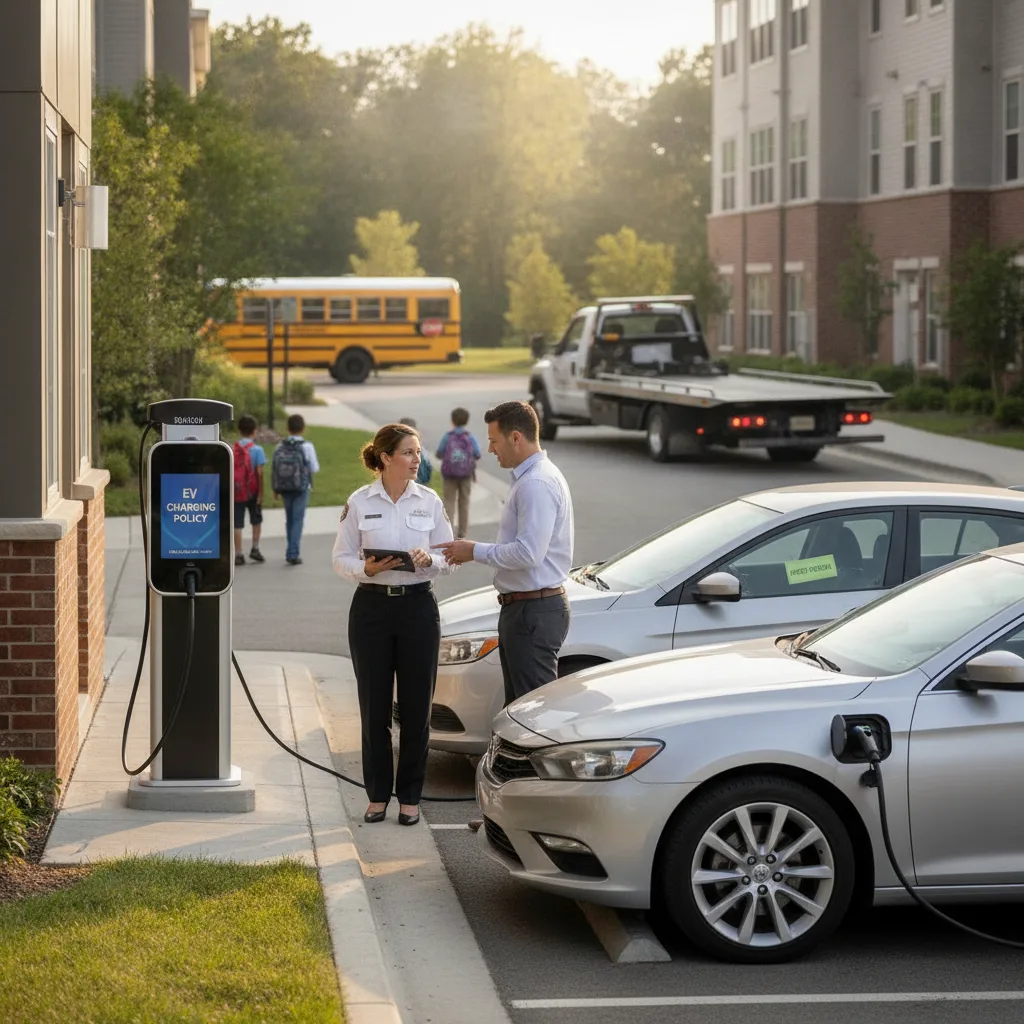
Direct answer: A community manager overseeing several properties can’t run EV charging enforcement the same way at every site, because the chargers themselves are rarely the same. One property might have two Level 2 stations installed by the developer, another has a resident-funded retrofit with a third-party network app, and a third has nothing but a 110V outlet a board approved informally years ago. The workable approach is a single decision framework — eligibility, dwell limit, fault handling, escalation — that each property applies to its own equipment, rather than a single hardware-specific policy that only works at one site.
This is written for community managers running multiple HOA or condo properties, where the same misuse complaint (non-EV cars blocking a charging spot, or a charged EV left in place for hours) shows up across a portfolio but the equipment, signage, and enforcement authority differ site to site.
Why a portfolio-wide EV policy usually breaks at the equipment layer
The complaint sounds identical everywhere: “someone’s been parked at the charger for six hours and isn’t charging.” But the evidence available to resolve it depends entirely on what’s installed. A networked charger with an app can show session start and end times and whether energy was actually flowing. An older or unmetered station shows nothing — staff are working from a windshield check and a guess about how long the car has been there. If your portfolio has a mix, a policy written around “pull the charger’s session log” will fail at every site that doesn’t have one, and staff will quietly stop enforcing there rather than escalate the gap.
The other recurring pattern across a portfolio is inconsistency in how “misuse” gets defined between properties — one board treats a non-EV car parked in the spot as an automatic violation, another treats it as fine unless a charging resident is actually turned away. Without a shared baseline definition, a manager moving between properties ends up enforcing (or not enforcing) based on whichever board they talked to most recently.
A framework that works across mixed equipment
| Property equipment type | What evidence is available | What the policy should require |
|---|---|---|
| Networked charger with app/session data | Start/stop time, energy delivered, fault codes | Use session data as the primary record; a car with a completed session past the posted grace period is a documented case |
| Unmetered or legacy charger | Visual observation only | Require two timestamped checks a set interval apart before treating dwell as a violation — a single drive-by isn’t enough evidence |
| Non-EV vehicle in a marked charging space | Plate and location only; no charging data needed | Treat as a standard reserved-space violation under the property’s existing parking rules, not an EV-specific case |
| Charger reported as faulted | Resident complaint, network alert, or visible error light | Suspend enforcement at that station until the fault is resolved or independently confirmed false |
Rolling this out property by property
- Inventory what each property actually has installed. Don’t assume — confirm charger count, network connectivity, and who currently has access to session data at each site before writing a single policy.
- Set one shared definition of misuse. A non-charging vehicle occupying a marked EV space, and an EV that has completed charging and stayed past the posted grace period, are the two cases every property should treat consistently.
- Match the evidence standard to the equipment. Networked sites use session logs; unmetered sites use the two-check rule above. Don’t hold every site to a standard only some of them can meet.
- Give staff a fast fault-reporting path. A charger that’s actually broken should pause enforcement immediately, not after a resident files a formal complaint.
Edge cases a portfolio-wide policy needs to name in advance
A resident with a documented accessibility need who can’t easily move a fully charged vehicle right away; a charger that shows as faulted in the app but is actually working (or the reverse); and a guest or visitor EV using a resident-reserved charging space. Each property’s board should sign off on how these get handled once, in writing, so the manager isn’t improvising a different answer at every site.
Testing before rolling it to the full portfolio
Pick one or two properties with different equipment types — ideally one networked and one unmetered — and run the framework for a full billing or reporting cycle. Track how many cases had usable evidence under each property’s standard, and how many fault-reported chargers turned out to be real equipment issues versus resident error. Portfolios that add license plate recognition for daily lot documentation get a consistent, site-independent record of which vehicles occupied which spaces and for how long — useful specifically at the unmetered sites where charger data doesn’t exist. It’s also worth reviewing your overall approach against other HOA parking enforcement methods your portfolio already uses, so EV enforcement doesn’t become a separate system from everything else staff track.
Common questions
What’s the first decision for a multi-property EV policy?
Confirm what evidence each property’s equipment can actually produce before writing a single evidence standard — a policy that assumes session data everywhere will fail at any unmetered site.
What belongs in the pilot?
A normal completed-session case, a non-EV vehicle in a marked space, and one fault-reported charger, tested at both a networked and an unmetered property.
What blocks expansion?
A property where staff can’t produce or access equipment evidence, an accessibility case without a documented exception path, or a board that hasn’t signed off on the shared misuse definition.
Related PLACA.AI planning resources
Plan a limited workflow review
Bring the current rule, process, exceptions, and success criteria for handling EV charging-space misuse for community managers. PLACA.AI can help evaluate a bounded pilot without assuming another property’s workflow is the right answer.
Editorial refresh: July 22, 2026. Independently confirm current product capabilities, third-party features, pricing, contracts, governing requirements, and local rules before acting.
Data source: Community Associations Institute