

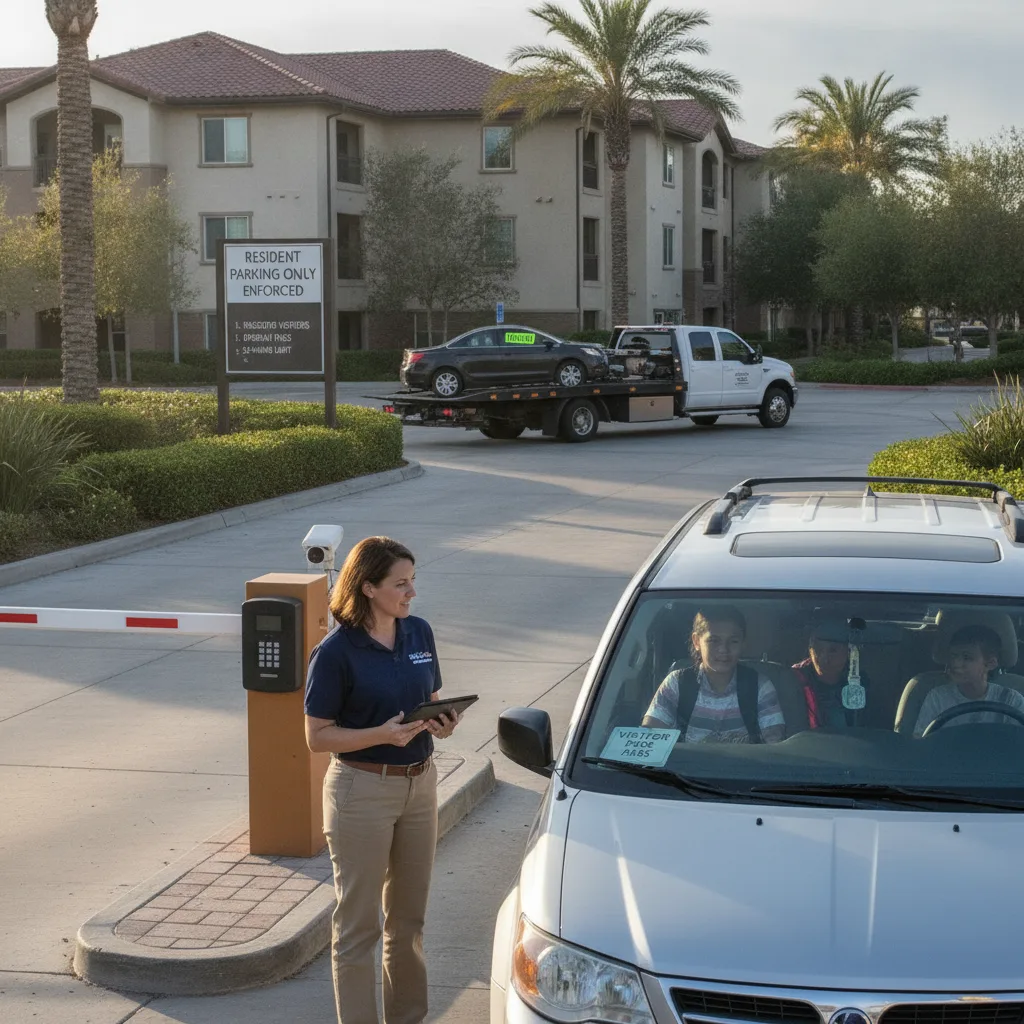
Direct answer: Community managers running visitor-parking enforcement across several HOA and condo accounts need one classification system — guest, recurring service, resident overflow, or suspected long-term storage — applied the same way at every property, even though each community’s actual guest limits and sponsor rules differ. The failure mode isn’t misclassifying a car; it’s applying Community A’s tolerance for recurring visitors at Community B and triggering a fairness complaint that has nothing to do with the vehicle itself.
This guide is for management company staff enforcing visitor parking rules across a portfolio of associations, where the same patrol tech or the same intake process might cover several communities with different visitor policies in the same week.
The classification problem, multiplied across accounts
Visitor-parking abuse complaints almost always start with a repeat plate: the same car in guest parking three nights a week. Before that becomes an enforcement action, it needs to be sorted — a home-health aide visiting on a recurring schedule, a resident’s third vehicle parked in guest spots because their own driveway is full, or an actual pattern of unauthorized long-term use. Getting that classification wrong in either direction causes real damage: treating a caregiver as an abuser creates a resident complaint that reaches the board fast, while waving through genuine overflow parking as “just a guest” lets the underlying problem — not enough resident parking, or residents avoiding registration — go unaddressed.
Across a multi-property portfolio, the classification categories should be identical everywhere you work, even though the resulting policy differs: a bounded recurring-visitor authorization might be a 90-day renewable pass at one community and a simple sponsor note at another, but “this is a recurring service visit, not an abuse case” should be a judgment your staff make the same way regardless of which property they’re standing at that day.
Building one intake process for many sponsor systems
| Decision point | Evidence or control | Required response |
|---|---|---|
| Classify | guest, recurring service, resident overflow, unknown | route to the correct policy for that property |
| Validate | sponsor, vehicle, visit dates, prior corrections | confirm against that community’s records |
| Communicate | notice, correction deadline, options | give the resident a defined path to fix it |
| Escalate | pattern evidence, reviewer, outcome | apply that community’s policy, not a different one |
Where portfolio-wide enforcement usually breaks down
Two things go wrong most often when one team enforces visitor rules across many communities. First, staff turnover: a new patrol tech assigned to a property doesn’t know that community’s specific guest-limit exception for recurring caregivers and either enforces too strictly or lets a real problem slide. Second, resident registration systems that don’t talk to each other — if each community keeps its own spreadsheet or sign-in sheet, cross-referencing a repeat plate against “did this resident already register this visitor” becomes a manual lookup that gets skipped when volume is high. Centralizing visitor registration and violation history, even across communities with different underlying rules, is what makes consistent classification possible at scale. See our resident parking report workflow guide for how to structure that intake so it works the same way across multiple properties.
Sequencing the work
- Classify using the same categories at every property, before applying any community-specific rule.
- Validate against that community’s sponsor records and prior correction history for the vehicle.
- Communicate a correction deadline in that community’s standard notice format.
- Escalate only under that property’s approved policy, with a named reviewer who knows which community’s rule applies.
Protected cases need a confidential path everywhere
Accessibility accommodations, medical visits, and similar protected situations need the same confidential review process at every community you manage, regardless of that property’s general visitor policy. This is one area where portfolio-wide consistency matters more than local flexibility — a management company that handles these cases differently at different properties is taking on unnecessary risk.
Running a bounded pilot before scaling across accounts
Test a unified classification process at two or three properties with different visitor policies before rolling it across the full portfolio. Track how many visitor records get corrected before escalation, how many recurring-service visits get classified correctly on the first pass, and how many resident complaints trace back to inconsistent handling rather than the underlying vehicle. If complaints cluster around classification errors rather than the vehicles themselves, the intake process — not the enforcement policy — needs fixing first. Our overview of HOA parking enforcement methods compares capture approaches that can reduce the manual lookup burden this creates at scale.
Related PLACA.AI planning resources
Frequently asked questions
How do we keep visitor classification consistent across properties with different rules?
Use the same classification categories — guest, recurring service, resident overflow, unknown — everywhere, then apply each community’s specific policy only after the vehicle is correctly classified.
What causes most enforcement inconsistency across a portfolio?
Staff turnover combined with disconnected, per-property registration records. A tech new to a property can’t apply an exception they don’t know exists.
Should protected cases (medical, accessibility) be handled differently per property?
No. Use one confidential review path across every community you manage, even where general visitor policy otherwise varies by property.
Plan a limited workflow review
Bring the current rule, process, exceptions, and success criteria for reducing visitor parking abuse without resident friction. PLACA.AI can help evaluate a bounded pilot without assuming another property’s workflow is the right answer.
Editorial refresh: September 18, 2026. Independently confirm current product capabilities, third-party features, pricing, contracts, governing requirements, and local rules before acting.
Data source: Community Associations Institute