

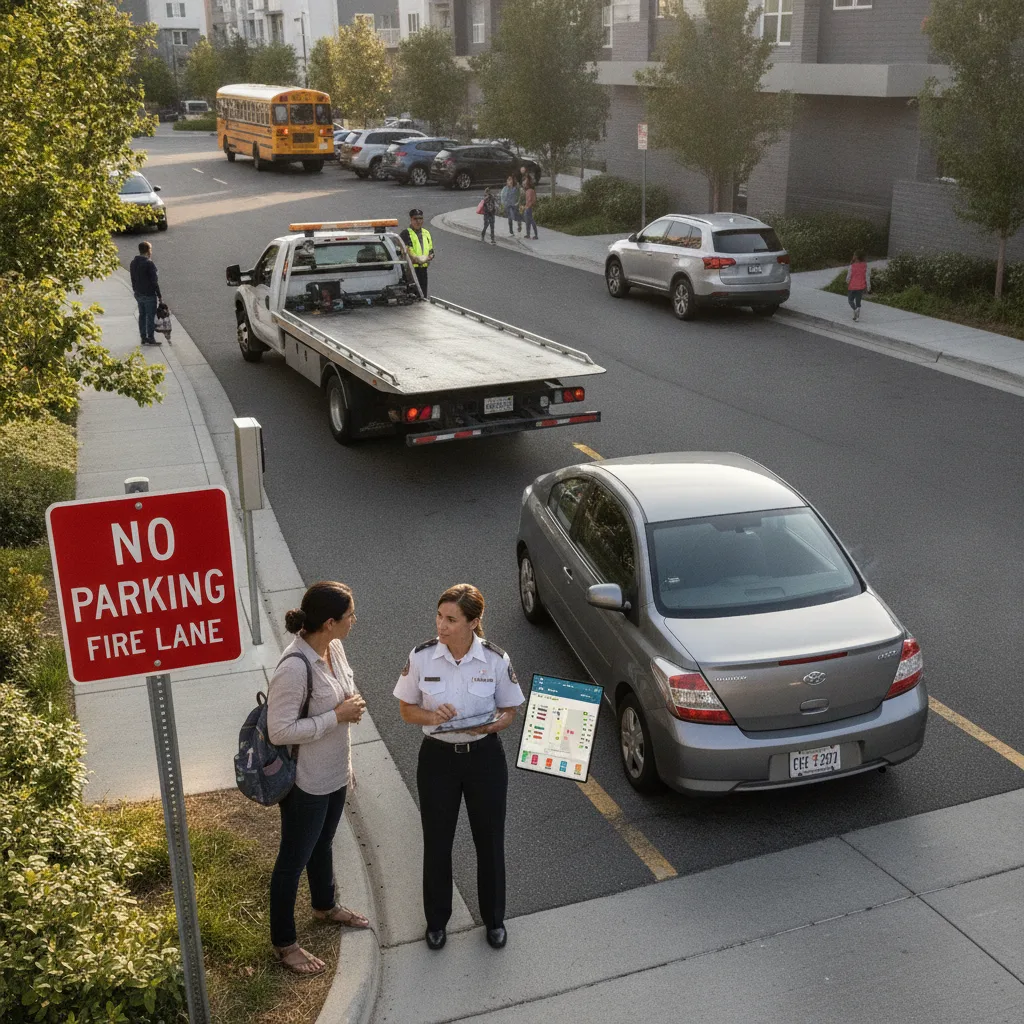
Direct answer: A community manager handling fire-lane complaints across several properties needs a triage step before anything else: is the lane blocked right now, or is this a complaint about something that happened earlier? Those are different response paths with different urgency, and treating every fire-lane report the same way — whether it’s a currently-blocking vehicle or a resident forwarding a three-day-old photo — either creates unnecessary panic on the easy cases or misses genuine active hazards buried in a routine complaint queue.
This is written for community managers overseeing multiple HOA or condo properties, where fire-lane rules, local fire-marshal expectations, and enforcement authority can all vary property to property, and where the same complaint format needs to work consistently across a portfolio.
Why this is harder across a portfolio than at a single property
At a single site, staff usually know the fire lane by sight — where it’s marked, what the local fire marshal has flagged in past inspections, and who to call. Across a portfolio, a manager is working from whatever documentation each property happens to have: some communities have clear curb markings and signage that match a recorded fire-department access plan, others have a fire lane that exists mostly by informal understanding, with faded or missing markings. A complaint that would be an easy call at one property — “yes, that’s clearly marked and clearly blocked” — can be genuinely ambiguous at another where the boundary itself isn’t well documented.
The other portfolio-specific problem is response consistency. If one property’s staff escalates every fire-lane complaint immediately and another property’s staff lets them sit in a general maintenance queue, residents at the second property reasonably conclude the rule isn’t taken seriously — and that inconsistency is also a liability exposure if an access issue ever becomes relevant after the fact.
A triage structure that travels across properties
| Complaint type | What to check first | Response |
|---|---|---|
| Vehicle currently blocking the lane | Is the obstruction happening right now, and does the lane have current, confirmable markings? | Treat as urgent — contact the vehicle owner immediately if possible, and involve emergency services directly if access is actively compromised, not through the routine complaint queue |
| Photo or report of a past incident | Does the photo clearly show the marked boundary and the vehicle’s position relative to it? | Route to standard evidence review; don’t escalate as urgent if the vehicle is already gone |
| Recurring complaint about the same spot | Has this location generated prior notices, and were they documented? | Pull the prior-notice history before deciding whether this is a repeat violation or a new one-off |
| Fire-lane markings unclear or disputed | Does the property have documentation matching local fire-code requirements for this lane? | Escalate to the property’s board and, where needed, the local fire marshal to confirm or re-mark before enforcing |
Standardizing the process without ignoring local variation
- Confirm each property’s fire-lane documentation before a complaint comes in, not during one. Knowing in advance which properties have clear markings and which don’t changes how fast a manager can act when a report arrives.
- Use the same urgency triage everywhere — “is this active right now” — even though the follow-up process (who to call locally, what the fire marshal expects) will differ by jurisdiction.
- Keep a portfolio-wide log of repeat locations. A spot that generates complaints at multiple properties, or repeatedly at one, may need a physical fix (better signage, a repaint) rather than continued case-by-case enforcement.
- Document every active-hazard response separately from routine violations, since these carry different liability and reporting considerations if a property is ever asked to show its response history.
Where this goes beyond a manager’s call
Actual emergencies always go to emergency services first — never wait on an internal process if access appears genuinely blocked right now. Beyond that, fire-code interpretation, marking requirements, and towing authority are jurisdiction-specific and fact-specific; a manager operating across multiple cities or counties should not assume the same fire-marshal expectations apply everywhere.
Piloting the triage process
Run the triage structure at two or three properties with different documentation quality — one with clear markings, one with ambiguous ones — before standardizing it across the full portfolio. Track how many complaints were correctly classified as urgent versus routine, and how many “unclear marking” cases needed board or fire-marshal involvement to resolve. Properties using license plate recognition for daily documentation get a timestamped, location-tagged record that helps resolve the “how long was it actually there” question for non-urgent cases, and pairs well with a broader resident parking report workflow so fire-lane complaints don’t get lost in a general maintenance queue.
Questions to settle
What must be approved first for responding to fire-lane complaints as a community manager?
Confirm which properties have current, fire-marshal-consistent lane markings before setting an enforcement standard — a property with ambiguous markings needs a documentation fix before enforcement, not the other way around.
What should the pilot reproduce?
An active-obstruction case, a past-incident photo report, and one ambiguous-marking case, tested at properties with different documentation quality.
When should rollout stop?
Stop when a property’s fire-lane markings can’t be confirmed against local fire-code requirements, or when a manager is asked to apply a rule without the documentation to support it.
Related PLACA.AI planning resources
Plan a limited workflow review
Bring the current rule, process, exceptions, and success criteria for responding to fire-lane complaints as a community manager. PLACA.AI can help evaluate a bounded pilot without assuming another property’s workflow is the right answer.
Editorial refresh: July 22, 2026. Independently confirm current product capabilities, third-party features, pricing, contracts, governing requirements, and local rules before acting.
Data source: Community Associations Institute