

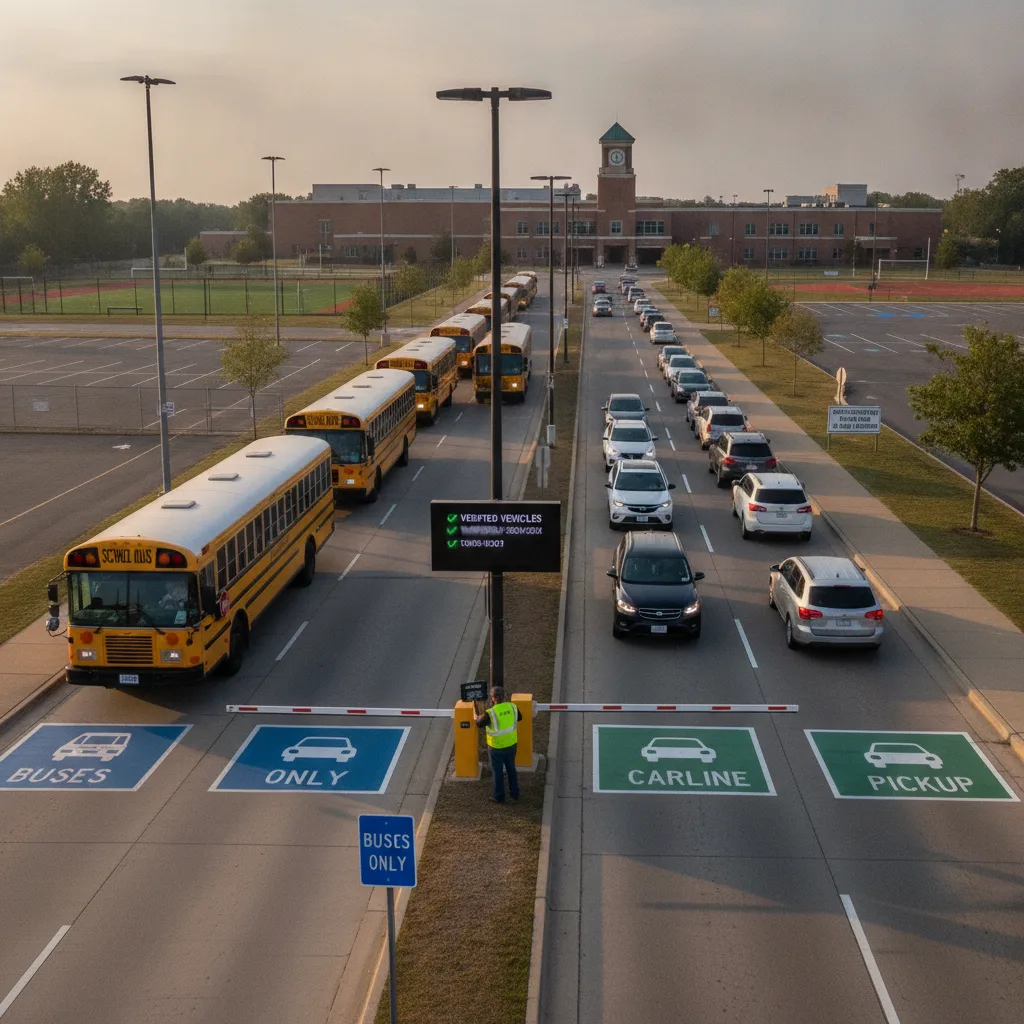
Direct answer: For district operations teams, separating bus and carline traffic is not a single-campus fix – it’s a standard that has to work across buildings with completely different driveways, some built decades before car pickup volumes reached current levels. The job at the district level is to define the transportation-mode field as a single system-of-record synced from the student information system to every site’s pickup roster and the transportation department’s routing software, require every campus to document its loop sequence in writing, and set a recurring audit so a workaround one principal invented in 2023 doesn’t quietly become the only version of the policy anyone remembers. Where a site’s driveway genuinely can’t separate the two flows, that becomes a facilities and municipal-coordination item, not something to leave to whichever assistant principal is on duty that year.
This guide is for district transportation, operations, and safety staff who set policy and standards across multiple campuses, not staff running a single site’s daily dismissal duty.
Why this is a systems problem, not a site problem
A district with two dozen elementary campuses is very unlikely to have two dozen identical driveways. Some were built with a dedicated bus loop; others share one entrance for buses, cars, and delivery trucks. If each principal solves the bus/car conflict independently, the district ends up with two dozen different definitions of “separated,” no consistent way to compare which sites are struggling, and no shared language when a new principal or transportation contractor needs to be brought up to speed quickly.
What a district-level standard actually has to cover
| Decision point | Why it can’t stay site-by-site | Who owns it centrally |
|---|---|---|
| Transportation-mode data | The bus routing system, the SIS, and each campus’s pickup roster need to agree on a student’s mode, or a change made at one point silently fails to reach the others | Transportation/operations, with IT owning the sync |
| Written loop procedures per site | Substitutes, new hires, and contracted staff move between buildings and need a documented procedure, not tribal knowledge held by one duty team | Operations, collected and reviewed annually |
| Sites with no room to separate loops | Requires facilities budget, striping, signage, or municipal coordination that no single principal can authorize | Operations and facilities jointly, with a prioritized capital list |
| Vendor and contractor accountability | Transportation contractors and technology vendors need one set of standards to meet across every site, not a different bar per building | Transportation director, enforced through the service contract |
Operate the district-wide standard
- Define the mode field once and sync it everywhere it’s used. The SIS record, the bus routing system, and any site-level dismissal or LPR tool should reference the same field, not three separately maintained lists that can drift apart.
- Collect a written loop procedure from every site. Require a one-page document per campus – sequence, staffing, fallback for a late bus or full car line – and keep it on file at the district level, not only in a principal’s notebook.
- Run an annual walkthrough with facilities and transportation together at sites flagged for driveway or capacity constraints, and track them on a capital priority list rather than treating each complaint as a one-off.
- Audit a sample of sites each semester against the written procedure to catch drift – a site that quietly stopped following the sequence, or one where the mode-change process reverted to phone calls and notes.
Where district authority ends
Street-level engineering – turn lanes, signal timing, curb cuts on a public road – sits with the municipality, not the district. A district operations team’s role there is to bring documented traffic data to that conversation, not to assume a site can fix a public-road bottleneck on its own. Internally, escalate any site where staff report the written procedure is unworkable in practice; a policy nobody can actually follow at 3 p.m. is a policy that will get abandoned.
What to track across a multi-site pilot
- Which sites have a current, on-file written loop procedure versus none.
- How many sites’ pickup rosters and bus routing data have drifted out of sync with the SIS mode field, and how that’s caught.
- Sites flagged for facilities or municipal-level driveway constraints, ranked for capital planning.
- Contractor or vendor performance against the standard, tracked per site.
Before rolling a standard districtwide
- Confirm the mode-field sync actually works end to end at a pilot site before requiring it everywhere.
- Get written procedures from a representative mix of site layouts, not just the easiest campuses.
- Set the facilities capital list and audit cadence before announcing the standard, so sites know what happens after the pilot.
- Build in a route for a site to flag “this doesn’t work at our driveway” without it becoming an informal opt-out.
Related PLACA.AI planning resources
Practical questions
What should a district standardize first?
Start with the transportation-mode data sync between the SIS, bus routing system, and any site-level pickup tool. Physical loop redesigns take facilities budget and time; a shared, accurate mode field is achievable immediately and prevents the most common cross-campus errors.
How do you handle sites with genuinely different driveways?
Don’t force identical physical layouts. Require every site to document its own loop sequence against the same standard (buses and cars never load simultaneously in the same space), and track sites that can’t meet it on a facilities priority list.
What blocks a districtwide rollout?
No confirmed data sync between systems, no written procedure on file for a site, unresolved facilities constraints with no funding path, or an audit showing sites have drifted from the standard without anyone noticing.
Plan a limited workflow review
Bring current site procedures, your SIS-to-routing data flow, and the sites you already suspect are out of sync. PLACA.AI can help evaluate a bounded, multi-site pilot without assuming one campus’s workflow is the right template for the district.
Editorial refresh: September 18, 2026. Independently confirm current product capabilities, third-party features, pricing, contracts, governing requirements, and local rules before acting.
Data source: National Center for Education Statistics