

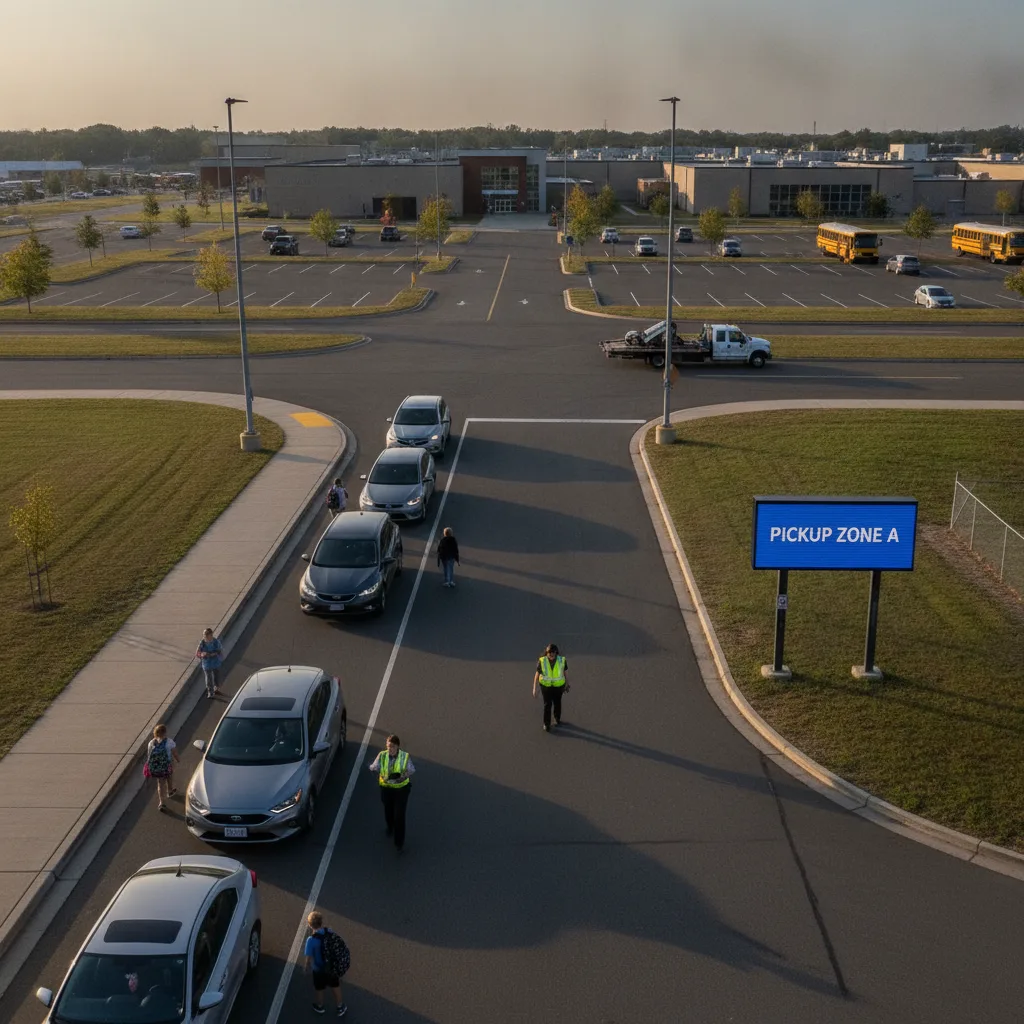
Direct answer: District-level standardization succeeds or fails on three things operations teams control directly: a single written definition of a completed dismissal that every campus principal signs off on, one system of record for custody restrictions and authorized-pickup lists that updates across all of a student’s campuses (not just the one where the record was entered), and an audit sample large enough to catch the campuses quietly running their own process. Layout, staffing, and lane count are not the district’s problem to standardize — campus leadership owns those.
This is for district operations, transportation, safety, and compliance teams responsible for dismissal consistency across a full portfolio of campuses — not a single school’s day-to-day process, but the policy, procurement, and audit layer that sits above it.
The Real Failure Mode Isn’t Technology — It’s Governance
Districts rarely fail at standardization because they picked the wrong app. They fail because thirty campuses were each allowed to interpret “released” differently for years, and nobody owned reconciling those interpretations until a custody dispute, a missing-child scare, or a board inquiry forced the question. By the time operations gets involved, the fix isn’t a new tool — it’s untangling which campuses have been quietly running their own rules, sometimes for good local reasons, and deciding which of those local variations are legitimate and which are liability exposure.
What Operations Should Actually Own
| Governance item | District operations owns this | Why it can’t be left to individual campuses |
|---|---|---|
| Written definition of “dismissal complete” | Yes | Needed for consistent incident reporting and legal defensibility across every campus |
| Custody restriction and authorized-pickup record | Yes | A restriction entered at one campus must be visible if the student transfers or has siblings elsewhere in the district |
| Vendor and data-handling standard | Yes | Different apps at different campuses create data silos that fail exactly when a cross-campus custody question comes up |
| Audit sampling and escalation review | Yes | Someone above campus level has to check that documented process matches what actually happens at the curb |
| Carline layout, staffing, local schedule | No | Campus leadership is closer to enrollment, geometry, and staffing reality than the district office |
The Custody-Record Gap Operations Teams Underestimate
The single most common gap a district operations audit finds isn’t a carline procedure — it’s a custody restriction that was entered correctly at Campus A after a legal filing, but never propagated to Campus B where a sibling attends, or to the campus a student transfers to mid-year. If each campus is running its own local record instead of a shared district system, that gap is structural, not accidental, and it’s the kind of thing that surfaces during a legal dispute rather than a routine review — which is the worst possible time to discover it. Making the pickup record follow the student across every campus in the district, not just the one where it was entered, is one of the highest-leverage standardization moves operations teams can make.
A Rollout Sequence That Survives Contact With Real Campuses
- Audit current state honestly: which campuses use which system, which have a written dismissal policy versus an unwritten one, and where custody records actually live.
- Draft the single-sentence definition of a completed dismissal and get sign-off from a representative sample of principals — not all of them, but enough to catch objections before districtwide rollout.
- Consolidate the custody and authorized-pickup record into one system that every campus reads from, even if front-line verification methods differ by campus.
- Set an audit cadence (monthly for the first quarter, then quarterly) that samples both compliant-looking and problem-flagged campuses, not just the ones that self-report issues.
- Report a small number of metrics to the board or cabinet — not scan volume, but exception rate, unresolved handoffs, and cross-campus record consistency.
Metrics for the District-Level Dashboard
- Percentage of campuses using the shared custody/authorization record versus a local workaround
- Cross-campus record consistency for students with siblings or mid-year transfers
- Unresolved dismissal exceptions older than 24 hours, by campus
- Vendor and data-handling exceptions found during audit sampling
Where Vehicle-Based Verification Fits the Governance Layer
License plate matching at the curb is a campus-level control, but it becomes a district-level asset when every campus checks against the same authorized-pickup record instead of a locally maintained list. That’s the difference between thirty campuses each doing their own version of verification and one district-wide system that operations can actually audit. It also gives operations something concrete to point to when a board member or legal counsel asks how the district would demonstrate that a custody restriction was enforced consistently — a record tied to the vehicle and the timestamp, not a staff member’s recollection.
Related PLACA.AI planning resources
Common Questions
What’s the first thing operations should standardize — process or the record?
The record. A shared custody and authorized-pickup record that follows the student across campuses closes the gap that causes the most serious incidents; layout and staffing standardization can follow.
How many campuses should be in the initial audit sample?
Enough to include your largest, smallest, and most geographically isolated campuses — the ones most likely to have quietly built their own process out of necessity.
Who should present standardization metrics to the board?
Operations, not individual principals — the board needs district-level consistency data, not one campus’s success story.
Standardize the record, not just the process
Placa.ai’s license plate recognition can check every campus against one shared authorized-pickup record, giving district operations an auditable, district-wide verification layer instead of thirty local workarounds. If you’re planning a standardization rollout, we can help map the current state first.
Editorial refresh: July 22, 2026. Independently confirm current product capabilities, third-party features, pricing, contracts, governing requirements, and local rules before acting.
Data source: National Center for Education Statistics