

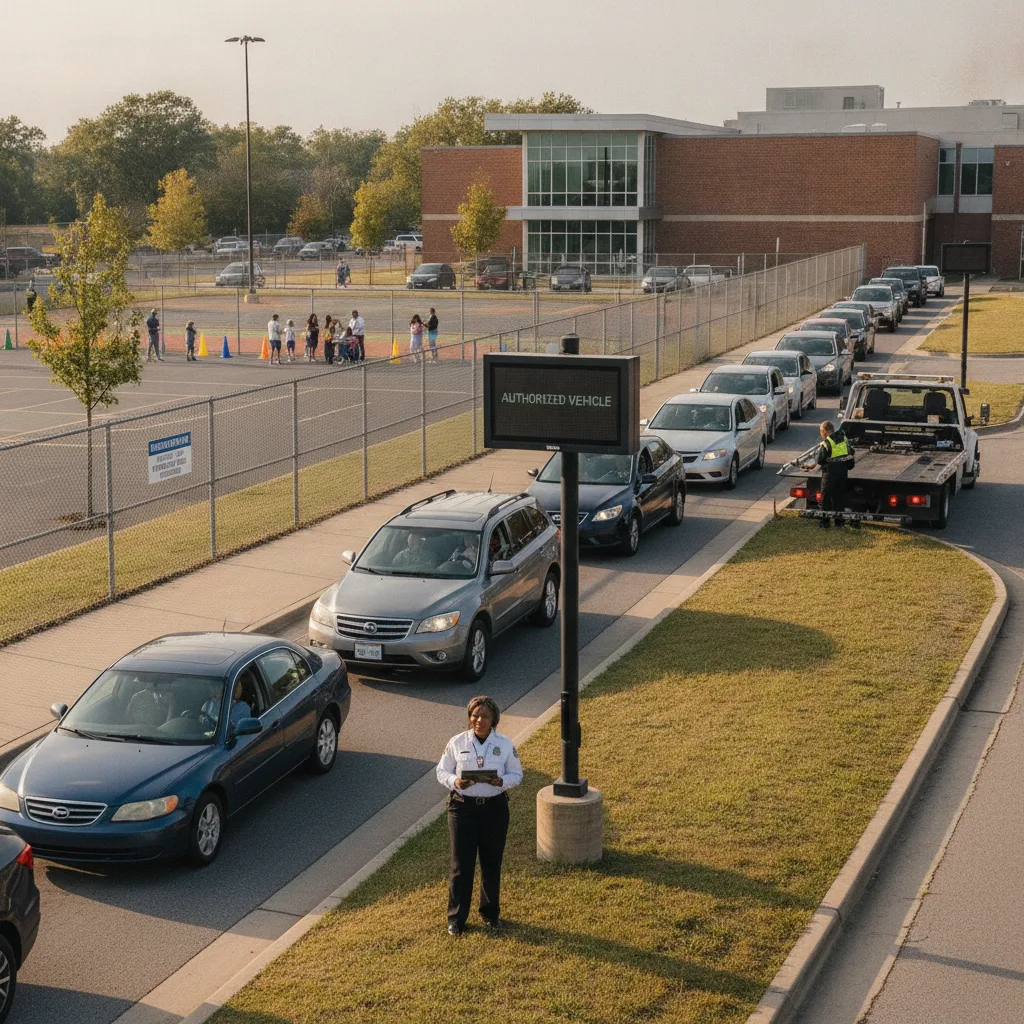
Direct answer: A five- or six-year-old can’t tell a substitute “I usually ride Bus 6, but on Fridays I go to my grandmother’s” the way an older student could — so the gap has to be closed before the substitute ever stands at the door, not patched in the moment. Give every substitute a class-specific dismissal card that lists each child’s normal mode, any standing exception (custody days, aftercare, sibling grouping), and exactly who to call if something doesn’t match. Pair it with a paraprofessional or aide who already knows the room, because in a K-5 building the aide’s institutional memory is often what actually prevents a mistake, not the substitute’s instructions alone.
This guide is for elementary school leaders who know that a dismissal mistake with a seven-year-old isn’t a paperwork problem — it’s a phone call to a terrified parent, and it happens because a substitute didn’t know something the regular teacher would have known without thinking.
Why young children make this harder, not the same
An elementary substitute is operating with two disadvantages a middle or high school sub doesn’t have: the students can’t reliably self-report their own dismissal plan, and the room is often run with an aide or paraprofessional whose continuity matters as much as the teacher’s. A kindergartner who normally waits for “the lady with the clipboard” to walk her to the car line has no way to explain that to someone new. If the regular teacher’s aide is also out that day, the classroom has lost its only source of institutional memory at once.
Example: A first-grade class has one set of twins who are picked up together on car-rider days but split — one to aftercare, one to a grandparent — on Tuesdays and Thursdays. The regular teacher knows this without looking. A substitute, working from a generic class roster with no notes, sends both twins to the car line on a Tuesday, and now the grandparent is waiting for a child who isn’t coming.
Elementary substitute dismissal sheet
| What a substitute needs | Why the gap happens without it | What closes it |
|---|---|---|
| Per-child normal mode and standing exceptions | A generic roster shows names, not dismissal plans, and a sub has no way to know a child’s routine differs day to day | A one-page, class-specific card printed fresh each morning, not last month’s version |
| Continuity in the room | If the aide is also absent, the classroom has zero institutional memory that day | Assign a familiar staff member — a specials teacher, an office aide — to walk dismissal with a substitute-covered class |
| Same-day change communication | A parent calls the front office, not the substitute, and the message may never travel down the hall | One system that pushes the change directly to whoever is covering that room, with a required acknowledgment |
| Sibling and multi-classroom coordination | Siblings in different grades may be covered by different substitutes who don’t know about each other | A front-office-held master list that flags sibling groups regardless of which room is covered |
Running dismissal with a substitute in the room
- Morning handoff: Before the day starts, the substitute receives the current dismissal card and confirms it with whoever is covering — not just skims it during a busy afternoon.
- Mid-day check: The front office confirms no changes have come in for that class since the card was printed, and if one has, delivers it in person or by a system that requires the substitute to acknowledge it.
- Staging: Ten minutes before release, group students by mode with the paraprofessional or covering aide’s help, so young children aren’t standing in the wrong line because the substitute is reading names off a sheet.
- Closure: Every child on the roster is accounted for by name — released, transferred to another supervised group, or flagged unresolved and handed to the front office before anyone leaves the building.
Where a substitute should always stop and ask
Anything involving a custody restriction, an unfamiliar adult at pickup, a child who doesn’t match the mode on the card, or a child who can’t be located immediately goes to the front office — a substitute should never be expected to make that judgment call alone with a six-year-old’s safety on the line. Make this explicit on the dismissal card itself, not assumed as common sense a new sub will figure out.
What to check during a two-week pilot
- Substitutes who received a current, class-specific card versus a generic or outdated one
- Same-day changes that reached the covering staff member before dismissal
- Sibling groups released correctly across different classrooms
- Students unresolved at the final bell
- Exceptions correctly transferred to the front office instead of guessed at
Pilot this specifically on days you already know have substitute coverage scheduled, rather than waiting to see how an unplanned absence goes.
Before rolling this out school-wide
- Confirm which staff member is responsible for printing and handing over the dismissal card each morning a substitute is scheduled.
- Pair every substitute-covered classroom with a familiar staff member for the dismissal window specifically, even if coverage isn’t needed the rest of the day.
- Test the process with a real substitute, not a hypothetical one, before publishing it as standard practice.
- Keep a record of any dismissal correction involving a substitute-covered class, so patterns are visible to the office, not just felt by frustrated parents.
Placa.ai’s first-week dismissal checklist and kindergarten dismissal workflow guide both cover related ground for younger students, where the margin for a missed detail is smallest.
Related PLACA.AI planning resources
Implementation questions
What’s the biggest difference between covering an elementary classroom and an older grade for dismissal?
Young children generally can’t correct a substitute’s mistake themselves. The safeguard has to live in the paperwork and the covering staff’s knowledge, not in the student’s ability to say “that’s not right.”
What if the classroom aide is also out that day?
Assign a different familiar staff member — a specials teacher, front-office aide, or another grade-level teacher who knows the students — to walk dismissal with the substitute specifically, even briefly.
When should this process expand to every grade level?
Once a pilot in one or two grades shows same-day changes reliably reaching the covering staff and sibling groups being released correctly — not before, since a false sense of coverage is worse than knowing where the gaps still are.
Plan a limited workflow review
Bring the current rule, process, exceptions, and success criteria for avoiding substitute-teacher dismissal gaps at an elementary school. PLACA.AI can help evaluate a bounded pilot without assuming another property’s workflow is the right answer.
Editorial refresh: July 22, 2026. Independently confirm current product capabilities, third-party features, pricing, contracts, governing requirements, and local rules before acting.
Data source: National Center for Education Statistics