
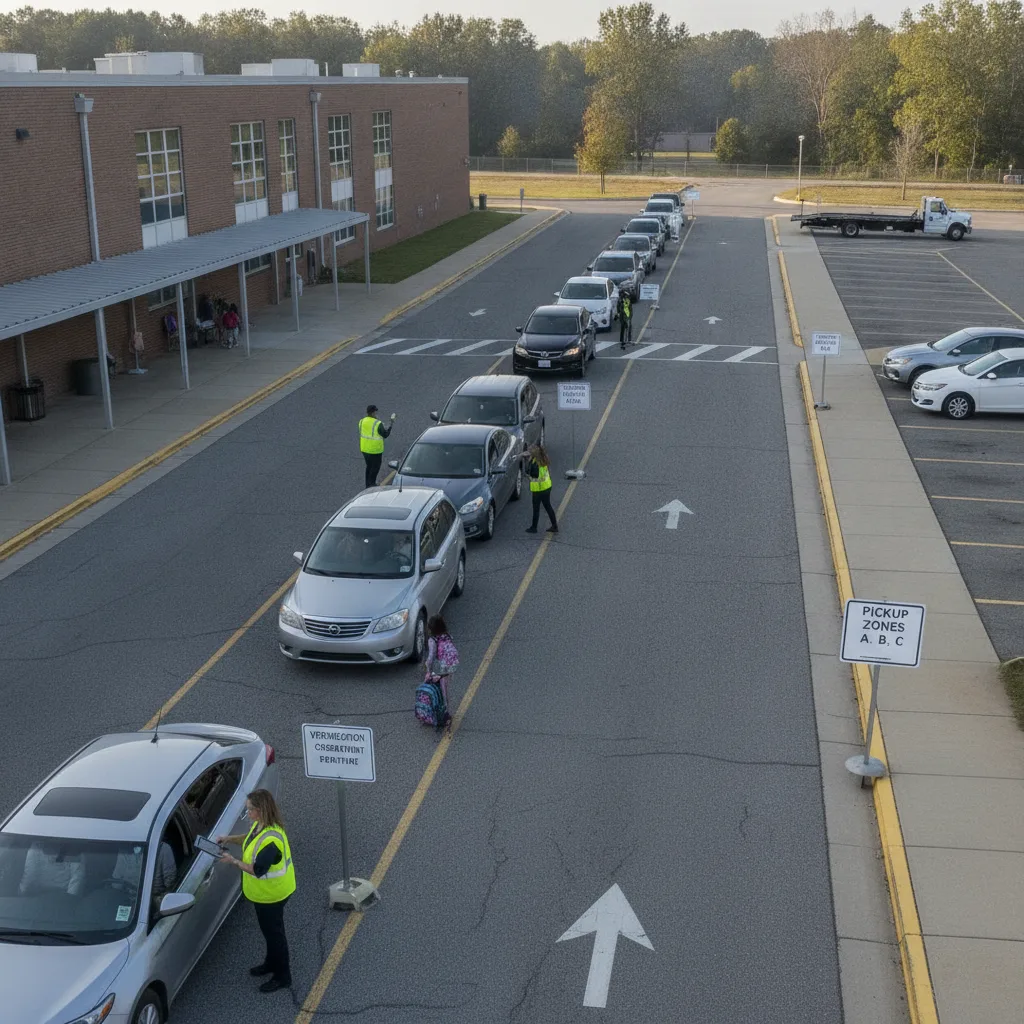
Direct answer: A five- or six-year-old cannot be told “wait by the flagpole, your ride is running late” and be trusted to manage that safely. For elementary schools, the late-dismissal plan has to move the child — not just the paperwork — into a supervised, indoor or covered location the moment their grade-level window closes, keep siblings together, and hand the child to a named staff member who is still accountable for them until a verified adult arrives. The plan should also assume the person walking that late student to the holding area is a classroom aide, cafeteria monitor, or front-office volunteer, not a trained security officer, and needs a script simple enough to follow under pressure.
This guide is for elementary school leaders, teachers, front-office staff, and the parents whose child ends up in the late group more often than they’d like. It focuses on what changes when the student left behind is six years old instead of sixteen.
Why “just wait” doesn’t work at the elementary level
At a middle or high school, a late student can typically sit in a hallway, text a parent, and manage their own wait. At an elementary school, that same gap is a safety event. A kindergartner or first-grader doesn’t reliably know what to do when the carline empties and their name hasn’t been called — they may wander toward the parking lot looking for a familiar car, panic, or simply not understand that “late” means anything different from “forgotten.” The bottleneck isn’t really about traffic flow at this age level; it’s about how fast and how reliably a small child gets from “no one has come” to “in the care of a specific, named adult” without an unsupervised gap in between.
The elementary late-pickup handoff sequence
| Moment | What happens | Who is accountable |
|---|---|---|
| Grade window closes | Classroom or grade-level roster is closed; any student not picked up is flagged by name | Classroom teacher |
| Transfer to holding area | Flagged students walk together (siblings kept as a group) to one fixed, supervised indoor or covered location | Receiving staff member, name logged |
| Family notified | One short message goes to the family stating the child’s exact location — not just “pickup is delayed” | Front office |
| Adult arrives | Adult is checked against the authorized pickup list before the child is released, even if the adult is familiar to staff | Holding-area staff member |
| Final signoff | Every name on the flagged list is reconciled — picked up, transferred to aftercare, or escalated — before staff leave for the day | Building administrator |
Staff the handoff for who’s actually available, not who you’d prefer
Most elementary schools don’t have a dedicated safety officer standing by at 3:15 — the person receiving late students in the holding area is often a classroom aide, a cafeteria monitor picking up an extra duty, or a parent volunteer. Building the plan around that reality matters more than building it around an idealized staffing chart. The handoff script needs to be simple enough that whoever is on duty that particular afternoon can run it without a supervisor standing over their shoulder: log the name, keep the group together, check the adult against the list, log the release. If the script requires judgment calls a volunteer isn’t equipped to make — like handling a custody dispute or an unfamiliar adult claiming to be a relative — that decision needs to route straight to the building administrator or front office, not be improvised at the holding area. A written workflow for split-custody and non-standard pickup situations is worth keeping posted at the holding-area station specifically because the person running it may not be the same staff member every day.
Keeping siblings together and other things that go wrong first
The most common failure in elementary late-pickup isn’t a missing child — it’s a sibling group that gets split between the classroom transfer and the holding area because one grade’s window closed before the other’s. A kindergarten sibling shouldn’t be sitting alone in a different location than their third-grade sibling while a parent is en route for both. Building the roster-closure step to check for sibling matches before transfer, not after, avoids this. It’s also worth walking your kindergarten-specific dismissal workflow alongside the late-pickup plan, since the youngest students in the building are the ones most likely to need extra handling at both ends of the process — on time and late.
What to check before you call the pilot done
- How many students were transferred to the holding area before their grade-level window fully closed (versus after)?
- Were sibling groups kept together every time, with no exceptions logged?
- Did every family notification name the specific holding location, not a generic “delayed” message?
- Was every adult checked against the authorized list, including adults staff recognized on sight?
- Were any students unresolved at final signoff, and what happened to close that gap?
Related PLACA.AI planning resources
Practical questions
Who should staff the late-pickup holding area?
Whoever is realistically available at that time of day — but that person needs a short, written script rather than being expected to improvise judgment calls, especially for identity checks and sibling matching.
How do you notify a family without causing panic?
Name the exact location the child is waiting, not just that pickup is delayed. A vague “please come to school” message reads very differently to a parent than “Emma is with Ms. Rivera in the front office.”
When should a late-pickup case get escalated to the administrator?
Any time the adult picking up isn’t on the authorized list, a custody question comes up, or a student’s grade window closes with no notification reaching a parent — these shouldn’t be resolved at the holding-area level.
Plan a limited workflow review
Bring your current late-pickup roster process, holding-area staffing, and sibling-matching steps. PLACA.AI can help evaluate whether vehicle-based verification at final pickup reduces how often staff have to make an identity judgment call by sight alone.
Editorial refresh: September 18, 2026. Independently confirm current product capabilities, third-party features, pricing, contracts, governing requirements, and local rules before acting.
Data source: National Center for Education Statistics