

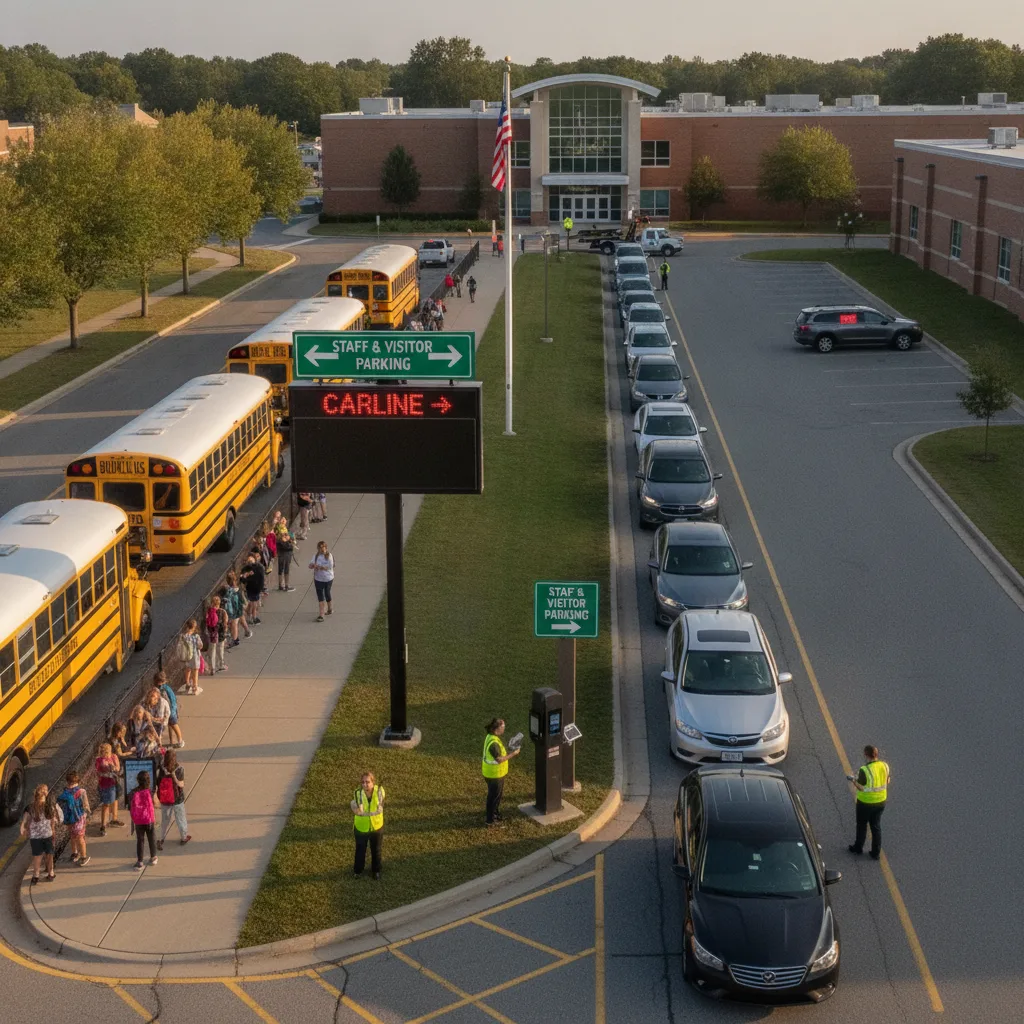
Direct answer: For elementary school leaders, separating bus and carline traffic comes down to two things: physical or timed separation of the two loops, and a single, logged process for handling the transportation-mode changes that happen constantly at this age – a grandparent filling in for a car rider, a bus rider staying for aftercare, a kindergartner whose mode was never updated after a family moved. Most elementary campuses were not built with two separate loading zones, so separation usually means staggering release times, using different sides of the same driveway, or holding buses until the car loop is clear (or the reverse) rather than redesigning the site. Whatever the method, it only holds if mode changes stop arriving as handwritten notes, hallway asides, and one-off phone calls and start arriving through one station that logs who requested the change, for which student, and until when.
This guide is for elementary school principals, assistant principals, and other building leaders who personally run – or directly supervise – daily dismissal duty, not district staff setting policy from a central office.
Why bus and car traffic collide at elementary campuses
At the elementary level the conflict is rarely just about lane geometry. Car riders need an adult to walk them to the vehicle and a visual match against the pickup roster, so the car loop moves slower than the bus loop by design – and a shared driveway means a stopped car line backs traffic into the space a bus needs to pull through. Layer in a five- or six-year-old’s limited ability to self-report a change (“my mom said someone else is picking me up today”) and the collision point is often not the pavement, it’s the moment a student’s mode changes after the morning bell and nobody who is standing at the curb knows about it yet.
Where the collision actually happens
| Decision point | What’s different at elementary campuses | Who should own it |
|---|---|---|
| Physical or timed separation | Most sites share one driveway; separation is usually sequencing (buses first, then cars) rather than two lanes | Principal or AP, coordinated with the custodial/facilities lead who sets cones and signage |
| Staggered release by grade | Younger grades typically need more escort time per student, so they benefit from an earlier or later window than older grades | AP or dismissal coordinator building the daily schedule |
| Same-day mode changes | High volume relative to older grades; young students often can’t confirm a change themselves | Front office, with a hard cutoff time communicated to families |
| Duty coverage and substitutes | Losing one duty staff member (illness, meeting) removes a trained set of eyes from a loop that moves slower than adults expect | Principal, with a standing backup list rather than an ad hoc pull from class coverage |
Build the daily duty structure
- Lock the transportation-mode field first. Before touching lane layout, make sure every student has a current, single source of truth for how they leave – bus, car, walker, aftercare – and that the front office, not individual teachers, owns changing it.
- Sequence the loops instead of assuming you can separate them physically. If the site has one driveway, decide explicitly whether buses load first and cars are held, or the reverse, and put that sequence in writing for substitutes and new staff.
- Release grade levels in waves. Call the slowest-loading grade (typically kindergarten and first grade) to the curb first so its car time doesn’t overlap with a grade that self-releases faster.
- Route every walk-up or call-in mode change through one station with a cutoff time. A parent who calls at 2:50 for a 3:00 dismissal should hit a named cutoff policy, not a scramble through three staff radios.
When the loops collide anyway
Plan for the day a late bus, a broken-down vehicle, or a weather closure forces both loops to run at once. Name in advance who has the authority to hold cars at the curb, who redirects a late bus around a full car line, and how a crossing guard or duty staff member signals the change to drivers waiting in the loop. Treat a same-day mode change discovered after a student is already in the wrong line as a stop-and-verify event, not something to wave through because the line is moving.
What to watch during a trial week
- How long it takes to fully clear the bus loop before car loading starts (or the reverse), measured at the same time each day.
- How many mode-change requests arrived outside the logged station – a note passed to a teacher, a call to the wrong number.
- How many students were staged in the wrong loop and caught before release versus after.
- Whether duty coverage held on a day with a called-out staff member.
Before you scale beyond a pilot week
- Put the loop sequence and grade-level release order in writing for substitutes.
- Confirm the front office cutoff time for same-day mode changes and communicate it to families in the same channel you use for weather closures.
- Assign a named backup for every duty position, not just the primary.
- Review any wrong-loop incidents from the trial week with the staff involved before widening the change to the whole building.
Related PLACA.AI planning resources
Common questions
What should an elementary leader change first?
Pick one lever – loop sequencing or grade-level staggering – and pair it with a locked-down, single-station process for same-day mode changes. Trying to redesign the physical layout and fix mode-change handling at the same time makes it hard to tell which change actually helped.
How do you keep mode changes from slowing down dismissal?
Give the front office one intake point for changes, a same-day cutoff time families know about in advance, and the standing authority to deny a change requested after that cutoff rather than pulling a student from class at the last minute.
What if the campus has no room for two lanes?
Sequence the loops instead of separating them physically – hold one mode of traffic until the other has cleared – and raise any longer-term site changes with district facilities or transportation rather than trying to solve a driveway constraint at the building level alone.
Plan a limited workflow review
Bring your current loop sequence, duty roster, and same-day mode-change process. PLACA.AI can help evaluate a bounded pilot at your campus without assuming another school’s layout is the right template for yours.
Editorial refresh: September 18, 2026. Independently confirm current product capabilities, third-party features, pricing, contracts, governing requirements, and local rules before acting.
Data source: National Center for Education Statistics