

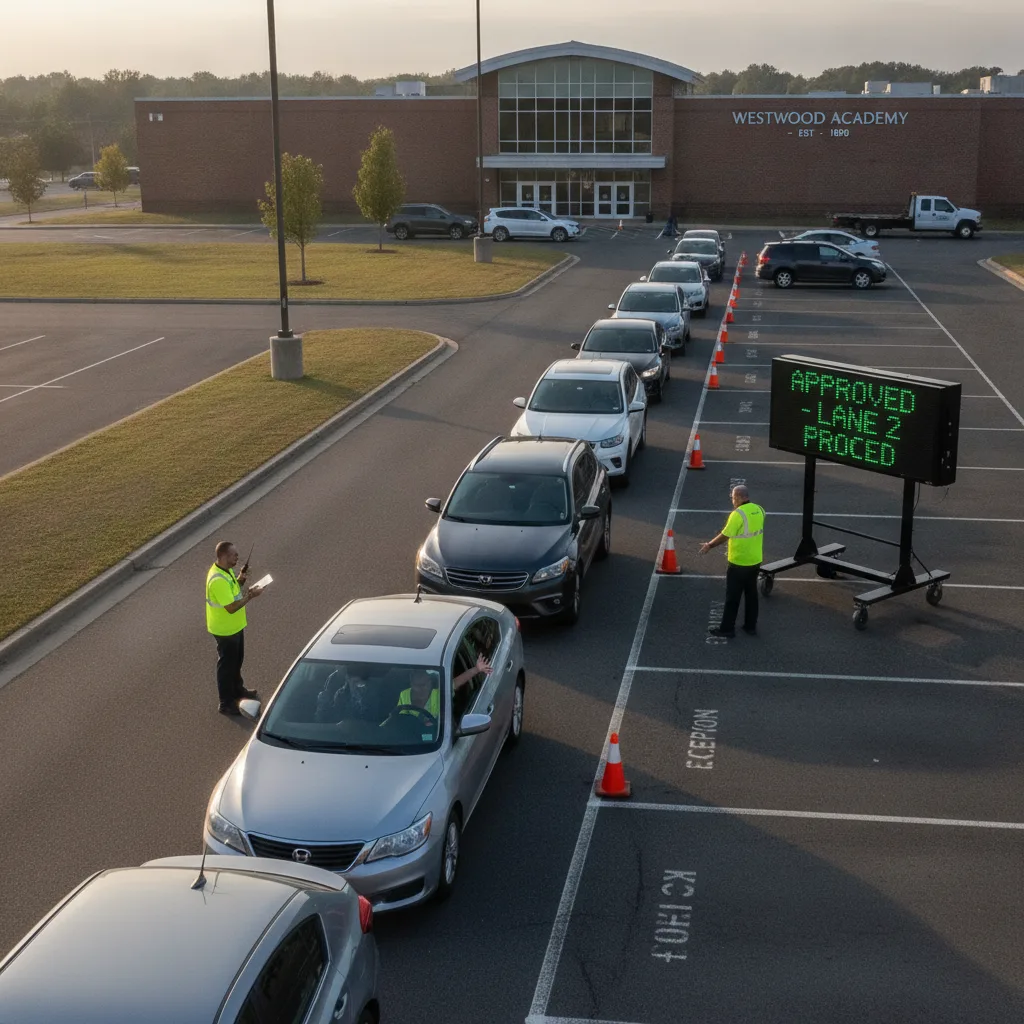
Direct answer: Shorten the line by designing a child-safe sequence: verified family arrival, lane assignment, classroom notification, supervised student movement, authorized-adult confirmation, and completed handoff. Optimize the slowest safe stage, not vehicle speed alone.
This guide is for elementary school leaders, teachers, dismissal staff, families, and transportation teams and addresses shortening pickup-line delays at an elementary school. Use actual site conditions, current records, and responsible roles.
Locate the real bottleneck
A faster arrival scan can create a larger student queue if classrooms release too early or if lane changes and authorization exceptions interrupt the curb.
Example: Two siblings released from different rooms should be grouped to one verified pickup event without creating duplicate calls or leaving one child waiting curbside.
Elementary pickup-stage board
| Decision point | Evidence or control | Required response |
|---|---|---|
| Arrival verification | current vehicle and family context | match without assuming identity |
| Student grouping | siblings and release locations | send coordinated call |
| Lane movement | assigned position and staff visibility | avoid unsafe reassignment |
| Adult handoff | authorization and completion | close before next event |
Document the handoffs
- Step 1. Review arrival verification: current vehicle and family context; then match without assuming identity.
- Step 2. Review student grouping: siblings and release locations; then send coordinated call.
- Step 3. Review lane movement: assigned position and staff visibility; then avoid unsafe reassignment.
- Step 4. Review adult handoff: authorization and completion; then close before next event.
Keep changes and exceptions in the same accountable history.
Exception route
Unknown vehicles, custody or authorization changes, missing students, and unsafe lane conditions must leave the normal flow for front-office or safety review.
Correct the record, approve a bounded exception, deny under the documented rule, or escalate to the named authority; do not leave the case open-ended.
Pilot measurement plan
Choose measurements before seeing the result.
- arrival-to-student-call time
- students waiting curbside
- duplicate or missed calls
- authorization exceptions handled off-line
- complete handoffs per loading cycle
Define who counts each measure, the observation period, and the result that prevents expansion.
Sign-off criteria
- State the purpose and non-goals for shortening pickup-line delays at an elementary school.
- Assign owners for the normal path, correction, exception, and final approval.
- Test live conditions with the people who administer and experience the workflow.
- Confirm contracts, pricing, integrations, support, data handling, and governing requirements independently.
- Retain the evidence needed to reproduce an approval, denial, correction, or escalation.
Related PLACA.AI planning resources
Questions to resolve
What should be approved first for shortening pickup-line delays at an elementary school?
Approve the purpose, responsible owner, decision rule, required evidence, and exception path before selecting a broad rollout.
What should the pilot prove?
The pilot should reproduce the normal path and the exception described above, while collecting arrival-to-student-call time and the other named measures.
When should implementation stop?
Stop when the required evidence is unavailable, ownership is unclear, a serious exception has no safe route, or the actual result conflicts with the approved rule.
Authoritative references
Use these sources as a starting point and confirm the current requirements that apply to the actual organization and location.
Plan a limited workflow review
Bring the current rule, process, exceptions, and success criteria for shortening pickup-line delays at an elementary school. PLACA.AI can help evaluate a bounded pilot without assuming another property’s workflow is the right answer.
Editorial refresh: July 22, 2026. Independently confirm current product capabilities, third-party features, pricing, contracts, governing requirements, and local rules before acting.