

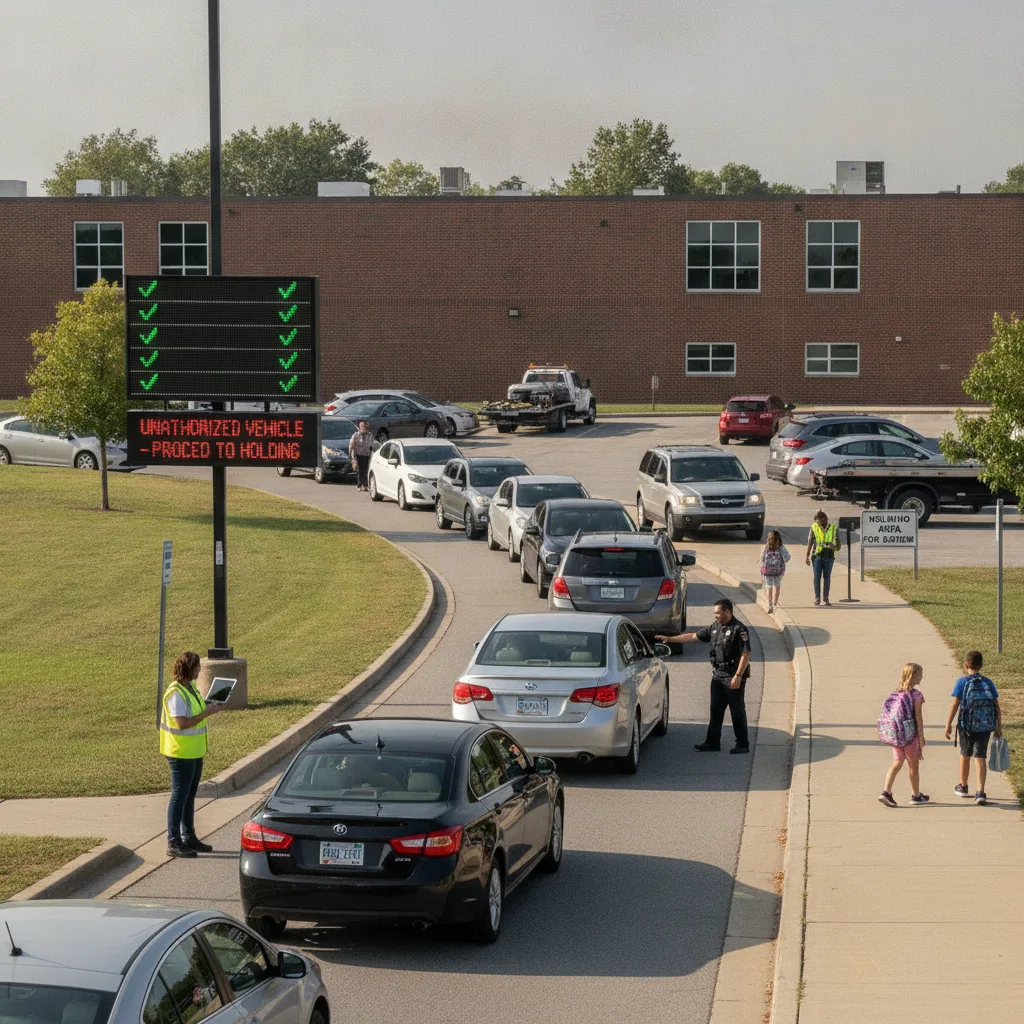
Direct answer: Treat the vehicle as a first-pass cue only, not proof of who is allowed to take a child. A five- or six-year-old cannot confirm the identity of the adult in the driver’s seat, cannot be expected to refuse an unfamiliar ride, and often cannot read or repeat a pickup password under pressure. Match the plate against a current, parent-maintained authorized list, confirm the adult visually before the student leaves teacher supervision, and give front-office staff a fast, quiet way to approve a same-day change without calling a child’s name across a crowded pickup lot.
This guide is for elementary principals, assistant principals, front-office managers, and the instructional aides, cafeteria staff, and parent volunteers who staff the curb during dismissal. It is written around the specific risk profile of a K-5 or K-6 campus, where the student being released cannot reliably participate in their own safety check.
Why five- and six-year-olds change the rules
At a middle or high school, a student can text a parent, recognize a stranger, or simply decline to get in an unfamiliar car. Most elementary students cannot do any of that. That single difference should drive the design of the workflow: the identity check has to happen before the student is walked to the vehicle, and it cannot depend on the student noticing that something is wrong.
Example: A family’s usual car pulls into the lane, but the driver is a new stepparent, a visiting grandparent, or a neighbor covering because a parent got stuck at work. The vehicle looks exactly right. The workflow should still hold that release for a quick office confirmation instead of letting a curb monitor juggling six cars at once wave the student out on the strength of a familiar bumper sticker.
The elementary handoff sequence
| Moment | What staff check | What a pass looks like |
|---|---|---|
| Vehicle arrives | Plate matches a vehicle on file for the family, or one added same-day by a parent | Lane monitor waves the car to the loading zone; no student is released yet |
| Driver confirmed | Adult in the vehicle is on the student’s current pickup list, or the office has cleared a same-day addition | Office sends a quiet signal to the curb, never a shouted name or grade |
| Student released | Teacher or aide walks the named student to the confirmed vehicle | One student, one confirmed adult, one vehicle — no releasing a sibling group on assumption |
| Handoff closed | Staff mark the student picked up in the same system the office used | No student still shows as waiting once the lane clears |
Same-day changes are the normal case, not the exception
Elementary campuses see an unusually high rate of last-minute pickup changes compared to older grades: a parent asks a neighbor to grab the kids because of a doctor’s appointment, a custody exchange moves earlier, an after-school program gets cancelled at 2:30 p.m. Treating every one of these as a rare exception overloads the front office at exactly the moment it has the least capacity to handle it. A workable process needs a simple, parent-facing way to add a driver for that day only — a text, a call logged by name and vehicle, or a parent portal entry — that automatically expires at the end of dismissal so it never lingers as a standing authorization. Campuses that still rely on laminated car tags and a paper sign-in sheet tend to struggle most with same-day changes; see why paper car tags fall short for modern dismissal for the specific failure points. A license-plate match at the curb gives the office a faster way to catch these same-day additions before a car reaches the front of the line, rather than discovering the mismatch only when the driver is already at the curb.
Staffing reality: who is actually watching the curb
Unlike a security office at a large campus, elementary pickup lanes are usually staffed by aides, cafeteria staff, or rotating parent volunteers — people who are not trained to make judgment calls about identity and who change from week to week. The verification step therefore has to be simple enough for a volunteer on their first shift: match a plate, look for a green or red signal, and radio the office rather than deciding on the spot whether a stranger “looks fine.” Principals who build the process around what a trained safety officer would do usually find it collapses the first week a substitute aide covers the lane. What principals should look for in dismissal software covers this staffing gap in more detail, since it shapes which tools are actually usable at 3:00 p.m. on a Friday.
Keeping verification from feeling like suspicion
Parents at this age band are often more emotionally invested in pickup than at any other grade — it is frequently their only daily face-to-face contact with the school. A verification process that feels like an accusation, or that repeatedly stops a well-known grandparent, erodes trust quickly. The fix is transparency: tell families up front exactly what is checked (the vehicle and the driver against a list they control), let them update that list themselves, and make corrections fast and low-drama rather than treating every mismatch as a security incident. A brief license-plate check that runs quietly in the background, flagging only genuine mismatches for office follow-up, tends to feel far less intrusive to families than a staff member stopping every car to ask questions.
What to measure before expanding the process
- arrivals matched to an authorized adult without a duplicate release
- same-day changes approved before the child reached the curb
- sibling groups released together and correctly
- handoffs held for a second check, and why
- students still unmatched at the final bell
Run the pilot long enough to see at least one messy same-day change and one substitute staffing the lane, not just a clean week.
Owner sign-off
- State the purpose and non-goals for verifying pickup vehicles at this elementary campus.
- Name who owns the normal path, the same-day exception, and the final override.
- Test with the actual staff and volunteers who work the curb, not just office administrators.
- Confirm contracts, pricing, support, integrations, data handling, and any custody-related legal requirements independently.
- Retain enough of a record to reconstruct any approval, denial, or correction if a family disputes it later.
Related PLACA.AI planning resources
Decision questions
What should be locked down before this goes live at an elementary campus?
The authorized-list source of truth, who can add a same-day driver, how staff signal an office decision to the curb without naming a child aloud, and who has final say on a disputed release.
What belongs in the pilot?
A normal week, at least one same-day driver change, one substitute covering the lane, and one sibling-group release, so the process is tested under real conditions before every grade uses it.
When should rollout pause?
If front-office staff cannot clear a same-day change before the child reaches the curb, if a volunteer cannot follow the signal-to-release step without help, or if a family’s authorized list is out of date at pickup time.
Plan a limited workflow review
Bring the current rule, process, exceptions, and success criteria for verifying pickup vehicles at an elementary school. PLACA.AI can help evaluate a bounded pilot without assuming another property’s workflow is the right answer.
Editorial refresh: July 22, 2026. Independently confirm current product capabilities, third-party features, pricing, contracts, governing requirements, and local rules before acting.
Data source: National Center for Education Statistics