

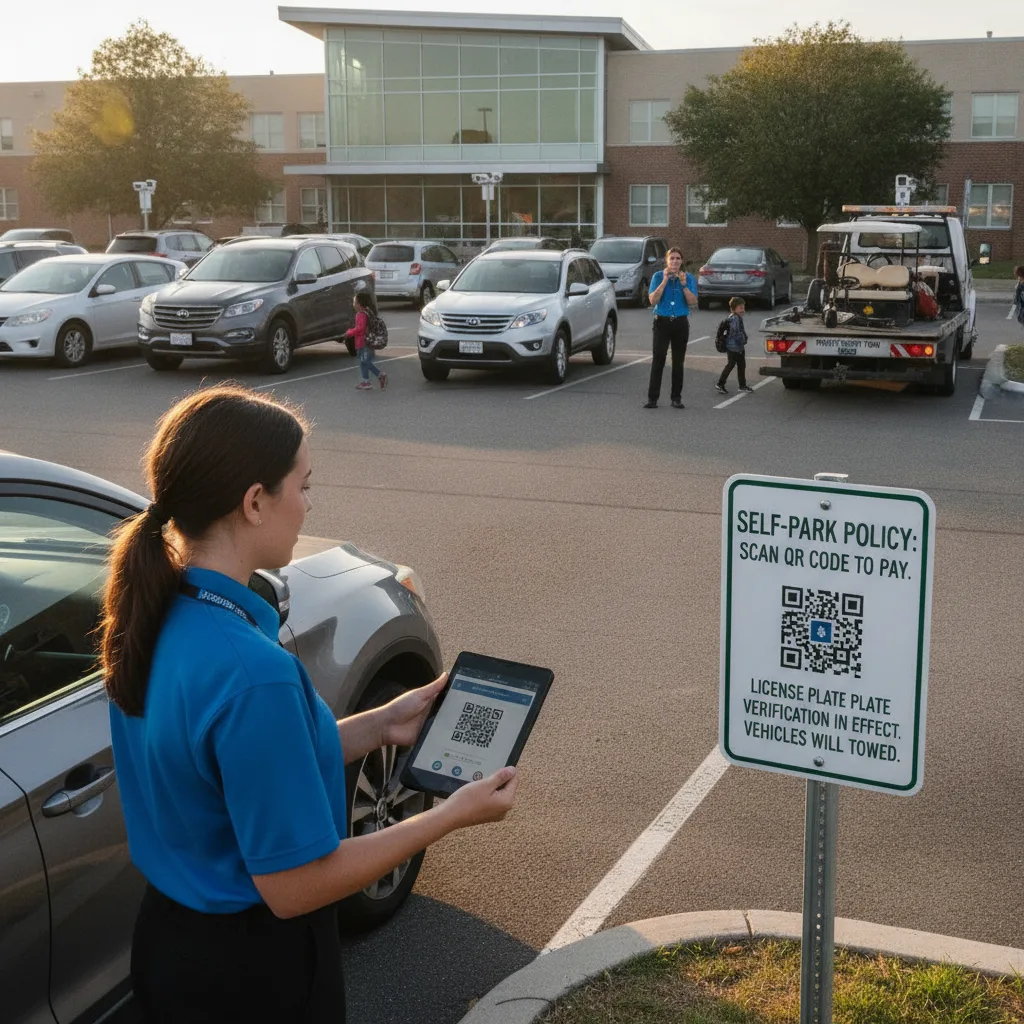
Direct answer: Event lots don’t have a steady trickle of arrivals to reconcile one at a time — they have a compressed surge, often thousands of vehicles in the hour before a gate or first pitch, followed by a single-direction egress crunch at the final whistle or last song. Self-parking compliance at an event lot is mostly a throughput problem wearing a compliance costume: if checking a plate takes too long, staff wave cars through unchecked to keep the line moving, and that’s where paid-pass fraud and unpaid entries both slip in. The fix that doesn’t need new hardware is separating the two things event lots currently conflate — “did this vehicle pay” and “is this vehicle allowed in this lane right now” — so a plate read at entry can validate a pre-purchased pass instantly without a staffer manually checking a barcode against a phone screen while a line backs onto the access road.
This guide is for event lot managers, traffic control leads, and the part-time or seasonal staff who cover event-day gates — whether the venue is a stadium, arena, fairground, or a leased overflow lot for a one-off event.
The surge is the compliance window, not an edge case
Most self-park compliance guidance assumes a steady arrival rate a staffer can check against, one car at a time. Event lots don’t work that way. Arrivals cluster hard in the 60-90 minutes before an event and again, in reverse, in the 20-30 minutes after it ends. Staffing for an event lot is also usually seasonal or part-time — the same crew may work a handful of events a year, not the same shift every day — so the compliance process has to survive being run by someone who hasn’t done it in three weeks, under a line of cars they can see growing in their mirror.
Pre-purchased passes bought through a ticketing or parking marketplace (platforms like SpotHero, ParkHub, or a venue’s own Ticketmaster-linked parking add-on) complicate this further: the pass is tied to an order, not necessarily to a specific plate, which means the vehicle that shows up may not match whatever plate was entered at purchase — sometimes because of a last-minute vehicle swap, sometimes because a pass was resold or shared. A workflow that hard-rejects any plate mismatch will stop legitimate guests who carpooled in a different car than they planned; one that ignores mismatches entirely opens the door to a single pass being used for multiple vehicles across a season.
Page-specific example: Simulate the 30 minutes before doors, running vehicles through at the rate your actual gate crew handles during a sellout, and check whether a plate mismatch on a valid pre-purchased pass can be waved through by the gate staffer with a recorded reason — without them having to stop the line to call a supervisor. Then simulate post-event egress and confirm the same lot isn’t relying on an entry-only check that has no record of who is still inside when the lot needs to close.
Event lot compliance: entry surge vs. post-event egress
| Phase | What typically breaks | What to confirm before go-live |
|---|---|---|
| Pre-event surge | Line backs up because plate checks require a manual barcode/phone lookup | Pass validation happens fast enough to not force staff to wave cars through unchecked |
| Plate-to-pass mismatch | Legitimate carpool swaps get treated the same as resold passes | Gate staff can record a reason and admit a mismatch without stopping the line |
| Day-of walk-up sales | Cash or QR walk-up payers use a separate, slower lane that bottlenecks | Walk-up payment resolves in roughly the same time as a pre-purchased pass check |
| Post-event egress | No record of which vehicles are still in the lot when it needs to close | Exit reads (or lack of them) inform lot-closure decisions, not just entry counts |
Staffing for a crew that isn’t there every week
Event-day staff often can’t be trained the way a full-time gatehouse attendant would be. The workflow needs to be simple enough that a seasonal hire’s second or third shift is enough to run it correctly: a clear default action (admit, flag, or deny) for each situation, and an obvious escalation path — a radio call to a shift lead, not a judgment call the gate staffer has to make alone while a line is forming behind them. Build the exception list around what actually happens at your venue: mismatched plates on valid passes, passes used at the wrong lot when a venue has multiple overflow areas, and vehicles arriving without any pass at all.
What belongs in a pilot
Test during an actual high-demand event, not a low-turnout weeknight — the failure modes only show up under surge conditions. Track average entry time per vehicle during the peak 30 minutes, the number of plate mismatches gate staff resolved without escalating, walk-up payment completion time relative to pre-purchased entry time, and whether the lot had an accurate count of remaining vehicles at closing. A workable pilot narrows the gap between pre-purchased and walk-up entry speed and gives the closing crew a real number to work from.
Before expanding across more events
- Confirm which pass marketplaces or ticketing integrations the lot needs to validate against, and how often each updates its data before an event.
- Assign a named shift lead who owns plate-mismatch exceptions during the surge window, separate from the gate staff waving vehicles through.
- Verify accessible-space allocation is protected from surge-driven overflow parking.
- Confirm contracts with any third-party parking marketplace or staffing agency independently before relying on their data feed.
- Keep a record of walk-up vs. pre-purchased volume by event type to right-size lane allocation for the next similar event.
Related PLACA.AI planning resources
Questions event lot managers ask
What if a pre-purchased pass doesn’t match the vehicle at the gate?
Give gate staff a way to admit the vehicle with a recorded reason instead of forcing a hard stop — carpool and last-minute vehicle swaps are common and shouldn’t be treated the same as pass resale.
How should walk-up (day-of) payers be handled differently from pre-purchased guests?
They need their own fast path, not a slower fallback lane — a bottlenecked walk-up lane creates the same wave-through pressure that lets unpaid entries slip in.
Do we need new gate hardware for this?
No — this is about how fast an existing plate read can validate against a pass or payment record, not about adding cameras or arms.
Plan a limited workflow review
Bring entry-time data from a recent sellout or high-demand event, your pass marketplace integrations, and your current plate-mismatch process. PLACA.AI can help evaluate a bounded pilot without assuming another venue’s surge pattern applies to yours.
Editorial refresh: September 18, 2026. Independently confirm current product capabilities, third-party features, pricing, contracts, governing requirements, and local rules before acting.
Data source: U.S. Department of Transportation