

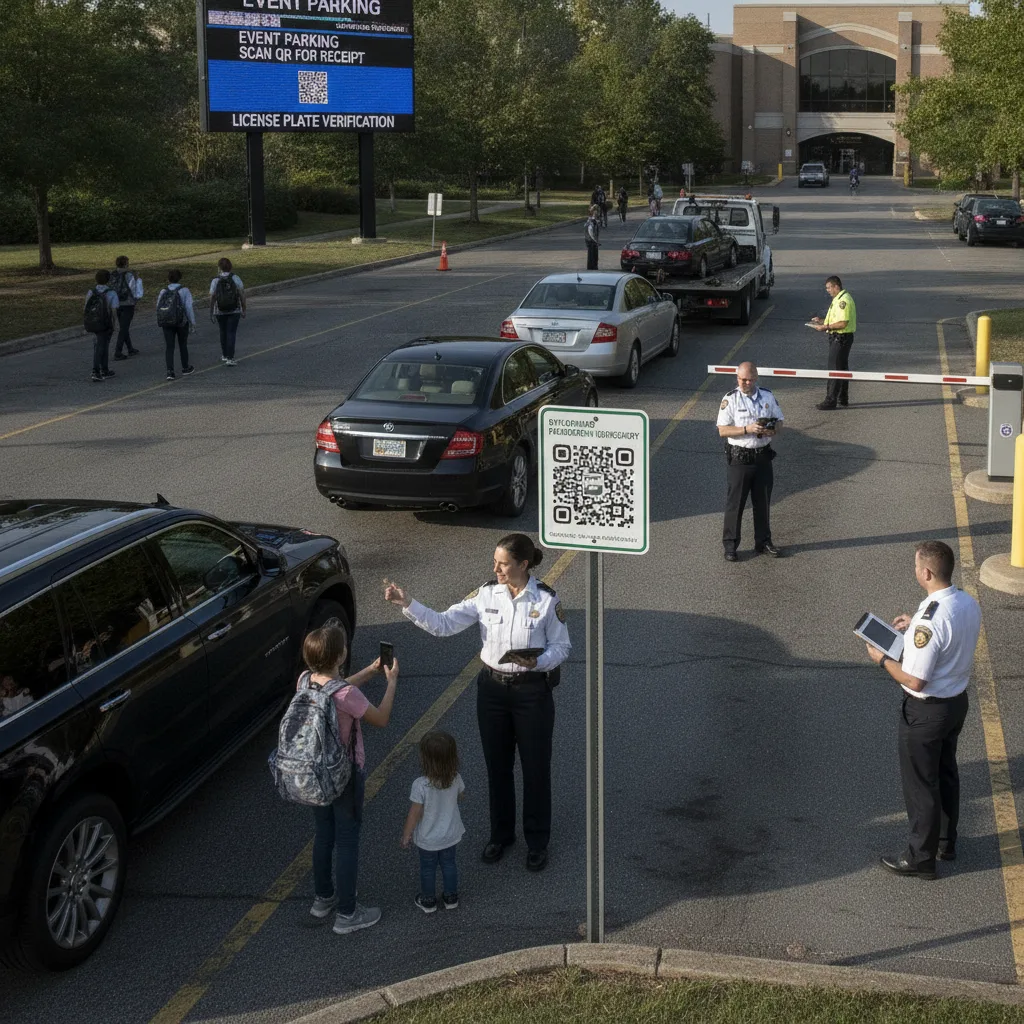
Direct answer: An event lot manager’s receipt problem is almost entirely one-off attendees — people who parked exactly once, for exactly one event, and need a receipt for a corporate reimbursement or client expense report days or weeks later. Unlike a monthly permit holder, they have no ongoing account, so the receipt has to be self-serve and findable by plate and date alone, without requiring them to remember a login or a confirmation email they may have deleted.
This is written for teams running parking for concerts, conferences, sporting events, and similar one-time gatherings, where most vehicles in the lot on any given day are there for the first and only time.
Why event parking receipts are a different problem than permit receipts
A monthly parker has an account, a payment method on file, and a history you can search. An event attendee typically has none of that — they scanned a QR code, paid once, and left. If their employer requires an itemized parking receipt for reimbursement (common for out-of-town conference attendees and vendor reps), the only way to reconstruct it after the fact is by plate and approximate date, because that’s the only information the attendee is likely to remember or have saved.
This matters most for events where a meaningful share of attendees are there on business — conferences, trade shows, and corporate-sponsored events routinely generate a wave of receipt requests in the following one to two weeks, well after your event staff has moved on to the next date.
What an event lot needs that a permanent lot doesn’t
| Requirement | Why it’s specific to event parking | What to build for it |
|---|---|---|
| Event name on the receipt | Attendee’s expense report needs to tie the charge to the specific event they attended | Auto-populate the event name and date into every receipt issued during that lot’s operating window |
| Plate-and-date lookup, no login required | One-time attendees won’t have or remember an account | A public self-serve lookup tied to plate plus approximate date range |
| Receipt availability window | Reimbursement requests often come in weeks after the event, not same-day | Keep session records searchable for at least 60–90 days post-event, not purged after the lot closes |
| Surge-period accuracy | Peak arrival waves can create near-duplicate timestamps for different vehicles | Plate capture at entry, not just a timestamp, to disambiguate near-simultaneous sessions |
Handling the post-event receipt wave
- Capture plate and event context at the point of payment, not just a generic timestamp, so a lookup weeks later can actually find the right session among hundreds parked the same day.
- Send the receipt immediately by email or text at checkout whenever an email or phone number is collected during payment, so most attendees never need to come back and ask.
- Publish a self-serve plate lookup for the subset who didn’t get (or saved) the automatic receipt, scoped to that event’s date range so a plate search doesn’t return results from unrelated lots.
- Route anything the self-serve tool can’t resolve — a misread plate, a shared vehicle, a payment that didn’t complete cleanly — to a named staff contact with a response-time target, since event attendees asking for reimbursement documentation are often on a deadline themselves.
A realistic scenario
A three-day conference runs a satellite overflow lot two miles from the venue, staffed only during event hours. A vendor rep parks there on day two, pays by QR code, and doesn’t save the confirmation text. Eleven days later, her company’s expense system rejects her mileage claim because there’s no itemized parking receipt attached. She emails your general contact address, which by now has no on-site staff to respond quickly. If the lot’s payment system captured her plate at entry and the event name is embedded in every receipt from that lot, a plate-and-approximate-date self-serve search resolves this in under a minute with no staff involvement. Without that, it becomes a multi-day email chain trying to match a description of “silver sedan, sometime on Saturday” against a spreadsheet.
Where this breaks down
Multi-day events create the most ambiguity — a vehicle that parked on more than one day of the same event needs receipts that clearly separate each session rather than merging into one total. Shared or fleet vehicles (a company van used by multiple reps across a conference) also need a way to split or annotate receipts by driver, since the plate alone won’t distinguish who incurred which charge. Build a manual escalation path for both cases rather than trying to force them through the same automated lookup that works for single-day, single-driver sessions.
Before the next event
- Confirm your payment flow captures plate and timestamp for every session, not just a card authorization.
- Set a retention window for session records that covers realistic reimbursement-request timing, not just the event weekend.
- Test the self-serve lookup yourself with a real plate before the event opens, not after the first complaint arrives.
- Name a staff contact and response-time target for the cases the self-serve tool can’t resolve.
For events where you also need mobile payment options for drivers who prefer paying from their phone rather than a kiosk queue, PLACA.AI’s plate-based session tracking can generate the itemized, event-tagged receipt automatically at checkout.
Related PLACA.AI planning resources
Common questions
How long should event lot session records stay searchable?
At least 60 to 90 days after the event, since corporate reimbursement requests routinely arrive weeks after the actual parking date, well past when most operators would otherwise archive or delete the data.
What if an attendee doesn’t remember which day they parked?
A plate-based search across the full event date range (rather than a single day) resolves most of these without staff involvement, as long as the plate was captured accurately at entry.
Should receipts include the event name automatically?
Yes — attendees submitting expense reports need the charge tied to a specific business event, not just a generic lot address, or their reimbursement request is more likely to be questioned.
Plan your next event’s receipt workflow
Bring your typical event size, staffing window, and current reissue-request volume. PLACA.AI can help evaluate a plate-based self-serve receipt lookup before your next multi-day event.
Editorial refresh: September 18, 2026. Independently confirm current product capabilities, third-party features, pricing, contracts, governing requirements, and local rules before acting.
Data source: U.S. Department of Transportation