

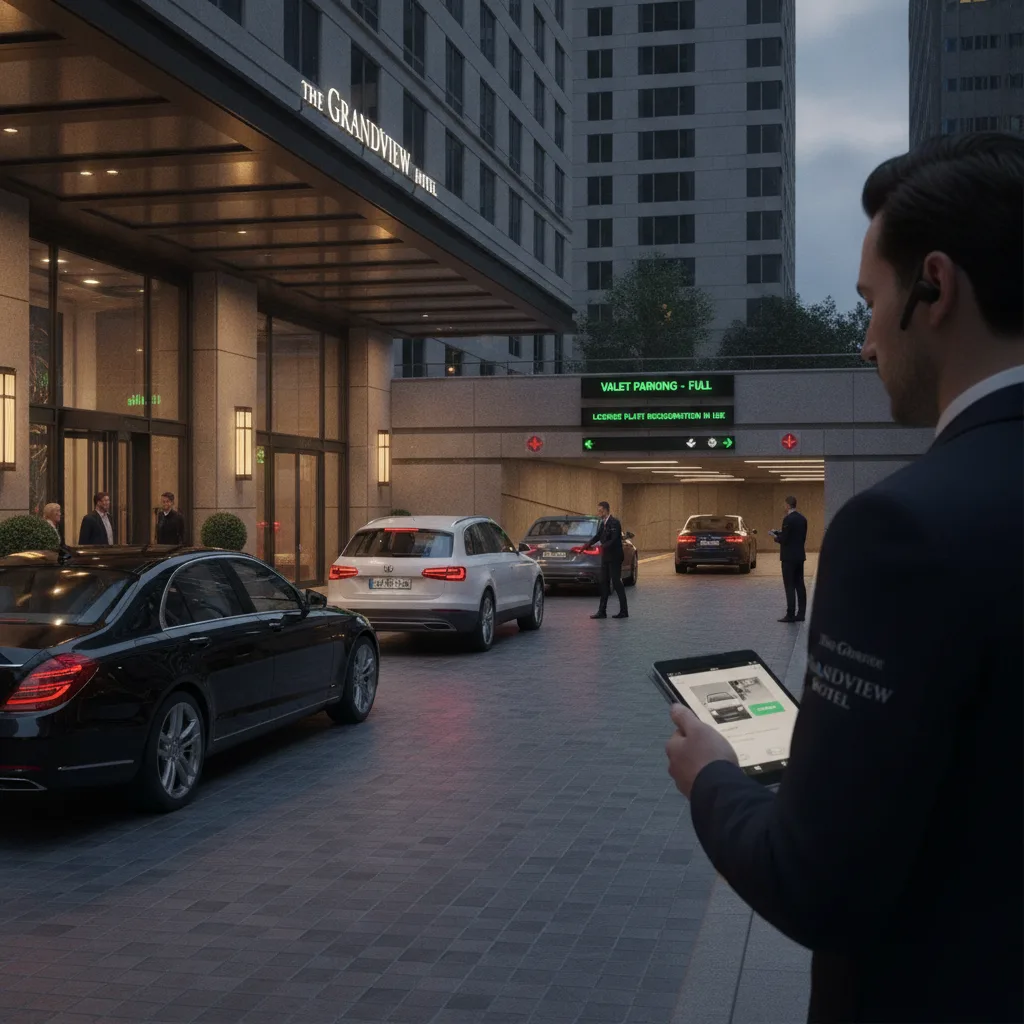
Direct answer: Event valet companies coordinate staffing on busy nights by building the shift around vehicle volume per hour, not a flat headcount, and by using ticketless vehicle recognition so runners don’t lose time matching paper tickets to cars in an unfamiliar lot. The core moves are: staff to the arrival and departure curve for that specific venue, cross-train runners so any of them can retrieve any car without hunting for a ticket stub, and build a real-time escalation path for the inevitable last-15-minutes rush at the end of the event.
Event valet is a different business from hotel or restaurant valet because the “site” changes every night. Your crew might work a ballroom gala on Friday and a stadium concourse on Saturday, with a different curb, different ramp grades, different number of entry points, and often a mix of your regular staff and day-of contract labor who have never parked a car at that venue before. That variability is exactly why staffing plans built around generic headcounts fail — the right crew size and role mix depends on the venue’s arrival curve, not a rule of thumb.
Build the shift around the arrival and retrieval curve, not a headcount
Most event venues have a predictable shape to the night even when the event itself varies: a slow trickle of early arrivals, a hard spike in the 30–45 minutes before doors or start time, a quiet middle period, and then a compressed retrieval surge when the event lets out — often more concentrated than the arrival wave because guests leave in a much tighter window than they arrive.
- Arrival wave: Staff heaviest at greeters and key-in — the bottleneck is usually how fast you can get a car off the curb, not how fast you can park it.
- Mid-event lull: This is when you rotate breaks, restock, and reposition floaters — not when you send people home early, because the retrieval surge is coming.
- Retrieval surge: Staff heaviest on runners and a dedicated curb lead who does nothing but manage the queue and call ahead on cars — this is where most guest complaints and most lost time actually happen.
If you’ve worked the venue before, use last time’s timestamped pull data (first car requested, last car returned, peak retrieval rate) as your baseline. If it’s a new venue or a one-off event, build your estimate from ticket sales or guest count and the venue’s number of curb lanes, then confirm it against the first 45 minutes of actual arrivals and adjust the retrieval-side staffing before doors close.
Why ticketless recognition matters more for event valet than any other segment
Hotel and residential valet crews work the same property every day and build muscle memory for where cars are parked and who’s driving what. Event crews rarely get that luxury — a runner might be working an unfamiliar lot layout with a mixed crew of full-timers and day-of contractors. Ticketless vehicle recognition removes the two things that slow an unfamiliar crew down most:
- No paper ticket to lose or misread. A torn, smudged, or misplaced valet ticket in a fast-moving retrieval line is one of the most common sources of delay and guest frustration at events — and it’s worse with a rotating crew that doesn’t know each other’s handwriting or shorthand.
- Any runner can pull any car. When the system identifies the vehicle by plate rather than relying on one runner remembering “the black SUV I parked,” you’re not bottlenecked on the one person who happens to remember where a specific car went. That matters enormously when half your crew is contract labor working their first (and maybe only) shift at that venue.
This is also a real advantage when a guest walks up without a ticket at all — lost tickets are common at events where people are carrying drinks, coats, and gift bags, not thinking about a stub in their pocket. A plate lookup gets that guest their car without a manual override process that stalls the whole line behind them.
Staffing roles for a single-night event crew
Curb lead
One person, dedicated, who does not park or retrieve cars. Their job is queue management, calling ahead to runners so a car is already moving before the guest reaches the curb, and being the first point of contact when something goes wrong — a disputed claim, a guest who can’t find their ticket, or a car that isn’t where the system says it should be.
Greeters and key control
At the arrival wave, you want enough greeters that a car is never idling at the curb waiting to be taken. Key control should be centralized — one station, one person accountable for where every set of keys is at any moment, especially with a rotating crew.
Runners and floaters
Staff runners to the retrieval surge, not the arrival wave — that’s usually the bigger bottleneck at events. Keep 1–2 floaters who aren’t assigned a fixed task; they cover breaks, jump on gridlock in the lot, and absorb the unpredictable stuff a single-night event always produces.
Escalation coverage
Name one supervisor per shift who has authority to make real-time calls — reassigning a runner, approving an exception for a guest without ID matching the reservation name, or deciding to open an overflow lot. On a one-night event you don’t have the luxury of “checking with the manager tomorrow.”
Managing a mixed crew of regulars and day-of contractors
A 15-minute pre-shift walk of the actual curb and lot layout with the whole crew — regulars and contractors together — prevents more problems than any written instruction sheet. Assign contract staff to the roles with the shortest learning curve (greeters, key control) and keep your experienced regulars on runner and curb lead, where site familiarity and judgment matter most. If your system supports plate-based lookup, make sure every crew member — including day-of hires — knows how to use the lookup on a phone or handheld before doors open, not mid-rush.
FAQ
How many valet staff do we need per 100 expected vehicles?
There’s no universal ratio — it depends on curb lanes, walking distance to the lot, and how compressed the arrival window is. Use your own timestamped data from a similar past event as the starting point, and treat industry rules of thumb as a rough sanity check only, not a plan.
What’s the biggest staffing mistake on event nights?
Staffing evenly across the night instead of loading the curb lead and runners toward the retrieval surge at the end. Most complaints happen in the last 20 minutes of an event, not the first.
How do we handle a guest who lost their ticket?
With ticketless vehicle recognition, a plate lookup tied to the guest’s name or a quick ID check resolves this without stalling the curb queue. Without it, have a documented manual verification step so the crew isn’t improvising under pressure.
For more on structuring valet operations for one-night and recurring events, see the valet operations knowledge hub, the valet parking software for venues overview, and the ticketless valet system guide.
Plan your next event’s valet staffing
Talk to PLACA.AI about setting up ticketless vehicle recognition for your next high-volume event so your crew can spend the night moving cars instead of chasing tickets.
Data source: U.S. Department of Transportation