

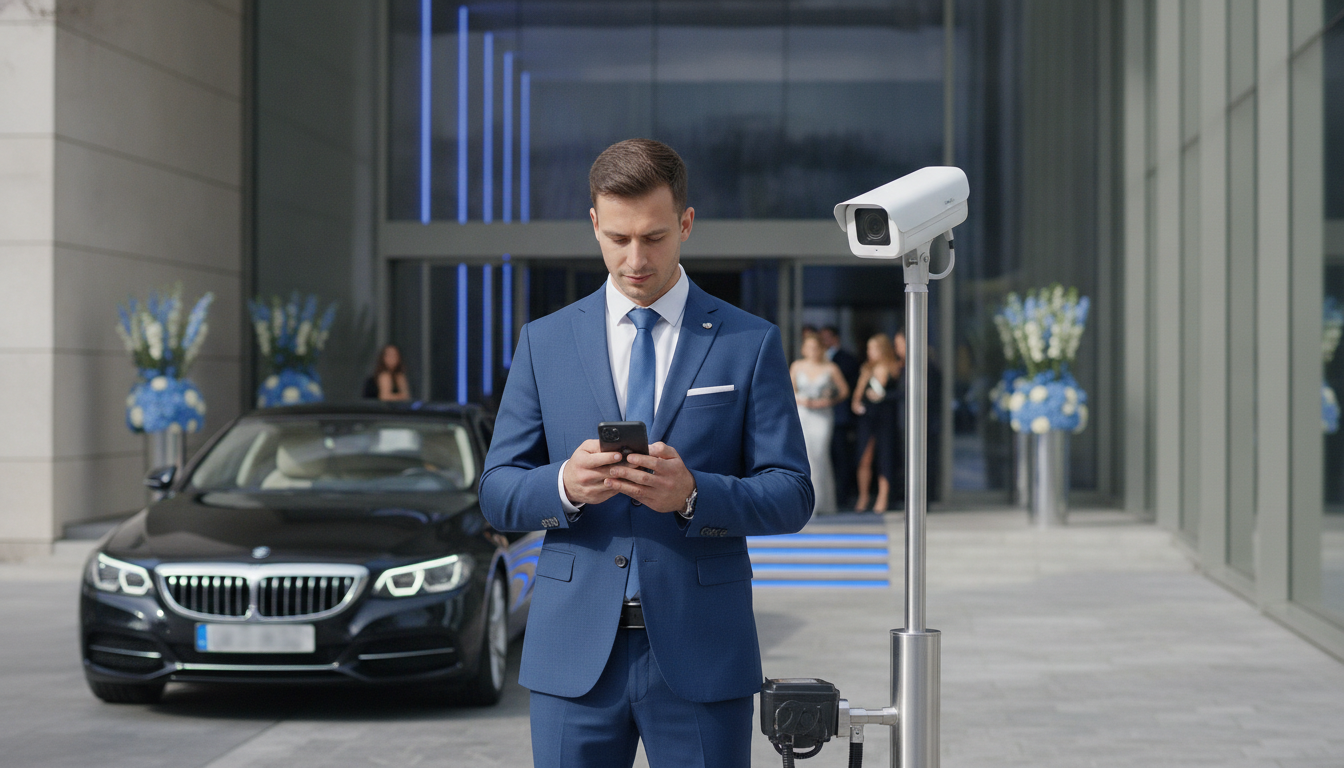
Direct answer: Event valet companies work a different site every time — a wedding venue this weekend, a corporate gala next week, a private estate the week after — with no fixed infrastructure and guests who will never interact with you again. SMS has to work with zero setup on the guest’s end: no app, no account, just a phone number captured at drop-off and a plate-linked text thread that works whether you’re running the job from a folding table on a lawn or a proper stand outside a hotel ballroom.
The constraint that shapes everything: you’re a guest at someone else’s venue every time
Unlike a restaurant or hotel valet team that works the same stand every night, an event valet company sets up fresh at a different site for nearly every job — often outdoors, often without existing signage or fixed drop points, and often for guests who have no prior relationship with your brand and won’t again. That changes what “good” SMS communication looks like. You can’t rely on guests recognizing your company name in a text. You can’t assume reliable cell signal at every venue (rural estates and historic properties are common trouble spots). And you’re frequently working under a client’s brand — a wedding planner, a corporate events team — who wants the communication to feel like part of their event, not like a third-party vendor’s system.
Building SMS for a one-night engagement
1. Capture the phone number fast, at drop-off, with zero friction
Guests arriving at a wedding or gala are not filling out a form. The number capture needs to happen in the same motion as the vehicle handoff — a quick text-to-confirm, or a number entered by staff at the stand — with the confirmation text arriving before the guest has walked ten feet toward the entrance.
2. Skip anything that requires an app or account
A one-time guest at a one-time event will never install an app for it. Plain SMS, tied to the vehicle’s plate rather than a ticket stub, is the only channel that reliably works for an audience you’ll likely never see again. This also solves the physical-ticket problem for formalwear — nobody wants to carry a paper stub in a tuxedo or a clutch all night.
3. Brand the message to fit the client’s event, not just your company
When you’re working a corporate client’s event or a wedding, a text that says “Placa Valet: your car is ready” can feel like advertising intruding on someone else’s occasion. Where possible, use a sender name or short message format that fits neutrally into the event rather than pushing your own branding — check with your client on what they’d prefer for a high-profile event.
4. Plan for weak or nonexistent signal at the venue
Historic estates, rural venues, and some hotel ballrooms have notoriously bad cell coverage. Scout this during your site walk before the event, not the night of. If signal is unreliable, have a visible staffed pickup point and clear verbal instructions as your primary system, with SMS as a supplement rather than the only channel guests can rely on.
Handling the end-of-night rush
Weddings, galas, and corporate events all share one pattern: relatively slow arrivals over hours, then a sudden, concentrated departure surge at the end. A few practices that matter specifically for one-off events:
- Pre-position for the known end time. If the client’s timeline says the event wraps at 11pm, start staging vehicles and preparing the first wave of retrieval before guests start requesting, the same way you’d plan any other logistics for the night.
- Give clear guidance for large groups leaving together. Wedding parties and corporate groups often want to leave in a cluster. A simple group-coordination approach — texting a lead contact for the group, or staggering pickup by table or department — avoids a pileup of vehicles at once.
- Keep a manual fallback ready at all times. Formalwear, alcohol, and an unfamiliar venue are a combination where some guests simply won’t engage with a phone. Staff should be ready to hand-match a guest to their vehicle without relying on the text thread if needed.
What to review with your client after the event
Event valet work lives or dies on client relationships and referrals, so it’s worth a short debrief covering how retrieval timing went, whether any guests complained about wait times or confusion, and whether the SMS branding felt appropriate for their event. This kind of feedback loop, done consistently, is what turns a one-off booking into a repeat client.
FAQ
Do we need consent language for a one-time event guest the same way a hotel does for repeat guests?
Yes — get a brief opt-in at the point of number capture, even for a single-use event. It protects you and keeps guests comfortable, since they didn’t choose to be your customer, they’re attending someone else’s event.
How do we handle a venue with genuinely no cell signal?
Fall back to a fully staffed, verbal system for that job and treat SMS as unavailable rather than trying to force it — scout signal quality during your pre-event site visit so this is planned, not discovered live.
Should pricing or staffing change for events where SMS communication is central to the plan?
Factor phone-number capture and message monitoring into your staffing plan for any event over a certain guest count — someone needs to own watching for delivery failures and stepping in manually when needed.
See PLACA.AI’s valet parking software for venues page and the ticketless valet system overview for how plate-based systems adapt to temporary, site-by-site setups. The valet parking knowledge hub covers broader operational planning.
Running valet for weddings, galas, or corporate events at different sites each time? Talk to PLACA.AI about a setup that travels with you.
Data source: U.S. Department of Transportation