

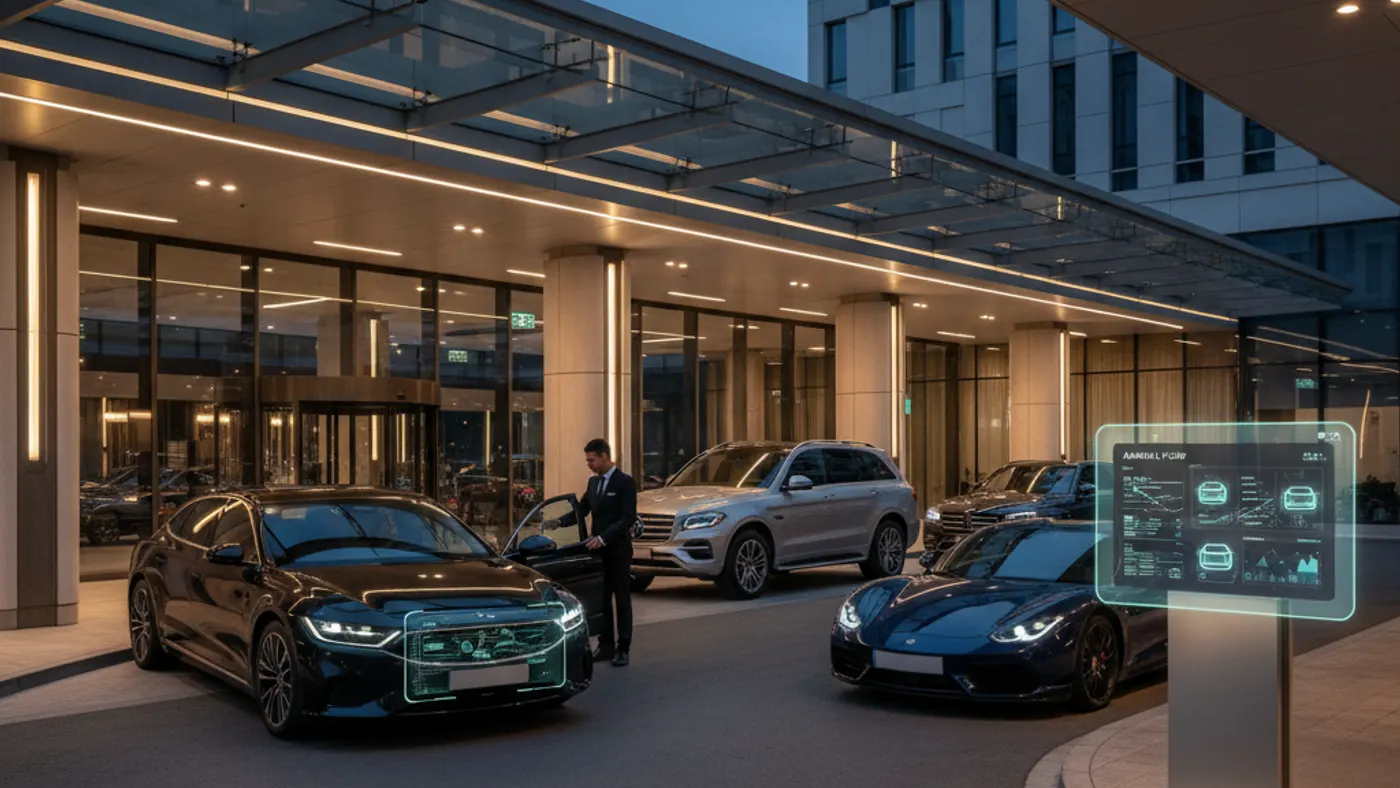
Direct answer: Event valet companies speed up retrieval by solving the problem hotel or venue valet teams don’t have: every job is a brand-new, unfamiliar lot, set up that same day, staffed by a crew that’s never parked a car on that property before, with everyone leaving in one 30-45 minute wave at the end of the night. Ticketless vehicle recognition helps because it replaces “remember where you put it” with a lookup that works the same way regardless of how unfamiliar the lot is — which matters enormously when your team has zero institutional knowledge of the site.
Why event valet retrieval is the hardest version of this problem
A hotel valet team works the same garage every shift for years. An event valet company might work a country club on Friday, a private estate on Saturday, and a downtown rooftop venue on Sunday — often parking on grass, in a repurposed lot, or across a scattered combination of on-site and overflow spaces that only exist for one night. There’s no accumulated muscle memory about “the third row always fills up first.” Every job starts from zero, and every job ends the same way: everyone wants their car within the same 30-minute window, right after the reception ends or the last speaker wraps.
That combination — unfamiliar lot, temporary layout, single-wave exit — is why paper tickets and radio call-outs fail events specifically. A runner who parked 150 cars over four hours has to reconstruct where each one is from a torn ticket stub while a line is forming, on a lot they may be seeing clearly for the first time in daylight versus how it looked at drop-off.
What actually slows down event retrieval
No fixed reference points
Hotel garages have level numbers and painted lines. A tented lawn or a gravel overflow lot doesn’t. Staff improvise zone names on the fly (“past the oak tree,” “second row by the fence”) that only make sense to the person who invented them. A system that logs vehicle location by scan or photo at drop-off — rather than relying on a hand-written zone name — survives the fact that your “map” for the night didn’t exist yesterday.
Crew that’s meeting each other, and the lot, for the first time
Event staffing is often a mix of a core team and day-of hires. Retrieval speed shouldn’t depend on whether the runner working the west end happens to be someone who’s worked with your company for years. If vehicle location is looked up rather than remembered, a first-shift runner performs close to your most experienced captain.
One departure wave, not a steady trickle
Unlike a restaurant or hotel, an event has a hard end time and nearly everyone leaves inside the same half hour. There’s no time to “catch up” once the queue builds — the plan has to be staged before the first guest asks for their car, not built reactively once the line starts.
A retrieval plan built for one-night jobs
- Walk the lot before drop-off starts and set zones on the spot. Even a temporary lot needs a quick zone plan communicated to the whole crew at the pre-shift huddle — but the system of record, not memory, should be what runners rely on once cars start arriving.
- Capture vehicle and location together at drop-off. A scan or plate capture tied to the parked spot at the moment the car is parked removes the dependency on a ticket stub surviving four hours in someone’s pocket.
- Stage runners near the exit 20-30 minutes before the event’s scheduled end. Don’t wait for the first retrieval request — event end times are known in advance; use that.
- Run one shared queue, not separate lists per runner. With guests requesting cars by app, text, and walk-up simultaneously, a single ordered queue prevents duplicate dispatches and skipped requests.
- Debrief every event while it’s fresh. Because no two lots are the same, the useful lessons are about setup speed and zone clarity, not long-term trend data — capture them the same night.
What to track
- Time from last-call announcement to average vehicle delivered — the single number that predicts whether guests leave happy or annoyed.
- Retrieval time for day-of/first-shift staff vs. core crew — a large gap points to a setup or briefing problem, not a staffing problem.
- Duplicate or missed retrieval requests during the peak exit wave, a sign the queue isn’t actually unified across intake channels.
FAQ
How do we set this up fast enough for a one-day event?
Setup is mostly about drop-off capture and zone naming, both of which can be defined at the pre-shift walkthrough. The system doesn’t need weeks of lead time the way a permanent garage installation might.
What about venues with no cell signal or spotty connectivity?
Plan for offline capture and sync as a fallback for remote estates or rural venues — confirm this with your vendor before booking a job at a site you haven’t worked before.
Does this help with the exit rush specifically, or just day-to-day operations?
It helps most at the exit rush, since that’s where event valet loses the most time — a location lookup at the moment of request beats reconstructing “where did we put that one” while a line is forming.
For more on setting up a ticketless system for one-off and recurring events, see the valet parking knowledge hub, the ticketless valet system overview, and valet parking software for venues.
Running valet for weddings, galas, or corporate events on lots you don’t control day-to-day? Book a demo and see how quickly it sets up for a single event.
Data source: U.S. Department of Transportation