
Direct answer: Florida law limits how much an HOA or condo association can restrict a resident’s right to install or use an EV charging station — associations generally cannot prohibit a unit owner from installing a charger at their own parking space, though the association can set reasonable rules about location, aesthetics, and shared-equipment scheduling. That legal backdrop changes how Florida associations should approach charging-space misuse: the enforceable rule is about dwell time, shared-equipment access, and safety, not about whether a resident is “allowed” to charge in the first place.
This is written for Florida association boards, managers, parking or ARC committees, and the residents and charging-equipment vendors involved wherever the community has installed or is considering shared EV charging — whether that’s a handful of amenity-area stations or individually installed chargers at limited common-element spaces.
The Florida-specific starting point
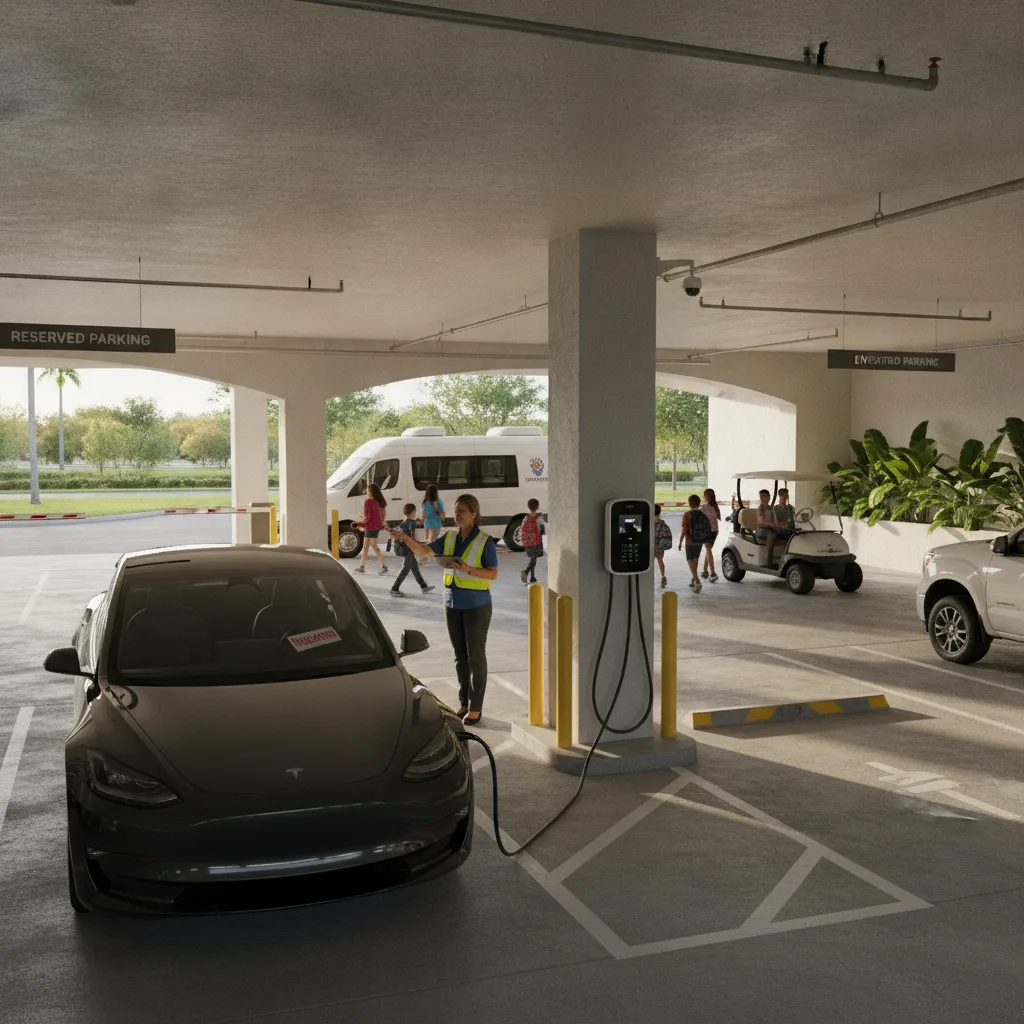
Two different situations come up in Florida communities and they need different rules. The first is an owner-installed charger at their own deeded or assigned space — under Florida’s statutory protections for EV charging installations, the association’s role is mostly limited to reasonable placement, permitting, and safety standards, not blocking the installation itself. The second is shared, association-owned charging equipment at a common area — here the board has much more latitude to set usage rules, dwell limits, and fees, because it’s managing a shared amenity rather than restricting an individual owner’s rights.
Conflating the two is where associations get into trouble. A board that tries to apply “shared amenity” rules (like time limits or usage fees) to an owner’s privately installed charger may be overstepping; a board that treats association-owned shared chargers as an unrestricted individual right ends up with one resident occupying the only two stations for hours at a time with no recourse for anyone else.
Florida EV policy map
| Charger type | Who controls it | What the association can reasonably require |
|---|---|---|
| Owner-installed at a deeded/assigned space | Individual owner, subject to statutory protections | Placement, permitting, and safety standards — not a blanket prohibition or unrelated usage fee |
| Association-owned shared station | The association, as a common-area amenity | Posted dwell limits, session fees, and a waitlist or reservation system |
| Non-EV vehicle in a marked space | N/A — standard parking rule applies | Enforce as a regular reserved-space violation, independent of any EV-specific rule |
| Equipment fault at a shared station | Association’s maintenance responsibility | Suspend dwell enforcement at that unit until repaired, and document the outage |
Building the policy in the right order
- Confirm which chargers are owner-installed versus association-owned before writing a single rule — the two categories need genuinely different governance, not one blended policy.
- For shared stations, set a posted dwell limit and grace period tied to session completion, and make it consistent with any fee structure the board has adopted.
- For owner-installed chargers, limit association involvement to placement and safety review under the applicable statutory framework, not to usage scheduling.
- Route any statutory question to counsel before adopting rule language. EV-charging rights and reasonable-restriction standards are specific enough that a generic parking-rule template usually isn’t sufficient on its own.
Where board authority ends
Anything touching statutory owner rights to install charging equipment, accessibility accommodations, or common-element modifications needs counsel review before the board acts — this is a different category from routine parking enforcement. For the broader enforcement-authority question in Florida associations, see how other Florida associations handle disputes under §720.305 before applying dwell rules against a resident who believes their charger installation is statutorily protected.
Piloting the shared-station rules
Before adopting dwell limits community-wide, run them at one shared charging location for a full billing cycle. Track how many sessions ran past the posted grace period, how many equipment-fault reports were confirmed real, and whether the fee or reservation structure actually freed up capacity during peak demand. Associations documenting shared-space usage with license plate recognition get an independent, timestamped record of which vehicle occupied a shared station and for how long — useful specifically because charger network data alone often doesn’t tell you whether the vehicle physically stayed after the session ended. It’s also worth reviewing your association’s broader towing and enforcement documentation approach so shared-charger enforcement follows the same evidentiary standard as everything else.
Questions to settle
What must be approved first for handling EV charging-space misuse in Florida associations?
Determine whether the charger in question is owner-installed or association-owned, since the association’s enforcement authority differs significantly between the two under Florida law.
What should the pilot reproduce?
A normal completed-session dwell case at a shared station, a non-EV vehicle occupying a marked space, and one equipment-fault report, run through a full billing cycle.
When should rollout stop?
Stop when a resident raises a statutory installation-rights question, when equipment faults aren’t independently confirmed, or when the fee structure hasn’t been reviewed against the association’s governing documents.
Related PLACA.AI planning resources
Plan a limited workflow review
Bring the current rule, process, exceptions, and success criteria for handling EV charging-space misuse in Florida associations. PLACA.AI can help evaluate a bounded pilot without assuming another property’s workflow is the right answer.
Editorial refresh: July 22, 2026. Independently confirm current product capabilities, third-party features, pricing, contracts, governing requirements, and local rules before acting.
Data source: Community Associations Institute