

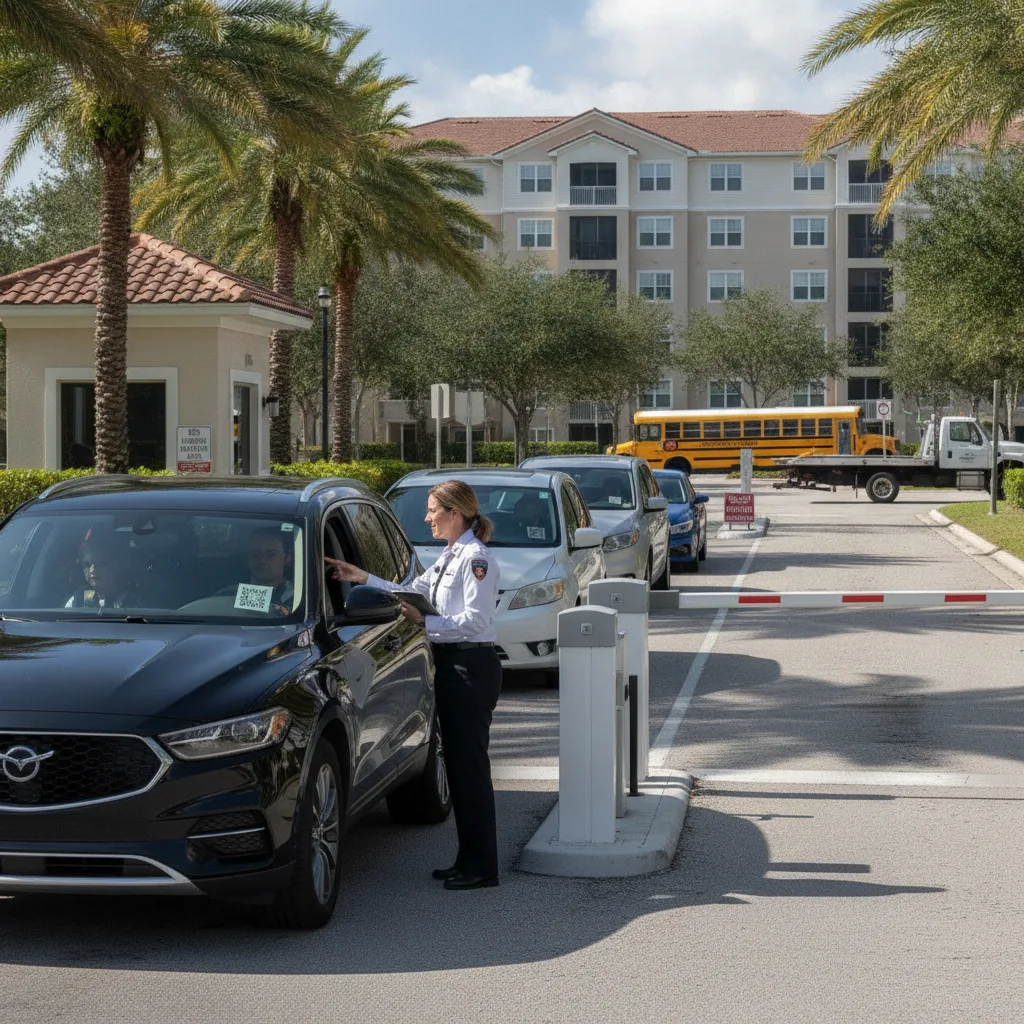
Direct answer: Florida associations have a registration churn problem most other states don’t see at the same scale: a meaningful share of owners are seasonal residents who swap which car is on-site twice a year, rental turnover in condo-heavy buildings means the vehicle list changes with every new tenant, and storm season creates a short window where evacuation and generator-delivery vehicles need to be handled outside the normal process. A registration policy that assumes one car per household, registered once, doesn’t survive contact with any of that.
This is written for Florida boards and their community association managers dealing with that turnover directly — not the legal notice-and-hearing requirements for fines, which is a separate topic covered elsewhere on this site. Registration here means keeping the list of who’s actually authorized to park on the property accurate as residents, tenants, and seasons change.
The three sources of churn a Florida registration policy has to handle
| Source of churn | What breaks a static registration list | What a working policy handles |
|---|---|---|
| Seasonal residents | An owner registers a vehicle in January, leaves for the summer, and a different vehicle (or a renter’s) shows up on the property with no update to the record | A seasonal-swap process: a short form to update the active vehicle when the resident’s presence changes, not a full re-registration |
| Rental and tenant turnover | A new tenant moves in and either doesn’t register at all or inherits the previous tenant’s still-active record | Registration tied to the lease or occupancy record, so a new tenant triggers a new registration and the old one closes automatically |
| Storm season | Evacuation, generator delivery, and repair vehicles show up outside the normal registration process and get flagged as unauthorized | A short-term temporary registration category with a fixed expiry, used specifically during declared weather events |
Building a registration process that survives a Florida year
- Build in a seasonal-swap path. Don’t make a returning snowbird re-register from scratch — a short update to the active vehicle on an existing record is faster and more likely to actually get used.
- Tie registration to occupancy, not just ownership. In rental-heavy buildings, a registration process that only triggers off ownership changes will miss most of your actual turnover.
- Pre-approve a temporary category for storm events. Deciding the rules for evacuation and repair vehicles during an actual storm is worse than deciding them in advance and just activating the category when needed.
- Keep the manager’s role clear. If your community association manager is the one processing registration changes, make sure they’re working from the board-approved version of each of these categories, not improvising when a resident calls mid-season.
If guest parking volume compounds the seasonal pattern — which it often does in Florida communities with a lot of visiting family during winter months — our guide on stopping guest permit sharing covers that adjacent problem. And communities dealing with the operational side of enforcement turnover alongside registration should also see reducing board enforcement disputes in Florida associations.
Why “just re-register everyone every January” doesn’t work
It’s tempting to solve seasonal turnover with a blanket annual re-registration requirement, but in practice that just shifts the problem: residents who are out of state in January miss the window, tenants who moved in mid-year get caught by a deadline that doesn’t match their lease, and the board ends up processing a flood of registrations in a short window instead of a manageable trickle throughout the year. A rolling, occupancy-triggered process is more work to set up once and considerably less work to run every year after that.
Questions to answer before your next board meeting
- Does your registration process have a real path for a seasonal resident to swap their active vehicle without a full re-registration?
- Is registration tied to lease or occupancy changes in rental units, or only to ownership changes?
- Do you have a pre-approved temporary vehicle category ready before the next named storm, or would the board be deciding it in the moment?
- Is your manager working from a current, board-approved version of each of these categories?
Related PLACA.AI planning resources
Plan a limited workflow review
Bring your current registration form, how seasonal swaps are handled today, and your storm-season plan for temporary vehicles. PLACA.AI can help evaluate whether an automated plate record would make seasonal and rental turnover easier to track without manual re-registration.
Editorial refresh: September 18, 2026. Independently confirm current product capabilities, third-party features, pricing, contracts, governing requirements, and local rules before acting.
Data source: Community Associations Institute