

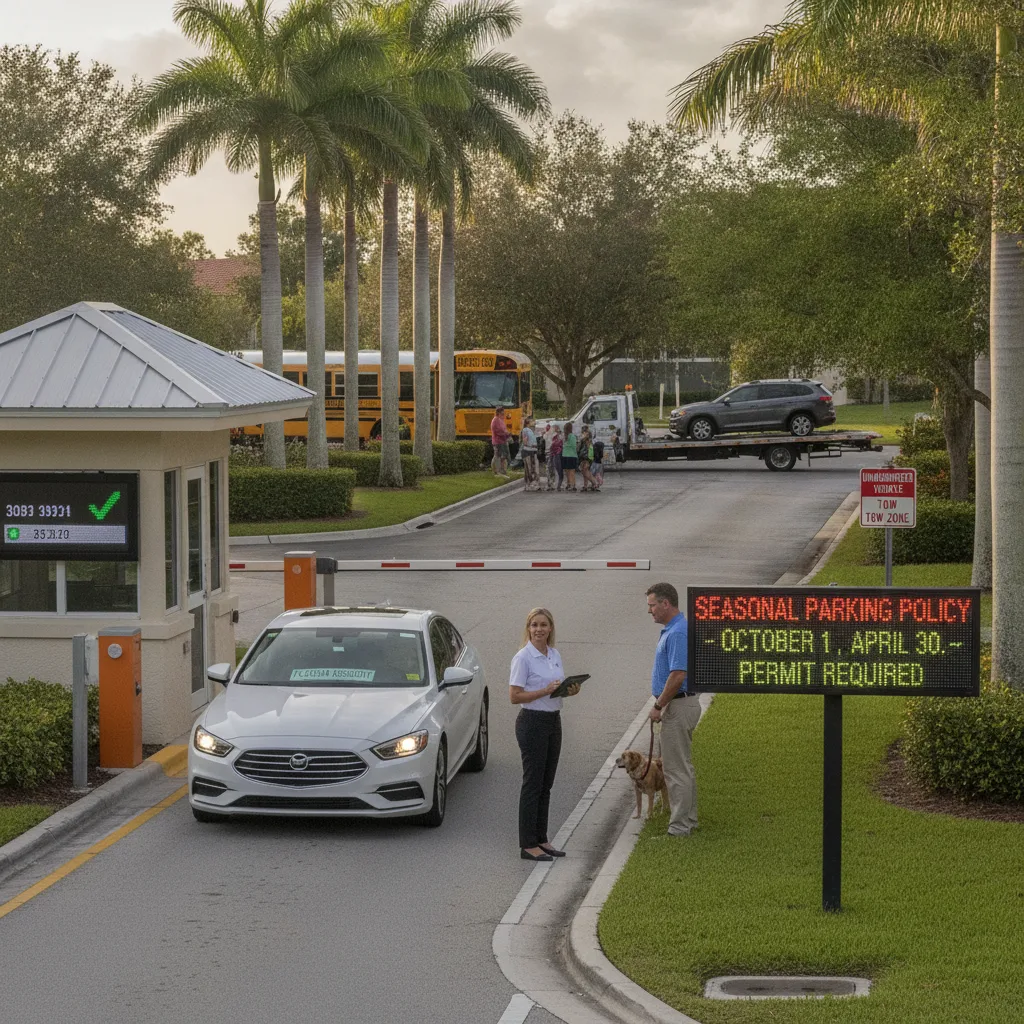
Direct answer: Florida’s seasonal parking problem is really a snowbird calendar problem. A large share of units sit empty from roughly May through October, then fill back up in a compressed window from late October through December as part-time residents return — often in a different vehicle than the one on file, and often before the association has finished processing last season’s departures. Build the seasonal record around dated arrival and departure windows tied to the individual owner, not a single community-wide “season start” date, because snowbird arrival is staggered across weeks, not a single day.
This guide is for Florida association boards, on-site and portfolio managers, front-desk or gate staff in seasonal buildings, and the committees that field complaints every October when the parking lot suddenly fills back up. It assumes a meaningful share of your units are seasonally occupied rather than year-round.
The specific failure pattern in seasonal Florida buildings
Two things happen every year in the same order. First, departing owners in the spring don’t always tell the association they’re leaving — they just stop showing up, and their vehicle sits in an assigned space for weeks or months with no record showing it’s a long-term departure rather than a short trip. Second, returning owners in the fall frequently arrive with a rental car, a newly purchased vehicle, or a car driven down by a family member, none of which match the plate on file from the prior season. If the parking roster isn’t re-verified at check-in, the association is enforcing against a plate that hasn’t been in the state in six months while waving through a car it has no record of.
There’s also a hurricane-season overlap worth planning for separately: owners who leave a vehicle behind during evacuation season need a documented “stored, inactive” status distinct from an active parking violation, so a storm-season sweep doesn’t tow or fine a car that’s simply been left in place during an evacuation window.
Florida seasonal parking calendar
| Window | What typically happens | What the association should require |
|---|---|---|
| Spring departure (roughly April–May) | Owners leave without formally notifying the office; vehicle stays parked | A departure notice with a return date estimate, and reclassification of the parked vehicle as inactive/stored |
| Off-season (June–September) | Unit may be rented short-term or left vacant; hurricane season is active | Separate rental-tenant registration with lease dates; documented storm-evacuation status for any vehicle left on site |
| Fall return (October–December) | Owners arrive in a different vehicle than last season, often within a compressed multi-week window | Re-verification of plate and vehicle at check-in — not automatic reactivation of last year’s record |
| Full season (January–March) | Peak occupancy; guest and visitor volume also peaks | Standard enforcement, with capacity for the higher guest-parking volume this period brings |
Running the changeover as staggered arrivals, not a single date
- Track departure and return by owner, not by season. Each seasonal unit should have its own departure and expected-return window rather than being reset on a single board-set community date.
- Require re-registration on return, every year. Don’t auto-reactivate last season’s plate. Ask for current vehicle information as part of the returning-owner check-in.
- Flag vehicles parked past a departure estimate. If an owner’s stated departure window has passed and their vehicle is still on site with no update, that’s a case for outreach, not automatic enforcement — it may be a delayed trip or a family member using the unit.
- Separate “stored during evacuation” from “parking violation.” During hurricane season, give staff a fast way to mark a vehicle as intentionally left in place so it isn’t swept up in unrelated enforcement.
Where Florida law and governing documents matter
Florida community associations operate under specific statutory notice and due-process requirements before towing or fining a vehicle — see how other Florida associations handle enforcement under §720.305 before applying seasonal parking rules against a returning owner’s replacement vehicle. Rental registration, guest limits during peak season, and any towing action still need to route through the association’s counsel-reviewed process, not a front-desk judgment call. This is worth reviewing alongside your community’s broader towing and enforcement documentation workflow.
Test it on one building or phase first
Before rolling this out across an entire association, run the fall re-verification process on one building or phase during a single return window. Track how many returning owners needed a correction to their vehicle record, how many departure-window flags turned out to be false alarms, and how long re-verification adds to front-desk check-in. Associations using license plate recognition for daily lot verification get a same-day answer on which plates are actually present on site, which removes a lot of the guesswork around whether a “departed” vehicle has quietly returned.
Practical questions
What should trigger re-verification instead of automatic renewal?
Any gap since the owner’s last confirmed departure, a different plate showing up at the assigned space, or the start of the fall return window — treat all three as reasons to re-confirm rather than assume last season’s record still applies.
What should the pilot reproduce?
A normal returning owner, a delayed return past the estimated date, and a storm-season stored vehicle, so staff have handled all three before the full building turns over in October.
When should enforcement stop and go to the board?
When a vehicle can’t be matched to any resident record, when an owner disputes a fine tied to a seasonal misunderstanding, or when the statutory notice requirements haven’t been met — these need counsel or board review, not front-desk resolution.
Related PLACA.AI planning resources
Plan a limited workflow review
Bring the current rule, process, exceptions, and success criteria for managing seasonal resident parking changes in Florida associations. PLACA.AI can help evaluate a bounded pilot without assuming another property’s workflow is the right answer.
Editorial refresh: July 22, 2026. Independently confirm current product capabilities, third-party features, pricing, contracts, governing requirements, and local rules before acting.
Data source: Community Associations Institute