

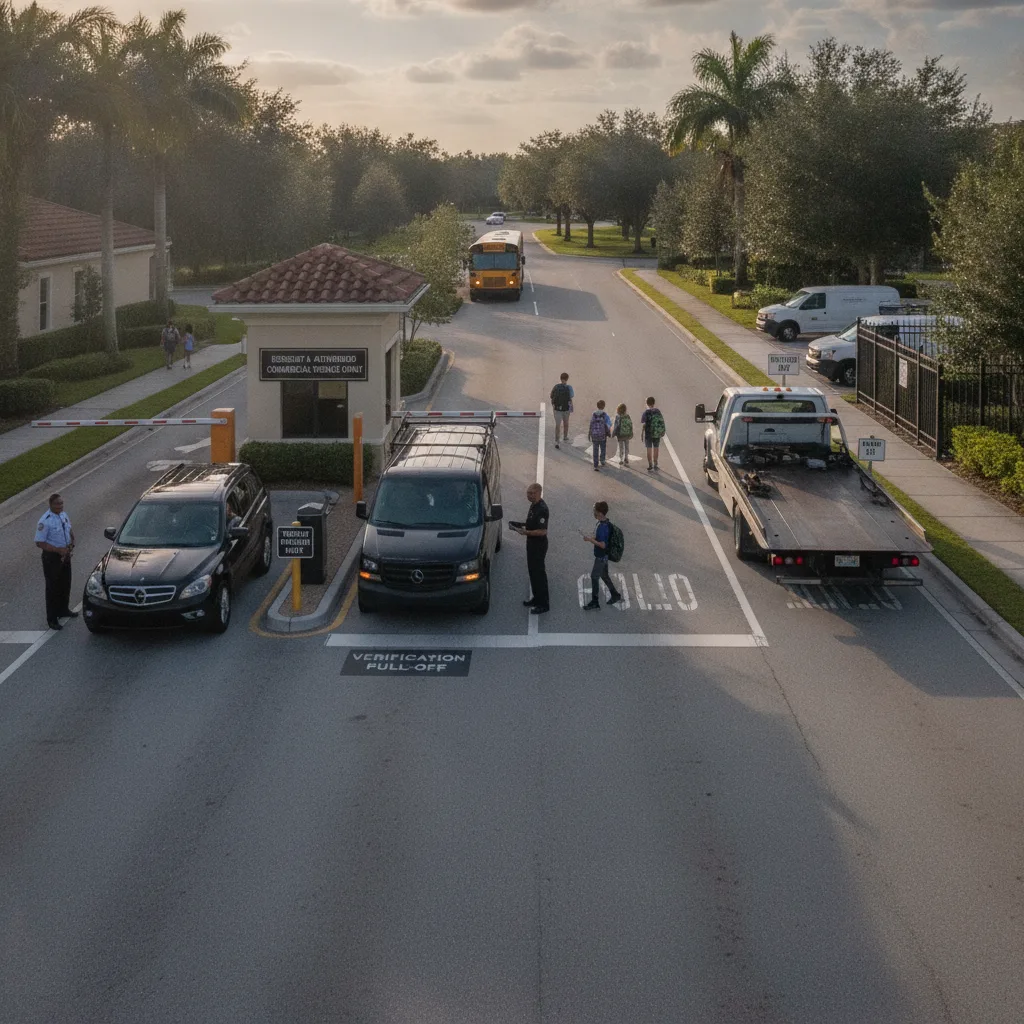
Direct answer: Florida associations should expect commercial-vehicle enforcement to spike after any major storm and stay elevated through hurricane season — roofers, tree services, generator installers, and remediation crews will legitimately fill guest and street parking for weeks after a storm, and the wrong response is applying the same overnight-storage rule to active storm-recovery work that it was written for chronic covenant violators.
This guide is for Florida HOA and condo association boards and managers dealing with unauthorized commercial vehicles. Florida’s exposure to hurricanes, its large share of investor-owned and seasonally vacant units, and the statutory difference between how condos and HOAs govern vehicle restrictions all shape this differently than it plays out in most other states.
Storm season changes what “unauthorized” means
After a hurricane or significant storm, it’s normal for a Florida community to see a temporary surge of roofing trucks, tree-removal equipment, generator installation vans, and insurance adjuster vehicles, often parked for multiple consecutive days while work is underway. Treating every one of these as a covenant violation the way the board would treat a permanently stored moving truck creates exactly the kind of resident friction this guide is meant to avoid — residents dealing with storm damage don’t need a parking notice on top of it. At the same time, storm recovery periods are also when genuine bad actors (unlicensed contractors soliciting door to door, vehicles with no actual connection to any unit) are most likely to show up, so the goal isn’t relaxing enforcement, it’s having a fast way to tell the difference.
Florida’s ownership mix adds a second layer. A meaningful share of units in many Florida communities are investor-owned rentals or seasonal (snowbird) properties, which means the person managing a work order isn’t always on-site and isn’t always reachable the way a full-time resident would be. A commercial vehicle at a seasonally vacant unit is a different case than the same vehicle at an owner-occupied one, and boards need a way to check who’s actually authorized to call in work at that address before assuming it’s storage.
Also worth knowing: condos and HOAs aren’t governed identically
Florida condominiums are governed under Chapter 718 and homeowners associations under Chapter 720, and while both allow reasonable parking and vehicle restrictions in governing documents, the fining and due-process mechanics differ slightly between the two statutes. A board or manager who oversees both a condo and an HOA property (common for management companies operating across Florida) should confirm which statute’s notice-and-hearing requirements apply before issuing a fine, rather than assuming one process fits both.
Sorting the case
| Situation | What to check | Outcome |
|---|---|---|
| Roofing/tree/generator vehicle after a declared storm event | Timeframe relative to the storm; visible active work | Temporary exception, no notice, log for the season |
| Commercial vehicle at a known investor-owned or vacant unit | Property manager or owner contact confirming the work order | Authorized if confirmed; treat as unverified storage if not |
| Unmarked solicitor vehicle, no matching work order, storm-season only | Cross-check with any resident who called them | Likely unauthorized — document and route to security/board |
| Vehicle stored long after visible work has ended | Notice history, whether it predates or postdates the storm window | Standard covenant enforcement applies |
A workflow that flexes for storm season without abandoning the rule
- Set a defined storm-recovery window, not an indefinite pause. A board can reasonably relax enforcement for a bounded period after a declared storm event without rewriting the covenant — document that window so it doesn’t quietly become permanent.
- Confirm authorization for vacant or investor-owned units before treating a vehicle as unauthorized. A quick check with the property manager or owner of record avoids penalizing a legitimate repair at a unit where nobody local can vouch for it in person.
- Apply the correct statute’s notice process. Confirm whether Chapter 718 (condo) or Chapter 720 (HOA) governs the property before issuing a fine, since the two aren’t interchangeable procedurally.
- Return to standard enforcement once active work visibly ends. A vehicle still parked weeks after the roof is finished and no tarps or equipment remain is back in ordinary covenant territory.
Where this needs qualified review
Disputes over whether Chapter 718 or 720 procedures were correctly followed, any case involving a licensing or contractor-fraud concern, and enforcement against a unit owner who is displaced or unreachable due to storm damage should go to the association’s attorney, not be resolved as a routine parking case.
Building this into the association’s actual storm plan
Most Florida associations already have some form of hurricane preparedness plan; commercial-vehicle handling during recovery deserves a line in it rather than being improvised each season. Test the process against last season’s actual storm-recovery traffic if the community has it: how many vehicles were legitimate repair work, how many were unverifiable, and how quickly the board or manager could confirm authorization for a vacant or investor-owned unit. A documented, timestamped plate record at community entrances — see the Florida HOA LPR camera guide — makes it easier to distinguish a three-day roofing job from a vehicle still there a month later, without a manager needing to physically track every unit’s status during the busiest weeks of the year. For the parking-notice due-process requirements that apply once storm season ends and standard enforcement resumes, see what §720.305 requires before you fine or tow.
What to confirm before formalizing a storm-season policy
- A defined, documented window for relaxed enforcement after a declared storm event.
- A fast way to confirm authorization for vehicles at vacant or investor-owned units.
- Which statute (718 vs. 720) governs the property’s fining and notice process.
- A clear point where storm-recovery leniency ends and standard enforcement resumes.
- An escalation path for suspected unlicensed or fraudulent contractors, separate from routine covenant enforcement.
Related PLACA.AI planning resources
Record questions
Should a Florida association enforce commercial-vehicle rules the same way during hurricane recovery?
Not identically — a defined, temporary window that recognizes active storm-repair work avoids penalizing residents for damage that isn’t their fault, as long as the window is documented and time-boxed rather than open-ended.
Do condos and HOAs handle this the same way in Florida?
The underlying covenant authority to restrict vehicles is similar, but Chapter 718 (condominiums) and Chapter 720 (HOAs) have distinct notice and fining mechanics, so confirm which applies before issuing a fine.
What blocks a storm-season policy from working in practice?
No defined recovery window, no fast way to confirm work orders at vacant or investor-owned units, or applying the wrong statute’s due-process steps.
Plan a limited workflow review
Bring the current rule, process, exceptions, and success criteria for managing unauthorized commercial vehicles for florida associations. PLACA.AI can help evaluate a bounded pilot without assuming another property’s workflow is the right answer.
Editorial refresh: September 18, 2026. Independently confirm current product capabilities, third-party features, pricing, contracts, governing requirements, and local rules before acting.
Data source: Community Associations Institute