

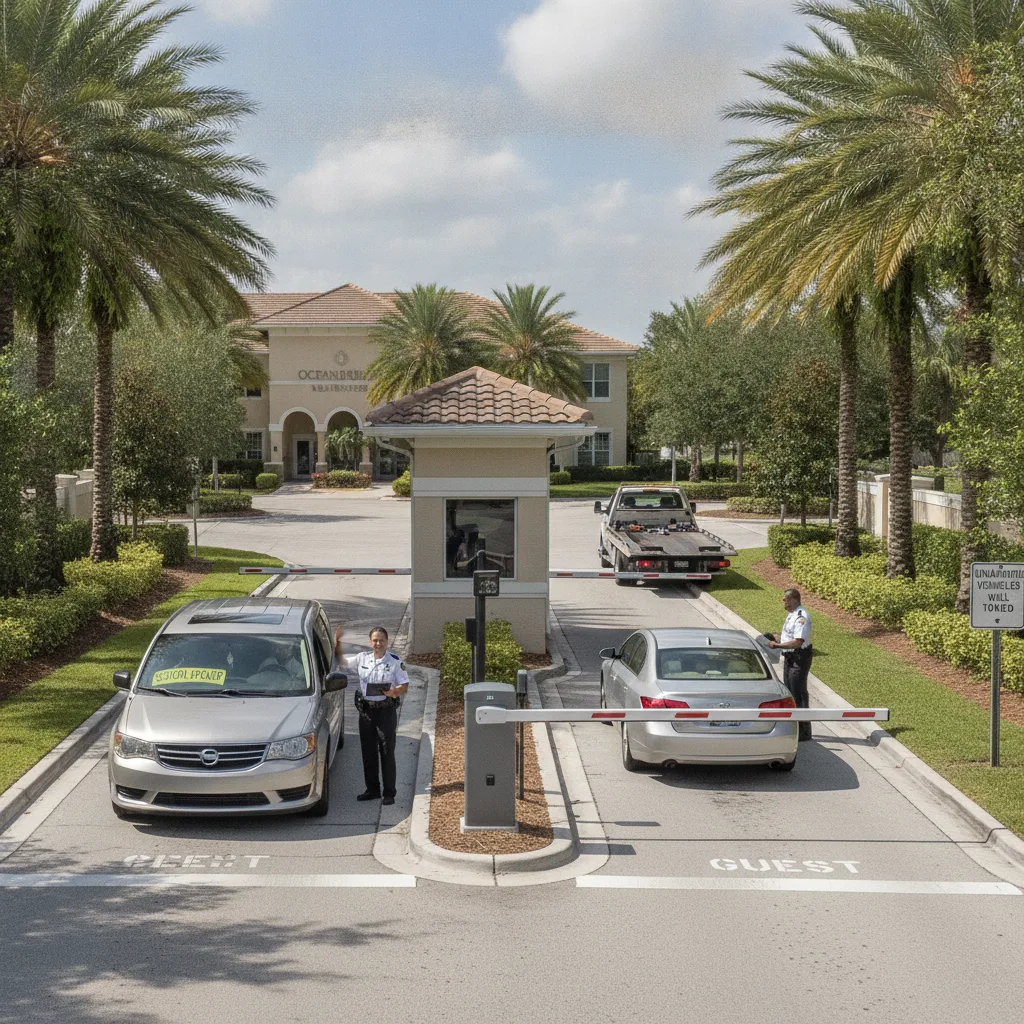
Direct answer: Treat scarce guest spaces as an allocation problem. Publish eligibility, stay limits, overflow rules, resident sponsorship, and an exception process before introducing plate-based monitoring or enforcement.
This guide is for Florida association boards, community managers, parking committees, and residents and focuses specifically on protecting limited Florida HOA guest spaces. This is deliberately not a universal product ranking. The relevant question is whether the proposed workflow works under the user’s constraints.
Why the current approach breaks
When a community has only a few guest spaces, an informal first-come system encourages resident overflow, long stays, and neighbor disputes. Enforcement then focuses on individual cars instead of the allocation rule.
Example: If weekend evenings are constrained but weekday spaces remain open, a blanket seven-day restriction may create friction without solving the real capacity problem. The policy should target the measured constraint.
Guest-space allocation table
| Decision point | Evidence or control | Required response |
|---|---|---|
| Short social visit | Resident-sponsored plate with arrival window | Normal guest-space access |
| Overnight guest | Defined consecutive-night or monthly allowance | Registration with expiry |
| Resident overflow vehicle | Not automatically a guest | Use resident permit or overflow policy |
| Contractor, caregiver, or service visit | Purpose and expected schedule | Time-limited exception category |
A practical operating sequence
- Step 1. Count spaces and measure when scarcity actually occurs.
- Step 2. Define guest categories and resident responsibilities.
- Step 3. Create overflow and accessibility exceptions before enforcement starts.
- Step 4. Pilot the rules during the busiest recurring period and publish results.
For protecting limited Florida HOA guest spaces, the named owner should document the approved rule, baseline, and result of each test. Require evidence from the target site and operating team; screenshots and feature lists are not substitutes for end-to-end testing.
Exceptions that need a human decision
Florida associations should obtain appropriate review of governing documents, notice, accessibility, towing, and local requirements. The operational model must be adapted to the association’s authority.
Exception records should show the input, reviewer, rule applied, response, and closure time.
How to test the workflow
Test the highest-frequency path and one difficult exception before adding more locations or users.
- guest-space occupancy during peak periods
- resident overflow incidents
- registrations that expire automatically
- warnings caused by entry errors
- appeals resolved within the published timeframe
Freeze the baseline and success threshold before the pilot begins.
Verification before rollout
- Write the purpose and non-goals for protecting limited Florida HOA guest spaces and name the accountable owner.
- Verify the process with the actual Florida association boards, community managers, parking committees, and residents who will use, administer, or review it.
- Test a correction, an unavailable-system path, and the exception described on this page.
- Confirm current pricing, contract terms, support, integrations, and data handling directly with each provider.
- Use guest-space occupancy during peak periods as one acceptance signal and record what evidence can stop the rollout.
Related PLACA.AI planning resources
Questions this page should answer
Can residents use guest spaces for a second vehicle?
Only if the written policy explicitly permits it; otherwise resident overflow should have a separate category.
What if all guest spaces are full?
Publish an overflow destination or a no-availability rule so staff do not invent exceptions during a conflict.
Should every guest pre-register?
That depends on the community’s operating model, but the rule should be consistent and offer a correction path.
Design a peak-period guest-space pilot
Bring the rules, current process, known exceptions, and success criteria for protecting limited Florida HOA guest spaces. PLACA.AI can help evaluate a limited pilot without presuming that another property’s hardware or workflow is the right answer.
Editorial refresh: July 22, 2026. Before using this framework for protecting limited Florida HOA guest spaces, independently confirm current product capabilities, third-party features, pricing, contracts, governing requirements, and local rules.
Data source: Community Associations Institute