

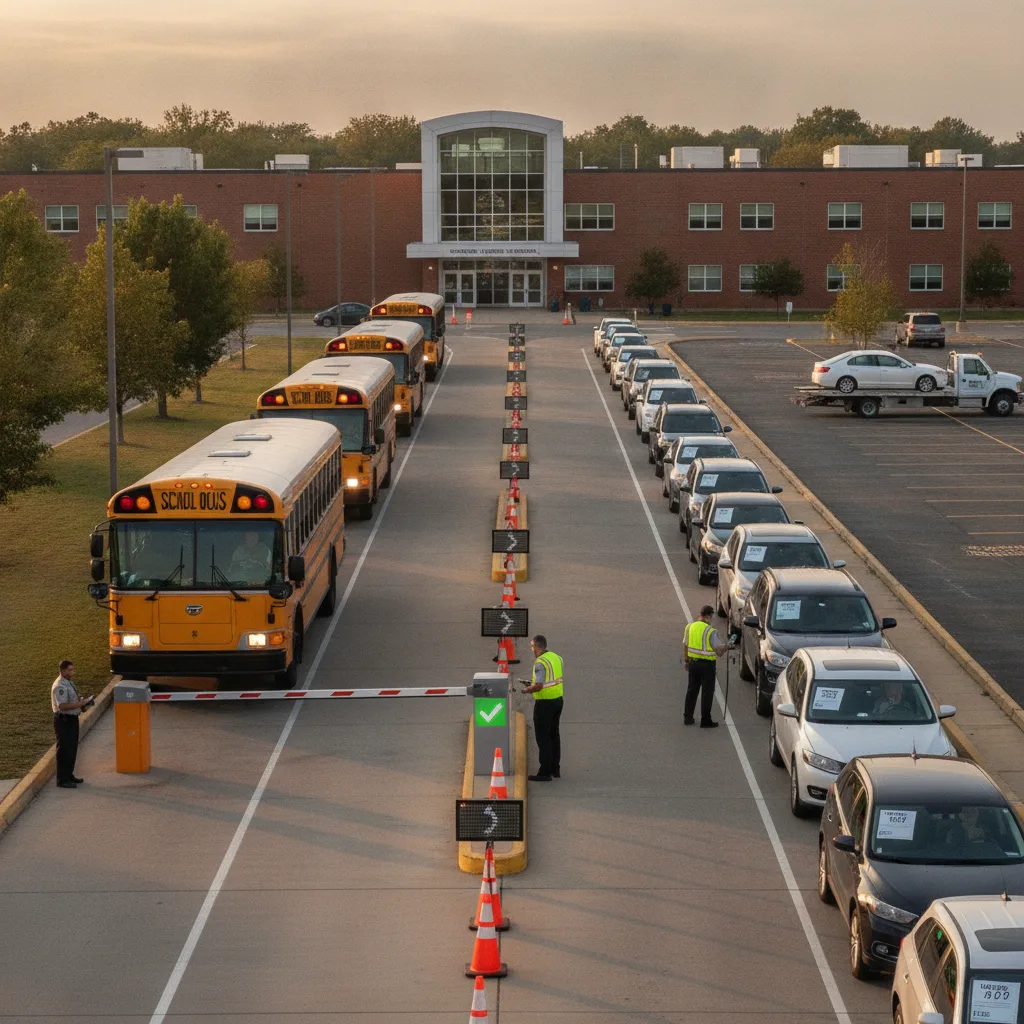
Direct answer: Front office staff usually don’t control where buses and cars physically drive, but they do control something just as important: where walk-up parents, visitors, and phone-directed traffic get sent. A parent who calls the office asking where to park, or a walk-up family redirected from a blocked entrance, can easily end up crossing into a bus lane if the front desk doesn’t have a clear, simple answer ready. The fix is a one-line direction the front office gives every time — where cars go, where walk-ups go, and which entrance is bus-only — so office-driven traffic never becomes the reason someone ends up in the wrong lane.
This guide is for front office staff who field the calls, buzz in the visitors, and answer the “where do I go” questions that happen well before a car or a parent physically reaches the carline or the bus zone.
The front office is often the first traffic decision a parent makes
Before a parent ever reaches the carline, they’ve often already made a decision based on something the front office told them — a phone call asking where to park during construction, a new family calling to ask about the pickup process for the first time, or a walk-up parent buzzed in through the main entrance and pointed toward an exit. If that guidance doesn’t clearly separate “where cars go” from “where buses go,” the front office can unintentionally send someone into a conflict point that campus safety or transportation staff are trying hard to keep clear. This is easy to overlook because the front desk isn’t physically standing at the bus loop — but the instructions given over the phone or at the counter shape where that traffic ends up minutes later.
What the front desk needs to know cold
| Question the desk gets asked | What to say | What to avoid saying |
|---|---|---|
| “Where do I park for pickup?” | Name the specific car lot or lane, and explicitly note which entrance is bus-only | A general “follow the signs” answer if the caller is new to the campus |
| “Can I just walk in to grab my kid?” | Direct them to the correct walk-up entrance, away from the active bus loop | Sending them through whichever door is closest to the office |
| “The main entrance is blocked, where else can I go?” | Have one pre-planned alternate route that avoids the bus zone, not an improvised answer | Guessing at a detour without confirming it avoids active bus traffic |
| New family’s first pickup | Walk through car versus bus routing specifically, since they have no prior habit to rely on | Assuming they’ll figure it out from watching other cars |
Building a one-line answer that actually gets used
The front desk fields dozens of small interruptions during dismissal prep — a phone call, a walk-up question, a delivery at the door — and a long, accurate explanation of the campus traffic pattern won’t survive that pace. What holds up is a short, specific line memorized well enough to say without thinking: which lot or lane is for cars, which entrance is bus-only, and one alternate route if the main path is blocked. Writing this down and keeping it taped at the desk — not buried in a staff handbook — is what makes it consistent across every staff member answering the phone on a given day, including substitutes covering the front desk for the first time.
Coordinating with whoever owns the bus and car separation plan
The front office isn’t usually the team deciding where bus and car lanes physically go — that’s typically campus safety or transportation. But the front desk is often the team a confused parent calls first, which means the office needs to know the current plan well enough to repeat it accurately, and needs a fast way to flag it when a parent reports something that sounds like a conflict — a car parked in a bus lane, a walk-up route that no longer matches what the office is telling people. Treat that as worth a quick call to whoever owns the traffic plan rather than something to note and move on from, since the front desk often hears about a developing problem before anyone physically watching the lot does. Reviewing your bus app failure workflow is also useful for the front office specifically, since a tech outage during dismissal often means more parent calls asking where to go — exactly the moment a clear, memorized answer matters most.
Handling the walk-up ID check without adding to the traffic confusion
When a parent is redirected to a walk-up entrance instead of the carline, the front office still needs to verify who’s picking up the child, and that check shouldn’t get rushed just because the desk is also fielding calls about where to park. Keep the walk-up verification step separate in your head from the routing conversation — first get the person to the right entrance, then run the same ID check you’d run at any other pickup point. A quick reference against your school pickup line FAQ is worth keeping at the desk for the routing questions that come up every year from new families, so the front office isn’t drafting an answer live while also managing a walk-up verification.
What to check before the school year gets busy
- Does every front-desk staff member — including substitutes — know the one-line answer for car parking, walk-up entrance, and bus-only entrance?
- Is there a pre-planned alternate route for when the main entrance is blocked, rather than an improvised one?
- Does the front office have a fast way to flag a reported traffic conflict to campus safety or transportation staff?
- Are new families specifically walked through car-versus-bus routing during enrollment or orientation?
- Is the walk-up ID verification step kept separate from the routing conversation so neither gets rushed?
Related PLACA.AI planning resources
Before rollout
Who should the front office call if a parent reports a bus/car traffic conflict?
Whoever owns the traffic separation plan on campus — usually campus safety or the dismissal coordinator — and it should be a quick call in the moment, not a note passed along after the fact.
How specific should the front desk’s parking directions be?
Specific enough to name the actual lot, lane, or entrance rather than a general “follow the signs” — vague directions are exactly what send an unfamiliar parent toward the wrong entrance.
Should walk-up ID verification slow down if the desk is also handling traffic questions?
No — treat them as two separate steps. Get the person routed correctly first, then run the same verification standard you’d apply at any other pickup point, without shortcuts because the desk is busy.
Plan a limited workflow review
Bring your current front-desk routing script and the traffic questions your office fields most often. PLACA.AI can help evaluate whether license-plate-based verification at the walk-up point keeps ID checks consistent even during your busiest routing-and-phone moments.
Editorial refresh: September 18, 2026. Independently confirm current product capabilities, third-party features, pricing, contracts, governing requirements, and local rules before acting.
Data source: National Center for Education Statistics