

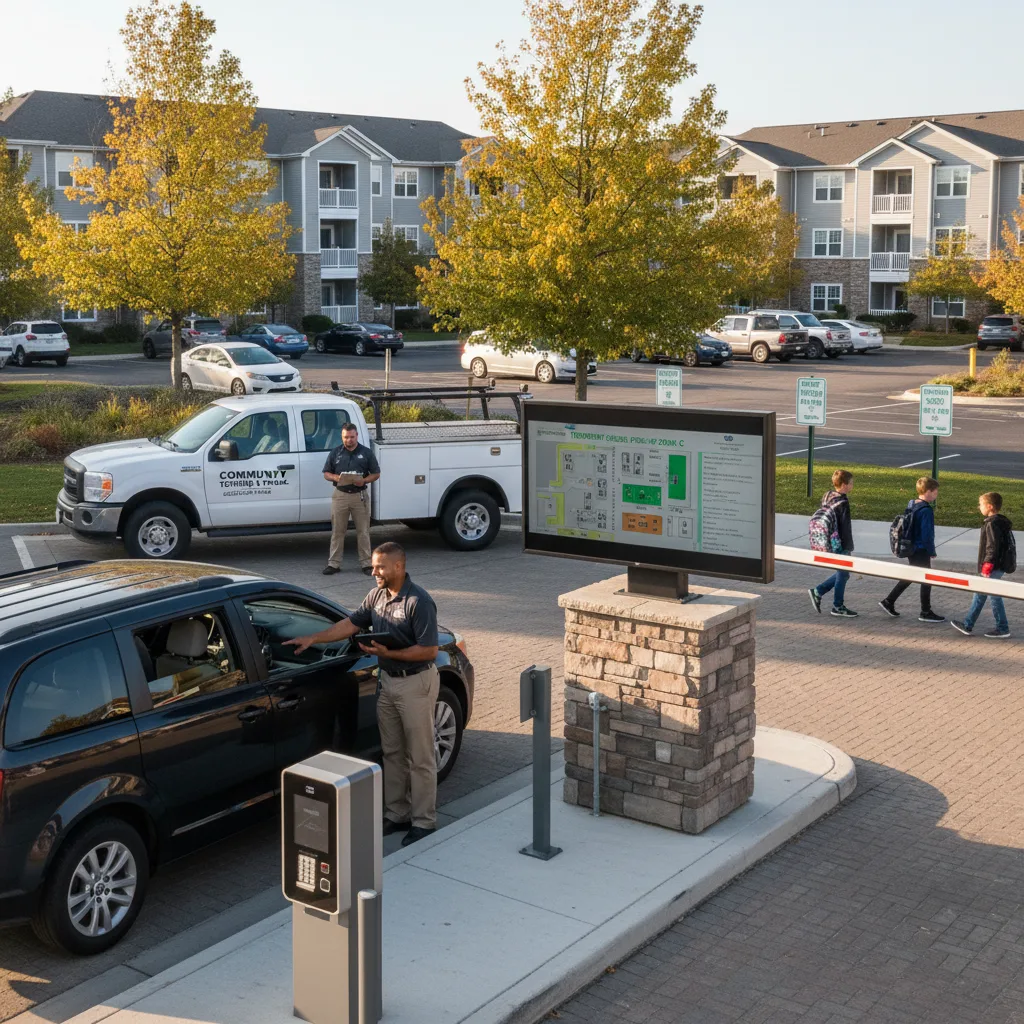
Direct answer: Use time-bounded seasonal entitlements with resident eligibility, vehicle list, arrival and departure dates, storage rules, guest limits, renewal, plate changes, and automatic expiry. Avoid leaving seasonal exceptions active year-round.
This guide is for HOA boards, community managers, seasonal residents, parking committees, and access administrators and addresses managing seasonal resident parking changes in an HOA. The page focuses on a reproducible operating decision rather than a general product claim.
Define the case
Seasonal residents often return with a different rental or replacement vehicle while last season’s plates and guest permits remain in the system.
Example: A winter resident who arrives with a rental car should receive an entitlement ending on the declared departure date while the prior vehicle remains inactive unless specifically restored.
Seasonal entitlement calendar
| Decision point | Evidence or control | Required response |
|---|---|---|
| Season activation | resident status, arrival, vehicle, permitted locations | start bounded access |
| Midseason change | replacement plate, guest, extended stay | update with new expiry |
| Departure | date, stored vehicle status, outstanding permits | close active rights |
| Next-season renewal | fresh confirmation and vehicle review | avoid automatic carryover |
Build the workflow
- Step 1. For season activation, verify resident status, arrival, vehicle, permitted locations and then start bounded access.
- Step 2. For midseason change, verify replacement plate, guest, extended stay and then update with new expiry.
- Step 3. For departure, verify date, stored vehicle status, outstanding permits and then close active rights.
- Step 4. For next-season renewal, verify fresh confirmation and vehicle review and then avoid automatic carryover.
Keep the owner, evidence, and outcome in the same case history.
Exception boundary
Medical extensions, delayed travel, caregivers, storms, and stored vehicles need documented exception owners and expiry dates.
Correct the record, approve a bounded exception, deny under the written rule, or escalate to the named authority; do not leave the case unresolved.
Pilot measures
Run a limited test long enough to observe the recurring pattern and at least one correction or fallback.
- seasonal entitlements with start and end dates
- prior-season plates remaining active
- midseason changes completed
- exceptions with current expiry
- departures closing guest permits
Define who counts each measure, the observation window, and the result that blocks expansion.
Approval checklist
- State the purpose and non-goals for managing seasonal resident parking changes in an HOA.
- Assign owners for the normal path, correction, exception, and final approval.
- Test live conditions with the people who administer and experience the workflow.
- Confirm contracts, pricing, support, integrations, data handling, and governing requirements independently.
- Retain enough evidence to reproduce each approval, denial, correction, or escalation.
Related PLACA.AI planning resources
Questions to settle
What must be approved first for managing seasonal resident parking changes in an HOA?
Approve the purpose, owner, evidence standard, decision rule, and exception path before scaling.
What should the pilot reproduce?
Test the normal process and the named exception while collecting seasonal entitlements with start and end dates and the other listed measures.
When should rollout stop?
Stop when ownership is unclear, required evidence is missing, a serious exception lacks a safe route, or the result conflicts with the approved rule.
Plan a limited workflow review
Bring the current rule, process, exceptions, and success criteria for managing seasonal resident parking changes in an HOA. PLACA.AI can help evaluate a bounded pilot without assuming another property’s workflow is the right answer.
Editorial refresh: July 22, 2026. Independently confirm current product capabilities, third-party features, pricing, contracts, governing requirements, and local rules before acting.
Data source: Community Associations Institute