

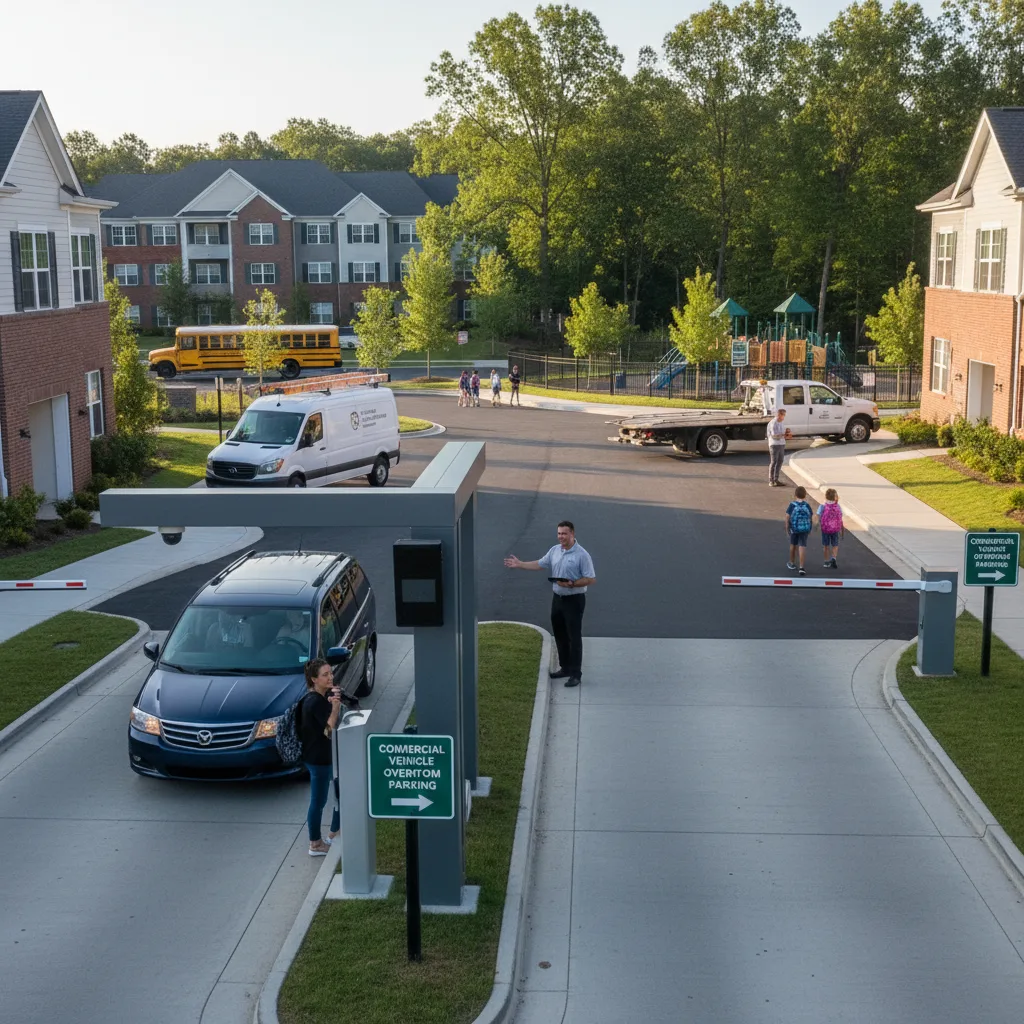
Direct answer: Define commercial-vehicle restrictions by observable rule rather than assumption: vehicle class or markings, location, duration, time window, approved work, resident relationship, and exceptions. Require consistent evidence before escalation.
This guide is for HOA boards, community managers, parking committees, residents, and enforcement providers and addresses managing unauthorized commercial vehicles in an HOA. The boundary matters because adjacent use cases may require different evidence and authority.
What must work
A vague commercial-vehicle ban can treat a resident work vehicle, active contractor, delivery, and stored fleet vehicle as the same case.
Example: A marked van actively serving a unit during permitted hours should enter the contractor path, while the same vehicle stored overnight may require a different rule and evidence.
Commercial-vehicle classification record
| Decision point | Evidence or control | Required response |
|---|---|---|
| Resident work vehicle | household relationship and policy definition | apply resident rule consistently |
| Active contractor | service location and time window | grant temporary authorization |
| Delivery or emergency service | short operational stop | exclude or document exception |
| Stored or repeated fleet use | dates, location, prior notice | follow escalation standard |
Assign each handoff
- Step 1. Review resident work vehicle: household relationship and policy definition; then apply resident rule consistently.
- Step 2. Review active contractor: service location and time window; then grant temporary authorization.
- Step 3. Review delivery or emergency service: short operational stop; then exclude or document exception.
- Step 4. Review stored or repeated fleet use: dates, location, prior notice; then follow escalation standard.
Record the source, timestamp, correction, and approval behind the result.
Escalation boundary
Definitions and enforcement authority depend on governing documents and local requirements. Obtain appropriate review before towing, fining, or changing eligibility.
Correct the record, approve a bounded exception, deny under the documented rule, or escalate to the named authority; do not leave the case open-ended.
Measure the live process
Do not average away a serious failure mode.
- commercial-vehicle cases classified
- temporary authorizations expired correctly
- warnings supported by evidence
- repeat storage after notice
- appeals resolved consistently
Define who counts each measure, the observation period, and the result that prevents expansion.
Approval evidence
- State the purpose and non-goals for managing unauthorized commercial vehicles in an HOA.
- Assign owners for the normal path, correction, exception, and final approval.
- Test live conditions with the people who administer and experience the workflow.
- Confirm contracts, pricing, integrations, support, data handling, and governing requirements independently.
- Retain the evidence needed to reproduce an approval, denial, correction, or escalation.
Related PLACA.AI planning resources
Frequently asked questions
What should be approved first for managing unauthorized commercial vehicles in an HOA?
Approve the purpose, responsible owner, decision rule, required evidence, and exception path before selecting a broad rollout.
What should the pilot prove?
The pilot should reproduce the normal path and the exception described above, while collecting commercial-vehicle cases classified and the other named measures.
When should implementation stop?
Stop when the required evidence is unavailable, ownership is unclear, a serious exception has no safe route, or the actual result conflicts with the approved rule.
Plan a limited workflow review
Bring the current rule, process, exceptions, and success criteria for managing unauthorized commercial vehicles in an HOA. PLACA.AI can help evaluate a bounded pilot without assuming another property’s workflow is the right answer.
Editorial refresh: July 22, 2026. Independently confirm current product capabilities, third-party features, pricing, contracts, governing requirements, and local rules before acting.
Data source: Community Associations Institute