

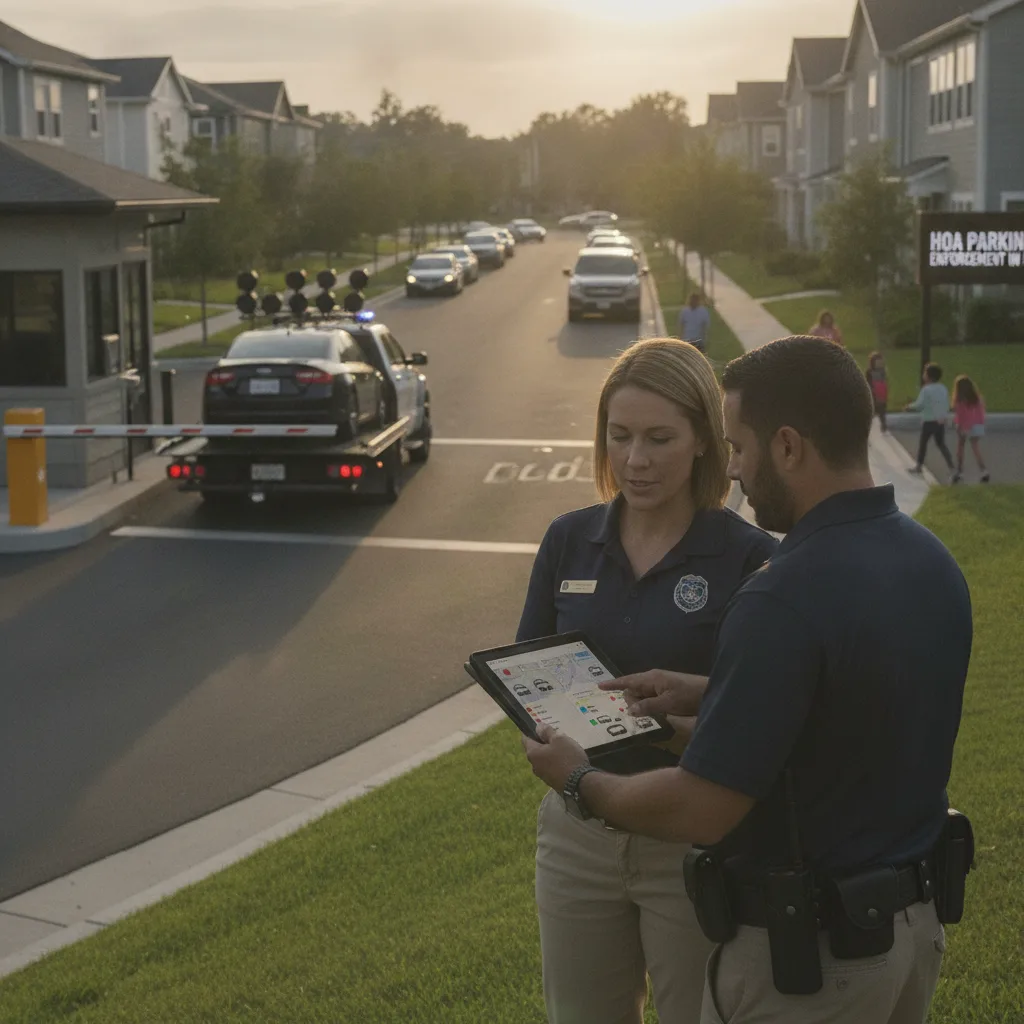
Direct answer: In an HOA, “repeat violator” almost always means an escalation ladder, not an automatic tow — most associations expect a warning, then a written notice, then a fine or towing referral, and each step has to be documented against the same vehicle or resident before the next one is justified. Tracking repeat violations well means building that ladder into your records, so the board and management company can see exactly where a resident stands before anyone authorizes a tow.
This is written for HOA patrol staff and vendors who enforce community parking rules under a board and management company, where “repeat violator” is as much a governance term as an enforcement one.
Why HOA repeat tracking is different from a commercial lot’s
A retail lot can usually tow on sight for a clear violation. An HOA almost never works that way for resident vehicles — most CC&Rs and state HOA statutes build in graduated response specifically because towing a homeowner’s car is a bigger deal than towing a shopper’s, both practically and politically. That means your repeat-violator record isn’t just “how many times has this plate shown up” — it’s “what step of the community’s process is this resident on, and can I prove each prior step actually happened.”
What a usable repeat-violator record needs
1. Resident versus guest, distinguished clearly
A homeowner’s own repeat violations and a recurring unregistered guest are different problems with different paths. The homeowner is accountable to the board through the standard warning-notice-fine ladder; a recurring guest violation might point to a resident who needs a reminder about guest registration rather than the guest themselves being “the violator.”
2. Each escalation step, dated and tied to the same vehicle or unit
If your community’s process is verbal warning, then written notice, then tow authorization, your record needs all three steps visible for the same address or vehicle — not just a count of “violations: 3.” A board member or manager reviewing an appeal needs to see the sequence, not just a tally.
3. The violation type held constant, or noted when it changes
Three violations of the exact same rule build a strong case. Three different rule violations by the same resident (overnight parking, then a commercial vehicle, then a guest overstay) may still justify escalation depending on your governing documents, but it’s a different argument — don’t let the record blur “repeat of the same thing” into “generally noncompliant” without being explicit about which one you’re claiming.
4. Resolved and disputed entries marked as such
If a prior “violation” was later reversed at appeal, or turned out to be a registered guest, that entry shouldn’t silently keep counting toward escalation. Mark it resolved-in-favor-of-resident so it doesn’t quietly inflate someone’s record.
Handling the vehicle-versus-person problem
Vehicles change — a resident sells a car, a new one arrives, a spouse’s vehicle gets used instead. If your repeat-violator tracking is purely plate-based, a resident with a real pattern of noncompliance can look like three unrelated first-time offenders because the plate changed each time. Where your community’s rules and privacy policies allow it, tying violation history to the unit or resident (not just the plate) gives a much more accurate picture — and, just as importantly, keeps an innocent new owner of a previously flagged plate from inheriting someone else’s record.
Reporting up to the board
Boards typically don’t want a raw violation log — they want to know who’s on the ladder, where they stand, and whether the process was followed correctly, especially before approving a tow or a fine that a resident might appeal. A record that shows the full escalation path with dates, evidence, and outcomes for each step lets the management company answer a board question or a resident appeal without having to reconstruct the history from memory or scattered notes.
When to pause before escalating
- A step in the required ladder can’t be confirmed as having actually happened (no record of the prior warning, for example)
- The vehicle involved may have changed hands since the prior violations were logged
- The violations being counted together aren’t actually the same rule, and your governing documents treat that differently
- There’s an open or recent appeal on a prior step in the same resident’s history
Any of these is a reason to check with the management company or a named community contact before moving a resident to the next step — a shaky record at the tow-authorization stage is exactly what gets appealed successfully.
FAQ
How many violations justify moving to tow authorization?
That’s set by your community’s governing documents and state HOA towing rules, not by patrol judgment — confirm the required number of prior notices and the notice period before authorizing.
Should guest violations count toward a resident’s own record?
Generally not directly, though repeated guest violations at the same unit are worth flagging to the resident separately — check your community’s specific rules, since some treat guest conduct as the resident’s responsibility and some don’t.
What’s the biggest mistake in HOA repeat-violation tracking?
Counting a tally instead of documenting the sequence. Three violations without dated proof of each required step is a much weaker record than two violations with the full ladder properly documented.
Related reading
- Parking enforcement software for towing companies
- Mobile LPR planning guide
- Parking enforcement LPR software overview
If your community’s escalation records are scattered across notices, spreadsheets, and patrol notes, PLACA.AI can show you what a documented mobile LPR workflow looks like for HOA enforcement — get in touch or book a demo.
Data source: Community Associations Institute