

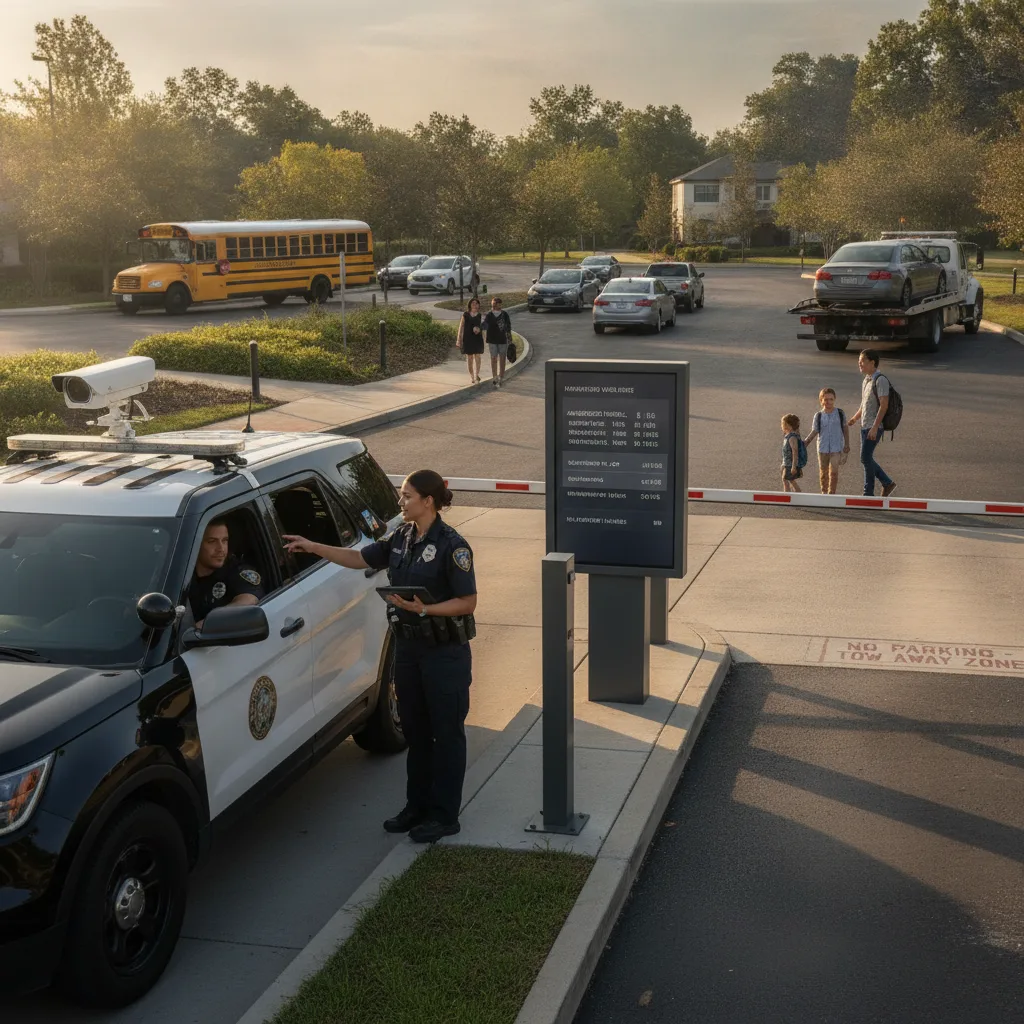
Direct answer: HOA patrol operators training drivers on mobile LPR need to build in something most other patrol contexts don’t: a warning-first mindset and close alignment with board-approved rules, because HOA enforcement is governed by covenants and often reviewed by volunteer board members who weren’t in the room when the driver made the call. The scanning skills are standard. What takes real training is knowing when a violation calls for documentation and a courtesy notice versus when it’s an immediate tow, and being able to show your work if a homeowner brings it to the board.
Why HOA enforcement runs differently than a commercial lot
A retail property or apartment complex is enforcing rules on strangers and short-term guests. An HOA patrol operator is often enforcing rules on homeowners — people who pay dues, sit on committees, and may personally know a board member. That changes the operational posture: most HOAs favor a graduated response (warning, then citation or fine, then tow) over jumping straight to towing on a first violation, and that policy is usually spelled out in the community’s governing documents or the management contract, not left to driver discretion.
New drivers need to learn this distinction explicitly, because a driver trained only on “scan, match, tow” from a different context will apply the wrong escalation ladder here and generate exactly the kind of complaint that ends up in a board meeting.
Core training: know the community’s actual rule set before the app
Every HOA is different, and unlike a franchise retail chain, there’s no standard playbook across communities. Before a new driver runs a route, they need a clear briefing on:
- What’s actually enforceable versus aspirational. Governing documents sometimes list rules that are on the books but not actively enforced by board direction — a driver needs to know which is which for that specific community, not assume every covenant line item is live.
- The escalation sequence for that community. Some HOAs require a documented warning before any tow; others allow immediate towing in specific zones (fire lanes, reserved spots) while requiring warnings elsewhere. This should be written down and reviewed with every new driver, not passed along informally.
- Who counts as authorized. Homeowners, tenants (in communities that allow rentals), registered guests, and vendors may each have different permit or registration requirements. Renters in particular are a common gap — their vehicle may not be tied to the homeowner’s permit record at all.
- Street parking, guest parking, and common-area rules. HOA communities often have more parking zone types than a commercial lot — designated visitor spots, time-limited street parking, and driveway or garage requirements — each with different enforcement rules.
The scan-to-action workflow for HOA context
- Scan and check permit status. Standard mobile LPR capture — but the driver’s next move depends heavily on the community’s escalation policy, not just the match result.
- Check violation history before deciding warning vs. citation vs. tow. A first-time violation and a fifth repeat offense from the same plate usually call for different responses under most HOA policies. Train drivers to pull up prior activity on that plate before acting, not just react to the current scan.
- Document thoroughly, every time — including warnings. Unlike a straightforward commercial tow, HOA violations often get reviewed later at a board or committee level, sometimes weeks after the fact. A driver needs to log a clear photo, location, and rule citation even for a warning, because that record is what the board or management company will reference if the homeowner disputes it.
- Know when to hold and escalate to the community manager. Ambiguous cases — a vehicle that might belong to a new resident, a dispute already flagged with the office, anything involving an accessibility space — should go to the community manager or management company contact rather than the driver making a unilateral call.
Situations that need specific training attention
- New homeowners and tenants. Permit issuance often lags actual move-in, especially in communities where the management company (not the board) handles registration on its own schedule. Train drivers to flag rather than tow when a plate has no record but other signs (moving truck, open garage, neighbor confirmation) suggest a recent move-in.
- Guest parking limits during events. Holidays, community events, or a homeowner’s private gathering can bring a wave of unregistered guest vehicles at once. Make sure drivers know your community’s actual guest allowance and whether there’s an easy way for residents to register guests in advance, so a legitimate gathering doesn’t turn into a mass-tow incident.
- Disputed or gray-area covenant rules. Some HOA parking rules (no commercial vehicles, no vehicles on blocks/jacks, RV restrictions) require judgment calls that aren’t a simple plate match. These should be flagged for a supervisor or covenant committee, not decided solely off an LPR scan.
- Board member and committee vehicles. However the community handles this politically, drivers need a documented, consistent answer — not an ad hoc exception made in the field, which is exactly the kind of decision that creates perception problems later.
Building a repeatable training and review cycle
Because HOA rules and boards can change (a new board is elected, a rule gets amended, enforcement gets stricter or looser by policy vote), the training program needs a refresh point, not just a one-time onboarding:
- Onboarding briefing per community. A written summary of that HOA’s actual escalation policy, guest rules, and known exceptions, reviewed before a new driver’s first shift there.
- Supervised shifts with real cases. Have a new driver shadow, then run supervised solo shifts where every warning, citation, and tow decision is reviewed against the community’s documented policy.
- Policy-change updates. When a board changes enforcement policy, update the reference sheet and walk drivers through what’s different before their next shift at that community — don’t rely on drivers remembering a verbal update from weeks ago.
- Periodic case audits. Spot-check a sample of logged decisions each month against the documented policy, particularly for communities where disputes have come up before.
Site questions
Should HOA patrol drivers always warn before towing?
It depends entirely on that community’s governing documents and board policy — some allow immediate towing in clearly designated zones (fire lanes, reserved spots) while requiring a documented warning step elsewhere. Drivers need this written down per community, not left to guess.
How is HOA enforcement training different from apartment enforcement training?
HOA enforcement usually deals with homeowners rather than renters, is governed by community covenants that a volunteer board can change, and leans more heavily on a graduated warning-then-escalation process rather than direct-to-tow enforcement.
What documentation matters most for HOA cases?
Photo evidence, the specific rule cited, and a timestamp — for warnings as well as tows — since HOA decisions are more likely than most to be reviewed later by a board or management company when a homeowner disputes them.
Related PLACA.AI resources
- Parking enforcement software for towing companies
- Mobile LPR planning guide
- Parking enforcement LPR workflow guide
Want to see how PLACA.AI supports warning-first enforcement and per-community rule documentation for HOA patrol teams? Get in touch or book a demo.
Data source: Community Associations Institute