

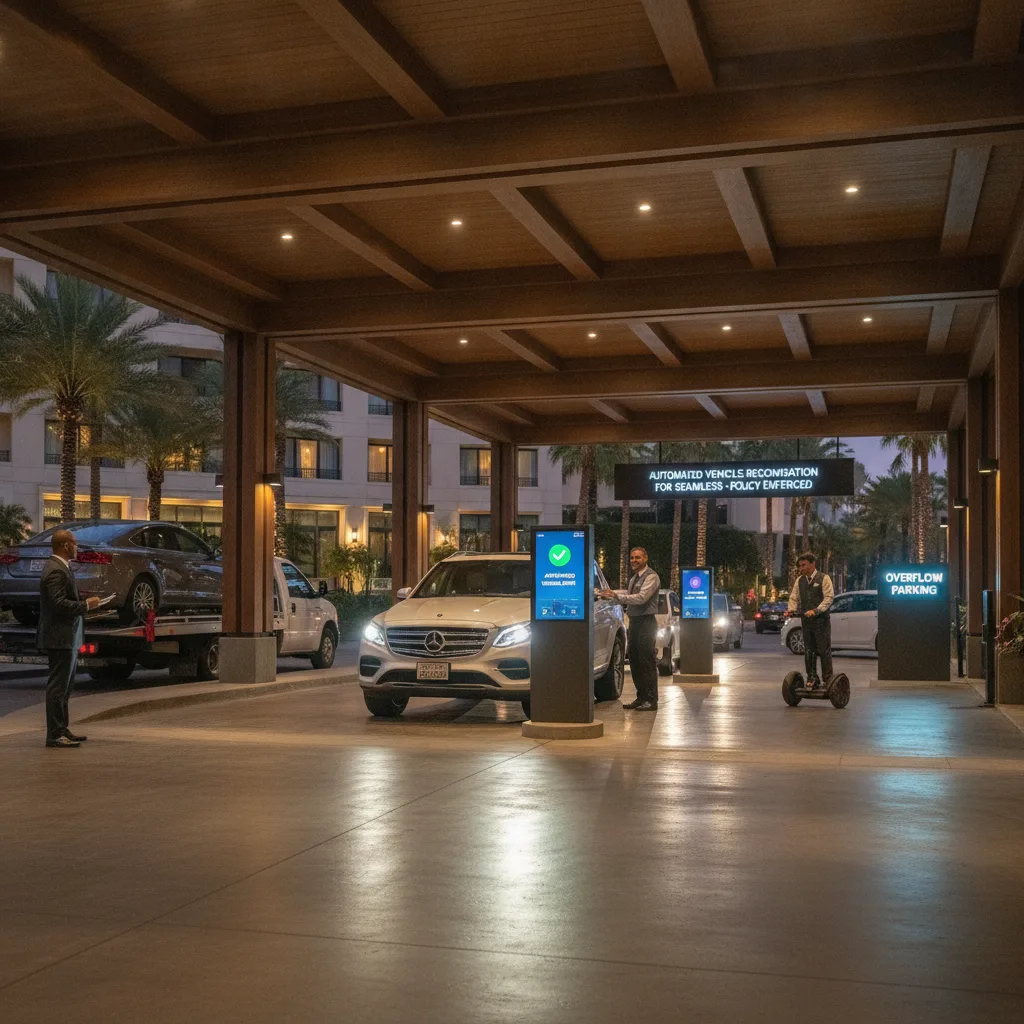
Short answer: Hospitality groups manage peak arrival surges across multiple properties by standardizing how each hotel, restaurant, and event space forecasts demand, staffs the curb, and records vehicles — while still letting each property tune the details to its own driveway, garage, and guest mix. Ticketless vehicle recognition gives a portfolio-wide operations team the one thing paper tickets never could: a comparable record of what actually happened at the curb, property by property, so surge planning stops being guesswork.
If you run valet operations across a portfolio — say three hotels, a couple of standalone restaurants, and a banquet property — you already know the real problem isn’t any single busy Friday. It’s that every general manager and valet captain in the group handles surges differently, so when corporate ops tries to figure out why Property B chronically backs up onto the street during Saturday check-in while Property A doesn’t, there’s no shared data to compare.
Why peak surges hit multi-property groups differently
A single-site valet team can build tribal knowledge about their own driveway. A hospitality group can’t rely on that. Each property has a different curb length, a different mix of hotel check-in, restaurant dinner service, and banquet load-in, and often a different valet vendor or in-house team with its own habits. A staffing template built around one flagship property’s rhythm can be wrong for a smaller sister property, and nobody notices until a group sales event or a citywide convention pushes several properties into overlapping surges on the same weekend.
The group-level job isn’t to write one script that every property follows word for word. It’s to define the handful of decisions that should be made the same way everywhere — how a surge gets forecast, when overflow gets triggered, what gets recorded about each vehicle — and then let local teams run the mechanics.
Build a shared surge playbook, not a shared schedule
A workable group standard usually covers four things:
- Forecasting inputs. Every property should be pulling from the same categories of signal — hotel arrivals/departures from the PMS, restaurant reservation counts, and any banquet or event block — even though the actual numbers differ property to property.
- Staffing triggers. Define surge tiers (for example, a rough band of expected arrivals per 15-minute window) and what staffing response each tier calls for, so a regional ops manager reviewing three properties’ Saturday plans is comparing apples to apples.
- Vehicle recording. Every property records the same minimum data for every car — plate, arrival time, condition note, and who took the keys — regardless of whether that property still uses paper stubs or has moved to a ticketless, plate-based system. This is the piece that makes cross-property comparison possible at all.
- Overflow escalation. A named person at each property who can activate overflow parking or call in additional runners, and a rule for when corporate/regional ops gets looped in (for example, when overflow triggers twice in one weekend).
Ticketless vehicle recognition helps specifically with the recording piece. When every property captures the same plate-based arrival and departure event automatically, a regional director can actually see, across the whole group, which properties are running long dwell times at the curb versus which ones are clearing cars efficiently — instead of relying on each GM’s self-reported summary after the fact.
A worked example
Consider a hospitality group with a downtown hotel and an attached restaurant that share one valet stand. On a weekend with a citywide conference, hotel check-in (2–5pm) can overlap with restaurant reservation arrivals (5–7pm) and then hotel checkout the next morning stacks against a Sunday brunch rush. If the group has already agreed on staffing tiers and overflow rules, the property’s valet captain isn’t improvising — they’re executing a plan the regional team has already seen work at a comparable property. That’s the actual value of standardization: not uniformity for its own sake, but making sure a property doesn’t have to solve a problem from scratch that a sister property already solved last quarter.
What to review before a surge weekend
- Confirm each property has pulled its forecast inputs (PMS arrivals, reservations, any group blocks) at least 48 hours out.
- Confirm staffing is scheduled against the agreed tiers, not just “add one more runner.”
- Confirm the overflow trigger and the person authorized to call it are named for that specific weekend, not just listed in a general policy document.
- Confirm vehicle recording is actually happening consistently — spot-check a sample of arrivals against the log.
Metrics worth comparing across properties
Rather than tracking dozens of numbers, most groups get useful signal from a short list: average time from arrival to key handoff, how often overflow was triggered, how many vehicles were still waiting for a runner more than a set number of minutes after arrival, and how many arrival records needed a correction afterward. Track these the same way at every property and the comparisons become meaningful — a property that consistently runs longer dwell times than its peers has a specific, findable bottleneck, not a vague “we were just busy” excuse.
FAQ
Should every property in the group use identical staffing levels for a surge?
No — staffing should scale to each property’s curb capacity and typical arrival volume. What should be identical is how the decision to add staff or trigger overflow gets made.
How do we get GMs to actually follow a group standard instead of their own habits?
Involve valet captains and GMs from at least two properties in writing the playbook, and show them the comparison data once it exists — most teams adjust their own approach once they can see how a sister property is performing on the same measures.
Does this require replacing every property’s current valet system at once?
No. Groups typically pilot a ticketless, plate-based recording approach at one or two properties first, confirm it holds up during a real surge weekend, and then extend the standard to the rest of the portfolio.
For a closer look at how plate-based vehicle recognition fits into a multi-property valet operation, see PLACA’s valet parking knowledge hub and the ticketless valet system overview. Groups managing a mix of hotel and restaurant curbs may also want to review valet parking software built for hotel operations.
Ready to compare how a standardized surge playbook would work across your properties? Get in touch with PLACA to talk through your portfolio’s specific curb layouts and peak patterns.
Data source: U.S. Department of Transportation