

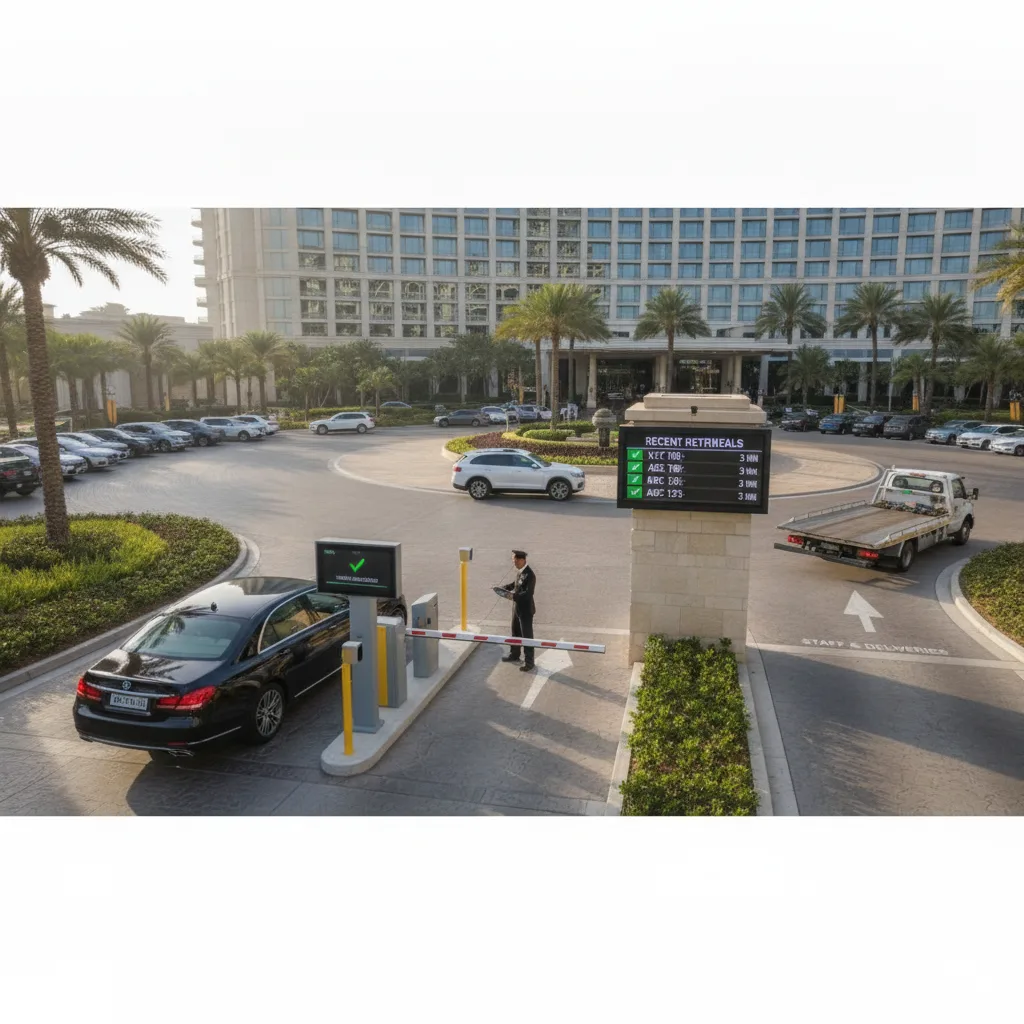
Direct answer: Hospitality groups speed up vehicle retrieval across a portfolio not by chasing a single average number, but by giving every property the same underlying system for identifying and locating vehicles — so a corporate ops team can actually compare performance across a resort with a remote lot, an urban hotel with a shared garage, and a franchise property that runs its own valet vendor, instead of comparing numbers that were never measured the same way.
The real problem: portfolios don’t fail the same way twice
If you manage valet operations across multiple properties, you already know the frustrating part isn’t any single hotel’s retrieval time — it’s that you can’t tell whether a slow number at Property C is a real operational problem or just a harder layout. A resort with valet parking a quarter-mile from the porte-cochère will never match an urban select-service hotel with a 40-space attached garage on raw minutes. Without a shared way of tracking where vehicles are and how requests move through the process, every property review turns into a debate about whether the comparison is even fair — and the properties that actually need help get lost in that debate.
Ticketless vehicle recognition gives every property the same data structure: a vehicle is identified, its location is logged, a retrieval request is timestamped, and delivery is timestamped. That’s the same skeleton whether the property has 20 valet spaces or 400. Once every property is generating comparable data, corporate ops can actually see which sites are underperforming for their layout and which are simply harder sites.
Where portfolio-wide retrieval programs break down
Third-party valet vendors with their own systems
Many hospitality groups don’t run valet in-house at every property — they contract local valet companies, and each vendor often has its own ticketing habits, radio protocols, and paper logs. That fragmentation is why “how fast is retrieval across the portfolio” is so hard to answer honestly. A shared ticketless platform that any contracted vendor can be required to run on, as part of the property’s operating standard, gives you one dataset regardless of who’s staffing the podium.
Property GMs optimizing for their own property, not the brand
Individual GMs are (rightly) focused on their own guest scores, not a portfolio dashboard. Retrieval improvements that work at one property often never make it to the next unless there’s a mechanism to test a change at one site and roll it out once it’s proven — rather than every property reinventing its own fix.
Seasonal and franchise staffing churn
Resort properties swing staffing seasonally; franchise properties turn over valet staff at a different rate than corporate-managed sites. A system where retrieval speed depends on vehicle-location lookup rather than a runner’s memorized lot layout is far less sensitive to that churn — new staff at any property in the portfolio perform close to tenured staff from day one.
Building a portfolio retrieval standard
- Define shared stage timestamps, not a shared target time. Request received, vehicle located, runner dispatched, vehicle delivered — track the same four timestamps everywhere, then let each property set its own realistic target against its own layout.
- Require the same vendor standard at every property, in-house or contracted. If retrieval data isn’t captured the same way, you can’t compare it — put the data requirement in the vendor contract, not just the SOP binder.
- Pilot changes at one property before rolling out portfolio-wide. Test a new staging pattern or queue setup at one comparable site, confirm it actually moved the number, then push it to similar properties rather than mandating it blind.
- Report the tail, not just the median. A property with a fine median but a long tail during checkout rush or event nights has a real guest-complaint problem the average hides.
- Give corporate ops a live cross-property view. Monthly spreadsheet rollups are too slow to catch a property sliding — a shared dashboard across properties surfaces the outlier while there’s still time to act on it.
What to compare across properties
- Retrieval time by property, normalized for garage/lot distance — the only fair way to compare a resort to an urban hotel.
- Tail retrieval time during peak (checkout rush, event nights) at each site, not just the daily average.
- Staff-tenure sensitivity — does retrieval time spike when a property brings on new or seasonal staff? That gap should shrink once lookups replace memorized lot maps.
FAQ
Can this work across properties that use different valet vendors?
Yes, provided the vendor contract requires the same platform or data standard. Without that requirement, cross-property comparison stays unreliable no matter what technology any single property adopts.
How do we compare a resort with remote parking to a hotel with an attached garage fairly?
Normalize for physical distance and set property-specific targets rather than a single portfolio number. Track the same stage timestamps everywhere so the underlying data is comparable even when the target isn’t identical.
How fast can a new franchise property get onto the same standard?
Onboarding is mostly a training and vendor-contract exercise, not a hardware buildout — most of the setup is agreeing on stage definitions and getting the property’s valet team (in-house or contracted) using the same lookup process as the rest of the portfolio.
For more on how ticketless systems support multi-property hospitality operations, see the valet parking knowledge hub, the ticketless valet system overview, and valet parking software for hotels.
Managing valet across multiple properties and want one standard everyone can actually be measured against? Book a demo and we’ll walk through how it fits your portfolio.
Data source: U.S. Department of Transportation