

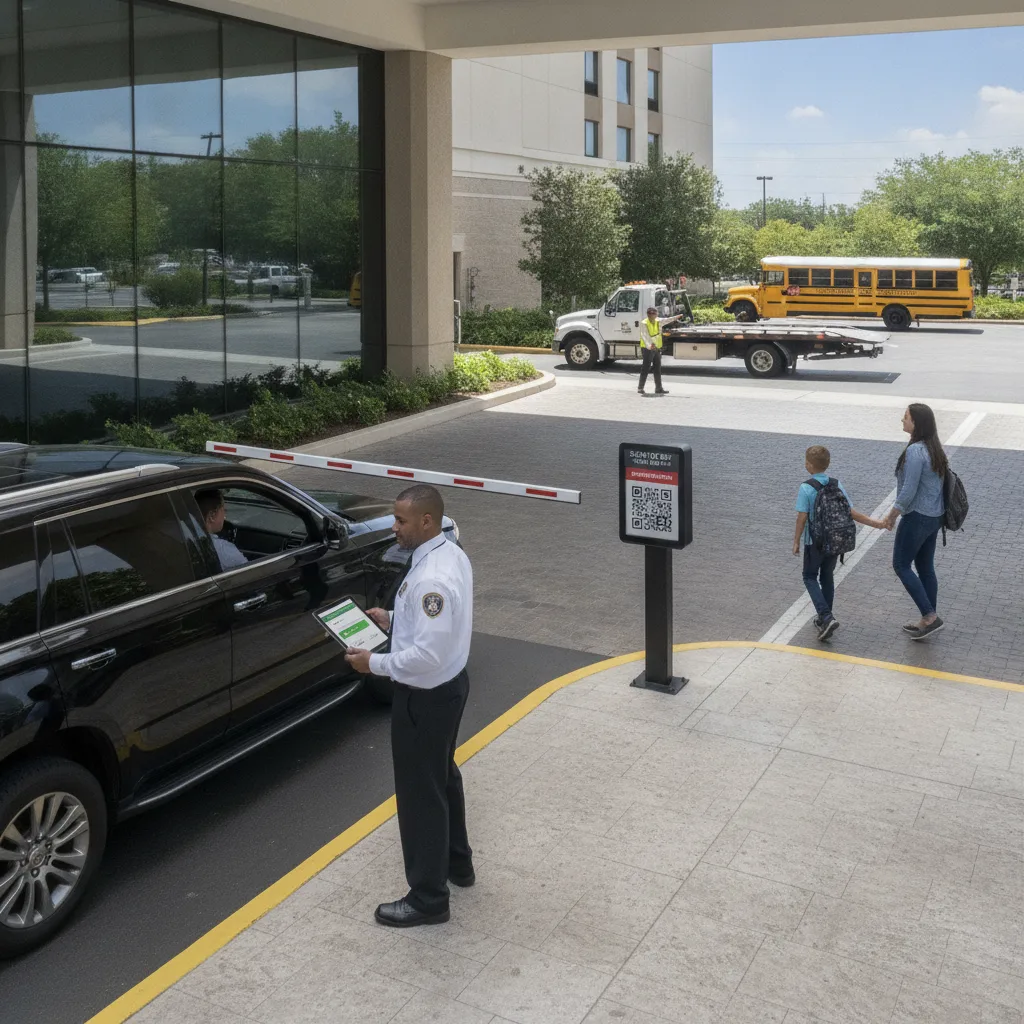
Direct answer: A hotel parking team’s real problem with unpaid sessions isn’t detection — it’s timing. An unmatched plate has to be reconciled against the guest folio before the guest checks out, or the lot loses its only easy collection point and the charge either gets written off or turns into an awkward post-stay dispute. The fix is linking the parking system to the front desk’s checkout workflow, not just running plate scans in isolation.
This is written for teams handling self-parking or valet at hotels, where the vehicle usually belongs to a registered guest with an active reservation — which makes unpaid sessions fundamentally different from a random public lot.
Why hotel unpaid sessions have a closing window
At most properties, an unpaid session is an open-ended problem — the vehicle might return, might not, and enforcement can happen whenever staff get to it. At a hotel, there’s a hard deadline: checkout. Once a guest settles their folio and leaves, collecting a parking charge becomes a chargeback dispute, a follow-up email nobody wants to send, or a write-off. The entire workflow has to be built around catching the mismatch while the guest is still on property and the charge can simply be added to a bill they’re already paying.
This is also why hotel unpaid-session handling can’t be purely plate-based the way a standalone lot’s can. The plate has to connect to a specific guest and room, not just a generic notice-and-collect process, because the resolution path is “add to folio,” not “mail a notice to a registered owner.”
Matching an unpaid plate to an active stay
| Situation | What to check first | Resolution path |
|---|---|---|
| Plate on-site, no parking payment, guest checked in | Match against the reservation system by room or reservation ID | Add itemized parking charge to the folio before checkout |
| Plate on-site, guest already checked out | Confirm departure time against the parking session timestamp | Route to post-stay billing or write-off per hotel policy — folio is closed |
| Plate doesn’t match any current reservation | Check valet log, day-visitor log, and restaurant/event validation | Treat as a walk-in nonpayment, not a guest billing issue |
| Payment attempted but failed (card decline, app error) | Pull the failed-transaction log before assuming nonpayment | Retry against the folio’s card on file rather than treating as unpaid |
Building the checkout-window workflow
- Run the plate match against active reservations continuously, not once per shift, since guests check out at all hours and the window to add a charge closes the moment they settle.
- Set a threshold for how long after arrival an unmatched plate needs review — long enough to allow for a guest who hasn’t parked yet, short enough to leave time to add the charge before a typical checkout.
- Give front desk (not just parking staff) visibility into pending unmatched charges, since they’re the ones who can actually add it to the folio during the checkout conversation.
- Separate guest mismatches from walk-in nonpayment early — a guest’s charge goes to the folio, a walk-in’s goes to your standard notice process, and conflating them slows down both.
A realistic scenario
A guest checks in Tuesday evening and parks in the self-serve lot without completing the QR payment — maybe their phone died, maybe they intended to pay at the desk and forgot. The plate sits unmatched in the system for two days. If the parking system and the front desk’s checkout queue aren’t connected, no one notices until the guest checks out Thursday morning, settles a folio with no parking charge, and drives away. The lot is now chasing a registered guest for a charge that should have taken ten seconds to add during a normal checkout conversation. If the front desk had visibility into unmatched plates against active reservations, this gets caught and resolved before the guest ever reaches the counter.
Where this breaks down
Watch for shared or company vehicles used by multiple guests across a stay — the plate might match a reservation that already checked out while a different guest is still using the car. Watch for valet handoffs, where a vehicle moves between self-parking and valet and the payment record doesn’t follow it cleanly. And watch for connectivity or feed delays that make a payment look unmatched when it actually went through — verify against the payment processor’s own log, not just the parking system’s read, before adding a disputed charge to a guest’s bill.
Before you connect parking to the front desk
- Confirm how (or whether) your parking system currently talks to your property management system at all.
- Set the review threshold that gives staff enough lead time before typical checkout patterns at your property.
- Train front desk staff on how to add a parking charge to a folio without treating it as a confrontation.
- Build a separate, lighter-weight process for walk-in nonpayment that doesn’t touch guest billing at all.
PLACA.AI’s plate matching can flag an unpaid session against an active guest stay in near real time, giving front desk staff a window to resolve it at checkout instead of after the guest has already left — worth reviewing alongside how you currently handle mobile parking payments for guests.
Related PLACA.AI planning resources
Common questions
What’s the biggest difference between hotel unpaid sessions and a standalone lot’s?
The checkout deadline. A standalone lot can pursue a registered owner indefinitely; a hotel loses its easiest collection point the moment the guest settles their folio and leaves.
Should parking staff or front desk resolve an unmatched plate?
Front desk, ultimately — they’re the ones who can add the charge to a folio during a normal checkout conversation, so they need visibility into pending mismatches, not just parking staff.
What about vehicles that don’t match any guest reservation at all?
Route those to a separate walk-in nonpayment process — day visitors, restaurant guests, and event attendees shouldn’t be handled the same way as a guest billing issue.
Plan a front-desk-connected workflow
Bring your current PMS setup and a sample of recent unpaid-session cases. PLACA.AI can help evaluate whether a real-time plate-to-reservation match fits your checkout process.
Editorial refresh: September 18, 2026. Independently confirm current product capabilities, third-party features, pricing, contracts, governing requirements, and local rules before acting.
Data source: U.S. Department of Transportation