

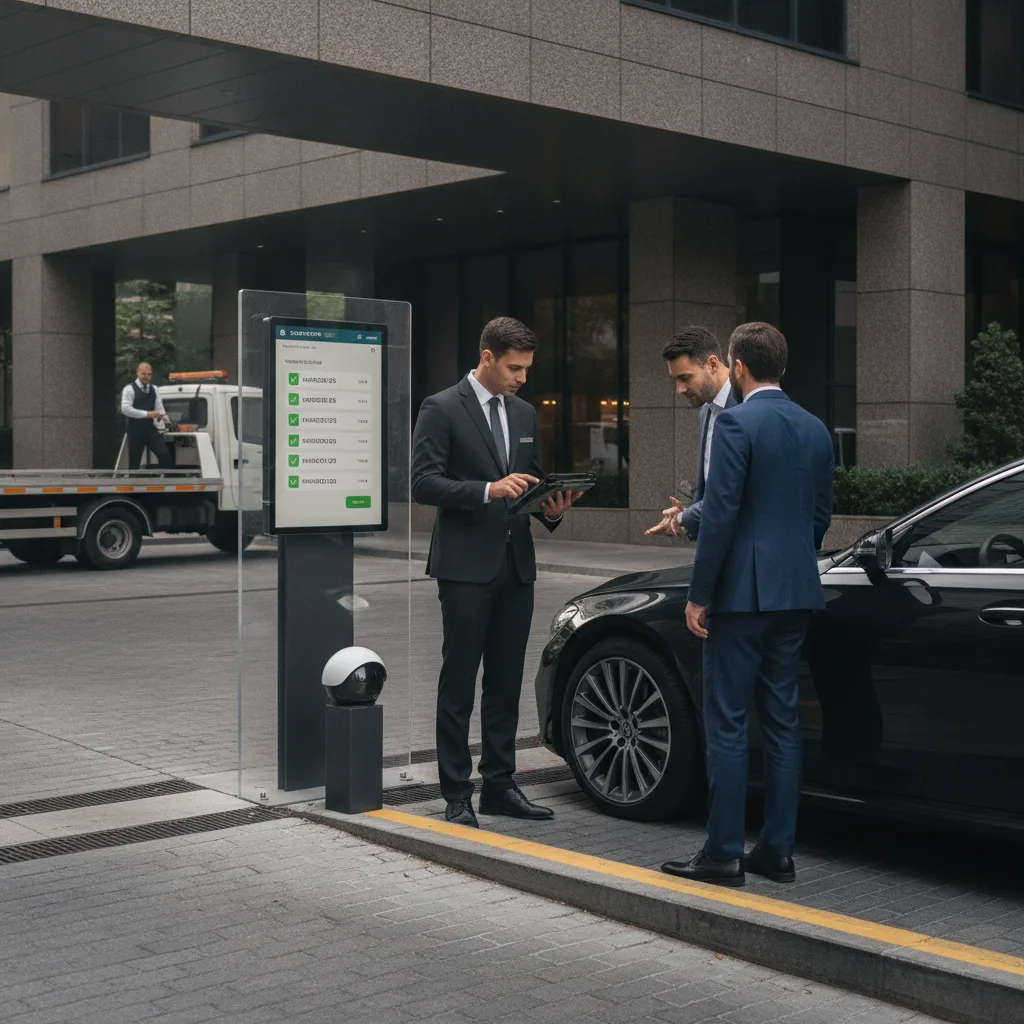
Short answer: Hotel valet liability questions almost always come down to whether your team can show what condition a car arrived in, who had the keys at every point during the stay, and who released the vehicle at checkout. Ticketless vehicle recognition doesn’t settle a claim, but it gives your front office and risk manager a timestamped, photo-backed record they can hand to the guest, the insurer, or the hotel’s legal counsel instead of relying on a bell captain’s memory of a Saturday night three weeks ago.
Why hotel valet liability is different from a restaurant or a one-night event
A restaurant valet holds a car for ninety minutes. A hotel valet can hold the same car for four nights, hand it to three different runners, move it between a self-park overflow lot and the covered garage during a resort fee dispute, and release it to a guest who checked out an hour before pickup. Every one of those touches is a place where a scratch, a missing item, or a “my car wasn’t where I left it” complaint can originate — and by the time the guest raises it, days may have passed since the actual incident.
That gap between when something happens and when a guest reports it is the core liability problem for hotels. Restaurant and event valets deal with immediate complaints; hotels deal with delayed ones, often escalated through the front desk, a loyalty program case manager, or a post-stay survey rather than caught in the moment.
Where hotel valet claims actually originate
Multi-day custody with rotating staff
Shift changes mean the valet attendant who parked the car Tuesday night is off by the time the guest checks out Friday morning. Without a system tying the vehicle to a specific person at each movement, “who moved my car” becomes unanswerable.
Overflow and remote lot transfers
When the covered structure fills during a conference or wedding block, cars get shuttled to a remote or self-park overflow lot. That transfer is a common source of “my car was damaged in transit” claims, and it’s also the point most hotels have the weakest documentation.
Checkout-day handoffs
A guest checks out, leaves bags with the bell desk, and requests the car an hour later for a spa treatment or late meeting. If retrieval isn’t logged against the original arrival record, disputes about timing, condition, or who actually picked up the vehicle get harder to resolve.
Third-party and valet management company contracts
Many hotels don’t run valet in-house — they contract it to a parking management company. When a claim comes in, the first question from the hotel’s risk team is almost always “is this on our garagekeepers policy or theirs?” That question depends entirely on being able to show which party had custody at the moment of the alleged damage.
Building a custody record that holds up
The goal isn’t more paperwork — it’s a clean, chronological trail your GM or risk manager can pull in five minutes instead of interviewing three shifts of staff.
- Arrival capture. Plate recognition logs the vehicle on entry with a timestamp and photos of visible condition, independent of whoever is working the podium that hour.
- Custody transfers. Every move — initial park, overflow shuttle, valet-to-valet handoff during a shift change — gets tied to the staff member who executed it, not just a general “moved” note.
- Retrieval match. At checkout or on request, the system matches the plate to the original arrival record and flags anything unusual, like a request coming from someone other than the original guest.
- Incident flagging. If a guest raises a concern, staff can pull the full timeline — arrival photos, movement log, and retrieval time — without digging through paper tickets or asking who was on shift three days earlier.
Coordinating with the front desk and loyalty program
Liability questions at hotels rarely stay contained to the valet stand. A damage claim from a top-tier loyalty member gets escalated to the front office manager, sometimes to a regional guest relations team, and the resolution often involves a comped night or credit long before insurance gets involved. Give your front desk staff read access to the same custody timeline valet uses, so a guest relations agent handling an escalated complaint isn’t calling down to ask the valet supervisor to reconstruct events from memory. Being able to show a guest an accurate record — even one that confirms fault — tends to de-escalate a dispute faster than a vague apology and a room credit.
Working with your insurer and legal counsel
This is operational guidance, not legal or insurance advice — always route actual claims through your risk manager, broker, and counsel. What you can control is the quality of the record you hand them. Garagekeepers liability carriers and hotel general liability policies both respond better to a documented custody chain than to a reconstructed narrative. If valet is outsourced, confirm in the management agreement which party’s policy is primary for which custody stage, and make sure your vehicle recognition records are structured so a claims adjuster can actually follow them — arrival condition, each transfer, and the retrieval event, in order.
Practical steps to put in place this month
- Require photo documentation at arrival for every vehicle, not just ones that look pre-damaged.
- Assign a named owner (usually the valet supervisor or director of guest services) for reviewing flagged incidents weekly, not just when a complaint arrives.
- Set a retention window for arrival photos and movement logs that matches your longest realistic guest complaint window — many hotels see claims surface 5–10 days after checkout.
- Confirm overflow-lot transfers are logged the same way as in-structure moves; this is the most commonly skipped step.
- Review the custody handoff process with any third-party valet vendor at least annually, alongside their insurance certificate renewal.
Frequently asked questions
Does vehicle recognition technology prove who caused damage?
No. It documents condition and custody at each point in time, which helps narrow down when and under whose custody something likely occurred. The actual liability determination still involves your insurer, the vendor’s insurer if applicable, and sometimes counsel.
How long should arrival photos and logs be kept?
Long enough to cover your realistic complaint window plus a buffer — many hotels retain records 30–90 days, though your specific retention period should follow your insurer’s and counsel’s guidance.
What’s the biggest documentation gap in hotel valet operations?
Overflow and remote lot transfers during high-occupancy periods. In-structure parking tends to be well tracked; the shuttle leg to an overflow lot is where records most often go missing.
PLACA.AI’s valet parking software for hotels is built around this kind of multi-day custody tracking, and our valet parking knowledge hub has more on setting up documentation workflows your front desk and risk team can actually use. If you want to walk through how this would map to your property’s layout and staffing, get in touch and we’ll go through it together.
Data source: U.S. Department of Transportation