

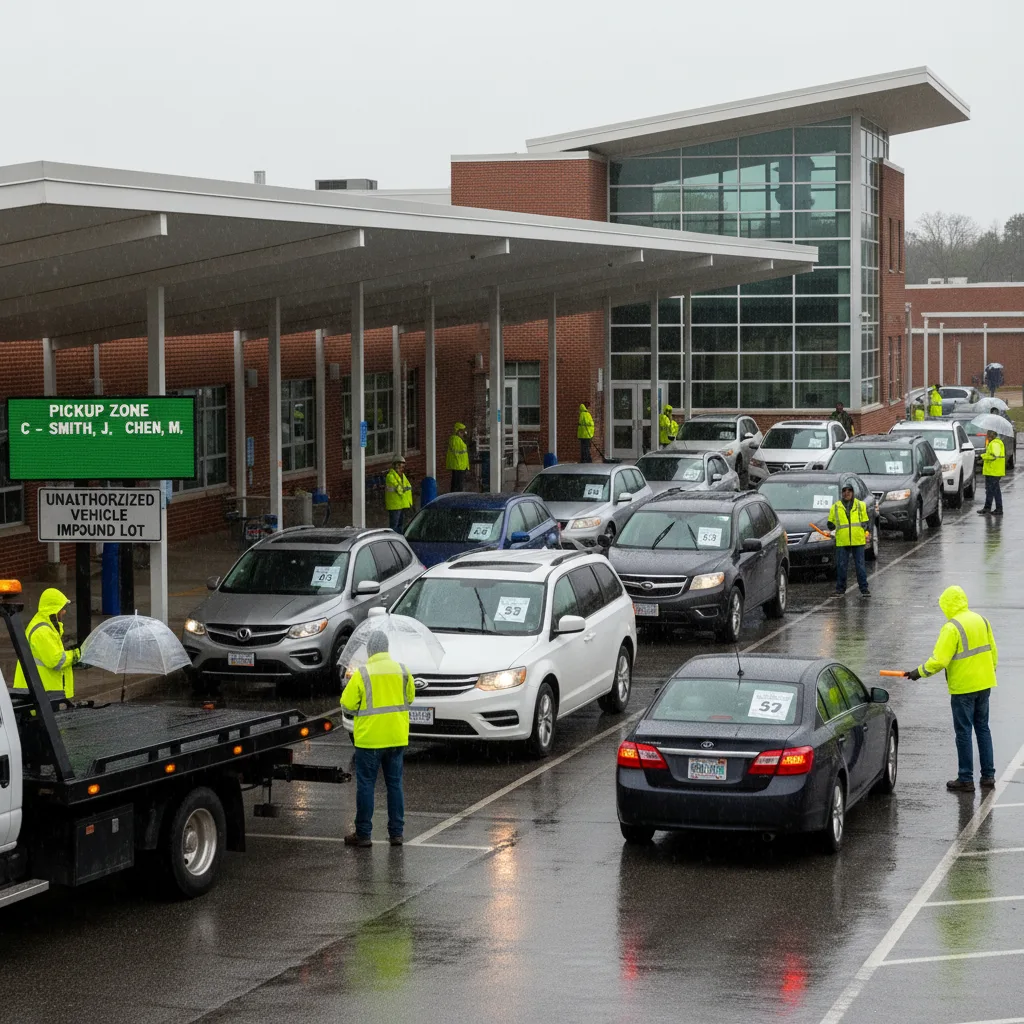
Direct answer: Use a separate rainy-day dismissal plan with covered verification points, explicit staff roles, a vehicle queue state, custody and exception checks, and a manual fallback. Weather changes the operating environment; it should not change who authorizes a student release.
This guide is for principals, transportation leaders, front-office staff, safety teams, teachers, and families and focuses specifically on managing rainy-day carline backups. The boundary matters: this is an operating decision, not a substitute for the site rules and professional review that govern the real deployment.
Where the process loses control
Rain compresses loading into fewer doors, obscures paper tags, moves staff away from normal posts, slows student walking, and increases radio traffic. A normal-day procedure with umbrellas added is not a contingency plan.
Example: If a recognized vehicle arrives but the adult differs from the current authorization record, the workflow must hold the release even when the queue is backing up. Weather pressure does not override custody controls.
Rainy-day dismissal swimlane
| Decision point | Evidence or control | Required response |
|---|---|---|
| Vehicle arrival | Capture or identify the arriving vehicle and queue position | Arrival record moves to staff review |
| Staff authorization | Confirm authorized pickup and current custody notes | Approved, hold, or escalate |
| Student staging | Route only approved students to the designated covered zone | Ready status visible to assigned staff |
| Handoff | Staff confirms the correct vehicle and completes release | Time and exception outcome recorded |
Build the workflow in stages
- Step 1. Declare the rainy-day plan before dismissal and assign one operational lead.
- Step 2. Move verification, staging, and handoff to named covered positions.
- Step 3. Keep custody changes and unrecognized vehicles in a human exception queue.
- Step 4. Run a no-student tabletop test followed by a controlled one-lane pilot.
For managing rainy-day carline backups, the named owner should document the approved rule, baseline, and result of each test. Use the actual environment for acceptance. A polished demonstration cannot reveal every lane, account, device, policy, or staffing exception.
Correction, appeal, and fallback
Power, camera, network, plate-read, substitute-staff, and late authorization failures need a printed or otherwise independent fallback that school leaders have tested.
Close each exception with a recorded decision and owner; untracked verbal workarounds eventually become the process.
Pilot scorecard
Start narrow, observe the current baseline, test normal and failure conditions, then decide whether expansion is justified.
- arrival-to-authorization time
- authorization-to-handoff time
- vehicles held for manual review
- radio calls per dismissal window
- wrong-zone or duplicate student calls
Choose the observation period before launch so the result cannot be selected after the fact.
Pre-launch review
- Write the purpose and non-goals for managing rainy-day carline backups and name the accountable owner.
- Verify the process with the actual principals, transportation leaders, front-office staff, safety teams, teachers, and families who will use, administer, or review it.
- Test a correction, an unavailable-system path, and the exception described on this page.
- Confirm current pricing, contract terms, support, integrations, and data handling directly with each provider.
- Use arrival-to-authorization time as one acceptance signal and record what evidence can stop the rollout.
Related PLACA.AI planning resources
Questions for the implementation team
Should schools release students faster during heavy rain?
Schools should improve flow while preserving the same authorization standard; speed cannot replace the release decision.
What happens when a plate is unreadable?
Move the vehicle to the documented manual-verification path rather than guessing or blocking the full queue.
Who owns the rainy-day plan?
Assign one school leader as operational owner and define the staff responsible for arrival, authorization, staging, and handoff.
Plan a one-lane rainy-day dismissal pilot
Bring the rules, current process, known exceptions, and success criteria for managing rainy-day carline backups. PLACA.AI can help evaluate a limited pilot without presuming that another property’s hardware or workflow is the right answer.
Editorial refresh: July 22, 2026. Before using this framework for managing rainy-day carline backups, independently confirm current product capabilities, third-party features, pricing, contracts, governing requirements, and local rules.
Data source: National Center for Education Statistics