

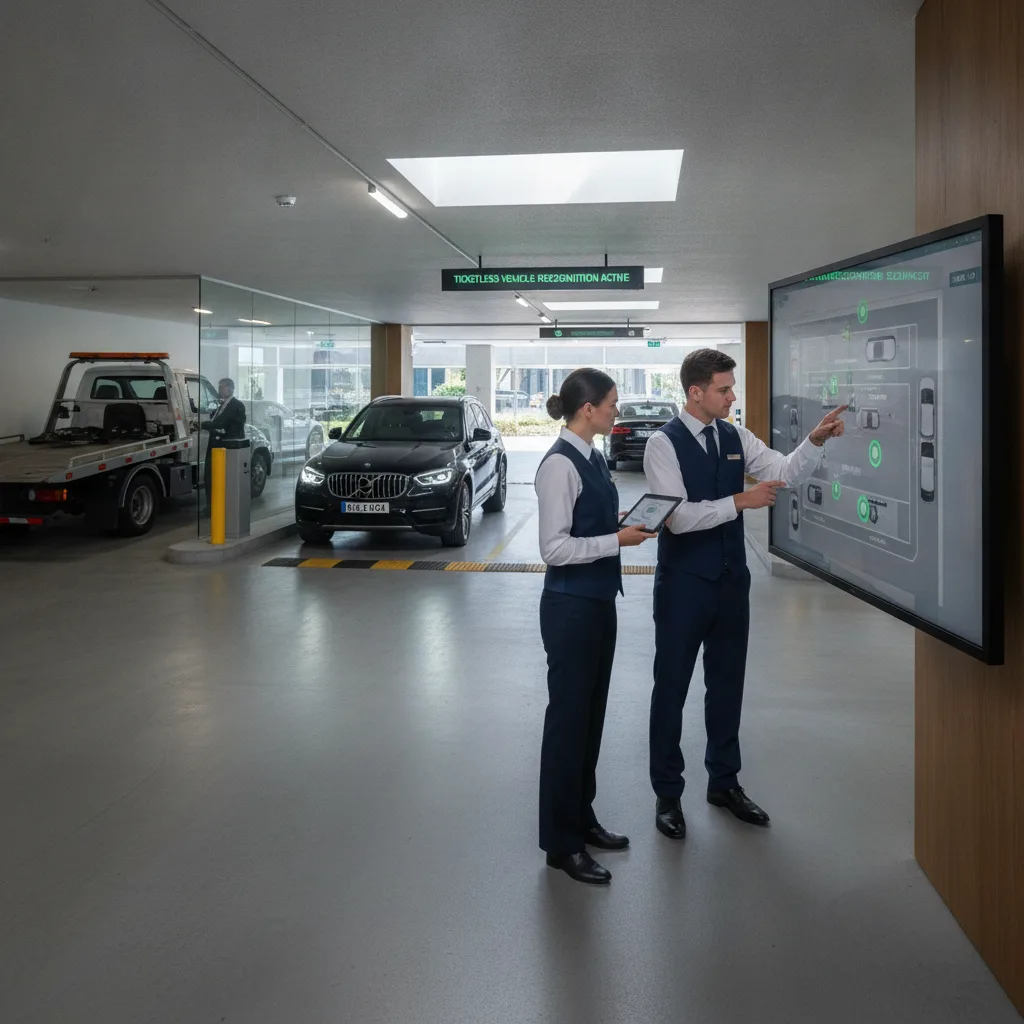
Direct answer: Improve retrieval speed by timestamping each request, linking it to the verified vehicle, assigning one runner, and measuring handoff time by stage. Ticketless recognition helps only when keys, queue ownership, and resident communication follow the same operating record.
This guide is for luxury residential valet managers, concierges, property leaders, and shift supervisors and addresses speeding vehicle retrieval at a luxury residence. The goal is a repeatable decision, not a generic technology recommendation.
Define the operating failure
Retrieval delays are often blamed on runners even when the request reaches the podium late, the vehicle record is ambiguous, or the key location is stale.
Example: A resident requests a vehicle before leaving the elevator. The system should show request receipt, assigned runner, verified key position, vehicle match, and curbside handoff instead of leaving staff to reconstruct the delay afterward.
Residential retrieval-stage scorecard
| Decision point | Evidence or control | Required response |
|---|---|---|
| Request received | timestamp, resident identifier, vehicle selection | confirm or correct before dispatch |
| Runner assigned | named staff member and queue position | prevent duplicate retrieval |
| Vehicle located | current key and parking location | escalate stale location |
| Handoff complete | vehicle and recipient verified | close with elapsed time |
Build the controlled workflow
- Step 1. Review request received: timestamp, resident identifier, vehicle selection; then confirm or correct before dispatch.
- Step 2. Review runner assigned: named staff member and queue position; then prevent duplicate retrieval.
- Step 3. Review vehicle located: current key and parking location; then escalate stale location.
- Step 4. Review handoff complete: vehicle and recipient verified; then close with elapsed time.
Document the owner and outcome at every handoff.
Handle the exception
If the requested vehicle, key record, or recipient cannot be verified, pause the normal queue and use the property’s documented identity and key-control escalation.
Correct the record, approve a bounded exception, deny under the documented rule, or escalate to the named authority; do not leave the case open-ended.
Run a bounded field test
Expand only when the failure cases are understood.
- median request-to-handoff time
- requests corrected before dispatch
- duplicate runner assignments
- stale key-location incidents
- resident updates sent on time
Define who counts each measure, the observation period, and the result that prevents expansion.
Acceptance checklist
- State the purpose and non-goals for speeding vehicle retrieval at a luxury residence.
- Assign owners for the normal path, correction, exception, and final approval.
- Test live conditions with the people who administer and experience the workflow.
- Confirm contracts, pricing, integrations, support, data handling, and governing requirements independently.
- Retain the evidence needed to reproduce an approval, denial, correction, or escalation.
Related PLACA.AI planning resources
- valet operations knowledge hub
- ticketless valet system guide
- vehicle recognition for valet operations
Questions decision-makers ask
What should be approved first for speeding vehicle retrieval at a luxury residence?
Approve the purpose, responsible owner, decision rule, required evidence, and exception path before selecting a broad rollout.
What should the pilot prove?
The pilot should reproduce the normal path and the exception described above, while collecting median request-to-handoff time and the other named measures.
When should implementation stop?
Stop when the required evidence is unavailable, ownership is unclear, a serious exception has no safe route, or the actual result conflicts with the approved rule.
Plan a limited workflow review
Bring the current rule, process, exceptions, and success criteria for speeding vehicle retrieval at a luxury residence. PLACA.AI can help evaluate a bounded pilot without assuming another property’s workflow is the right answer.
Editorial refresh: July 22, 2026. Independently confirm current product capabilities, third-party features, pricing, contracts, governing requirements, and local rules before acting.
Data source: U.S. Department of Transportation