

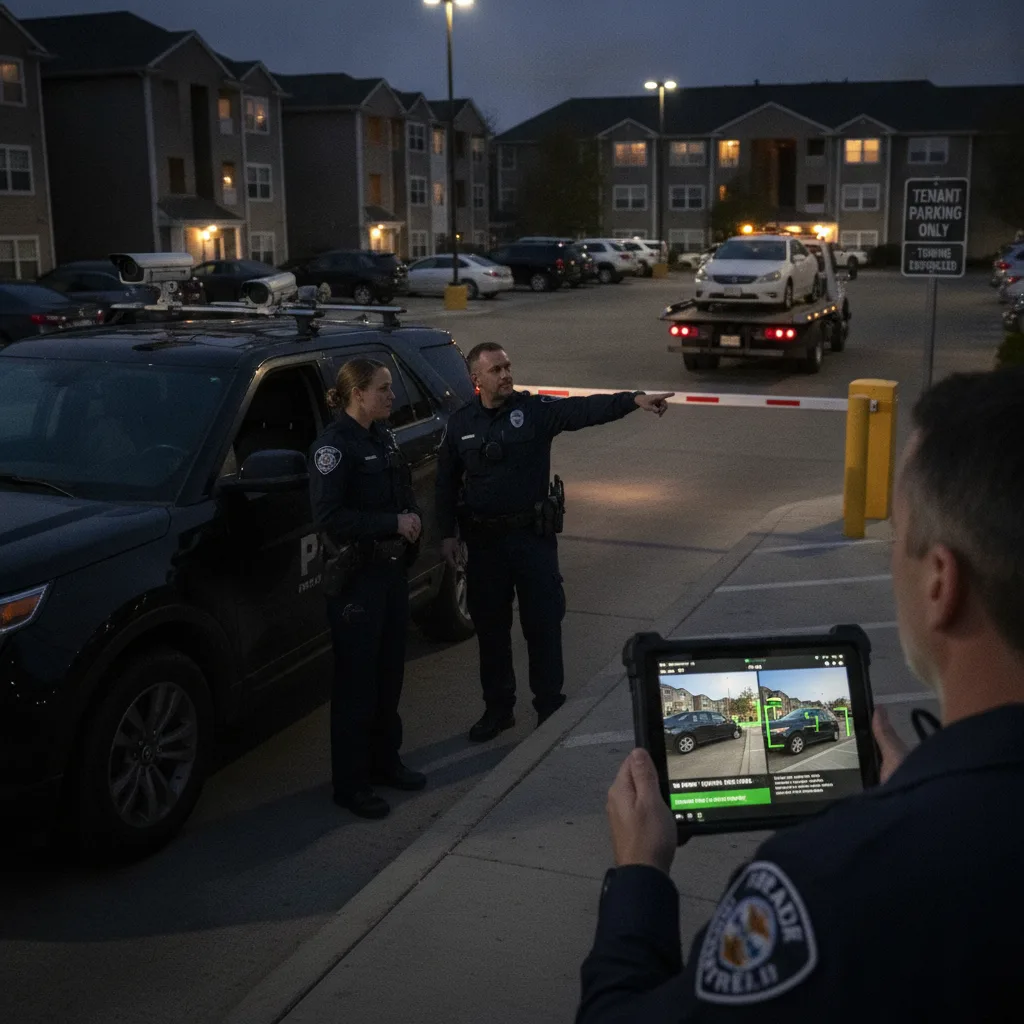
Direct answer: Night tows get challenged more often than day tows, mostly because the photo evidence is weaker — glare off the plate, no context showing the vehicle actually in the violation zone, no visible signage, no timestamp anyone can verify. The fix isn’t more photos, it’s a consistent low-light capture sequence every patroller runs the same way, every time, before the hook goes down.
This is written for solo and two-person night patrol crews working private lots, apartment complexes, and mixed-use properties after dark — the shift where lighting is worst, backup is farthest away, and a bad tow decision is hardest to walk back at 2 a.m.
Why night evidence gets disputed more than day evidence
A close-up plate photo taken under a sodium lot light or a phone flash often looks clear on the truck’s small screen and turns out washed out, color-shifted, or partially reflective once someone reviews it on a desktop the next morning. Add a driver who’s tired at the end of a long route, and the two most common failure points are: the plate photo is unreadable at full zoom, and there’s no second photo proving where the car was actually parked relative to the sign or curb marking.
Both are avoidable. Neither requires slowing the route down much — they require capturing the same three things in the same order every stop.
The three-shot minimum for a defensible night tow
1. Wide establishing shot
Before you get close, get one photo or short clip that shows the vehicle, the curb or space marking, and the sign (if there is one) in the same frame. This is the shot that proves location and context — it’s also the shot that gets skipped most often because it feels redundant once you’ve got a clean plate read.
2. Plate capture with a confidence check
Whether you’re using a mounted mobile LPR camera or a handheld device, don’t trust the on-screen preview alone. Glare from headlights, streetlights, or your own vehicle’s beams reads differently on a 4-inch screen than in the full-resolution file. If the system flags a low-confidence read, or if you’re shooting manually, take a second angle rather than assuming the first one is good enough.
3. Timestamp and location metadata intact
Whatever capture method you use, make sure the file actually carries a timestamp and GPS coordinate that survives into whatever system stores the evidence — not just a caption you typed later from memory. If your phone’s camera app strips metadata when photos get shared through a messaging app, that’s a workflow problem worth fixing before it becomes a dispute problem.
Handling glare and low light without slowing the route
- Kill your own light source first. High beams and spotlights washing across a plate at a steep angle are the single biggest cause of unreadable night captures. Approach at an angle that lets ambient or property lighting do the work.
- Use burst or multi-frame capture on reflective plates. Some states’ plates catch headlight reflection harder than others. If your device supports quick sequential shots, take two — one is usually clean.
- Don’t rely on digital zoom to fix a bad angle. A blurry wide shot zoomed in is still blurry. Reposition instead.
- Note poor property lighting separately. If a section of a lot is genuinely too dark to capture reliably, that’s useful information to flag back to the property contact — not just a problem to work around silently every night.
What actually stops the tow
Officer safety always overrides the evidence checklist — an unsafe stopping position, poor sightlines, or an occupied vehicle changes the situation immediately, no photo sequence matters more than that. Beyond safety, a night tow should be paused rather than pushed through when any of these show up:
- The plate read can’t be confirmed even after a second attempt
- Signage isn’t visible or legible in the wide shot
- There’s any indication the vehicle just arrived (running lights, occupant present, engine warm) when the property’s rule requires a dwell-time window
- A permit or hangtag is present but its validity can’t be verified from the field
When any of these hit, the right move is to document what you observed, hold the vehicle, and route it to whoever has authority to make the call — supervisor, dispatch, or the property’s after-hours contact — rather than deciding solo in the truck.
Shift handoff: don’t lose the evidence trail at 6 a.m.
A lot of disputes don’t come up the night of the tow — they show up two or three days later when a resident or driver calls the property office. If your capture data lives on individual phones, in a group chat, or in a paper log that gets handed off between shifts, it’s genuinely hard to reconstruct a clean record on demand. A mobile LPR workflow that timestamps and stores captures centrally as they happen means the morning shift, the office, and the towing company aren’t depending on someone’s memory or a photo roll search three days later.
FAQ
Do I need a mounted LPR camera to do this, or does a phone work?
A phone works for the fundamentals — wide shot, plate shot, intact metadata — as long as the capture and storage workflow is consistent. Mounted mobile LPR adds speed and reduces manual error at higher volume, but the discipline matters more than the hardware.
How long should we hold captured evidence before a tow is disputed?
That depends on your state’s towing notice and record-retention rules and your property contract, not on judgment alone — check both before setting a retention window, and err longer rather than shorter.
What’s the single most common mistake on night tows?
Skipping the wide establishing shot because the plate read already looks good. The plate proves identity; it doesn’t prove the vehicle was actually violating the rule.
Related reading
- Mobile LPR planning guide
- Parking enforcement software for towing companies
- Parking enforcement LPR software overview
If your night crews are still relying on phone photo rolls and memory to defend tows after the fact, PLACA.AI can walk through what a mobile LPR evidence workflow would look like for your routes — get in touch or book a demo.
Data source: U.S. Department of Transportation